Özet
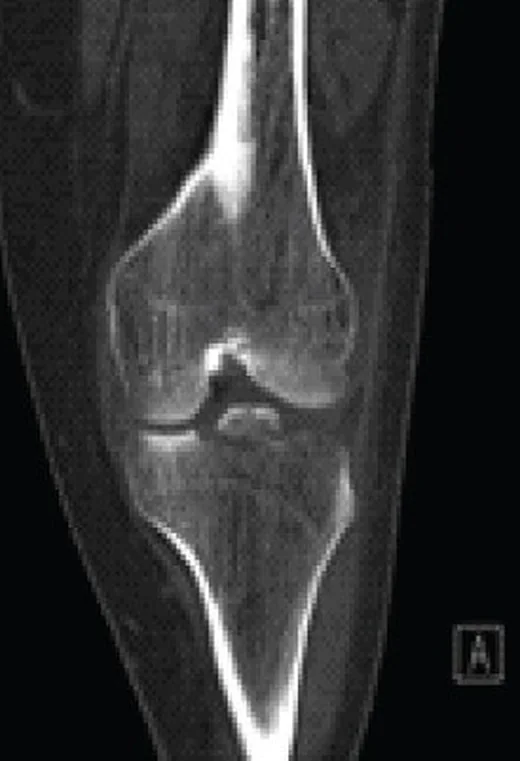
Tibial eminens avulsiyonu, özellikle büyüme plağı açık çocuk ve ergenlerde ön çapraz bağın tibial yapışma yerinden kemik fragman kaldırmasıdır; erişkinde bağın kendisi yırtılabilir. BT, fragmanın kemik anatomisini, yer değiştirmesini, rotasyonunu ve eklem yüzü uzanımını düz grafiden daha ayrıntılı gösterir. Fragman yükselmesiyle terminal ekstansiyon kaybı görülebilir; eşlik eden menisküs sıkışması, ACL liflerinin devamlılığı ve diğer yumuşak doku yaralanmalarının değerlendirilmesinde MRG daha uygundur. Küçük ya da posterior menteşesi korunmuş kırığın atlanması, deplasmanın ve eklem içi engelin eksik tanımlanmasına yol açabilir.
Faz ve pencere
- Kontrastsız tanısal
- İnterkondiler eminens tabanından ayrılan kemik fragman, yükselme/rotasyon, posterior kemik menteşesinin devamlılığı ve eklem yüzüne uzanan kırık hattı değerlendirilir.
- Kemik algoritması tanısal
- Düz grafilerde posterior menteşenin bütünlüğü her zaman net seçilemeyebilir; bu durum Meyers–McKeever Tip II ile Tip III ayrımını güçleştirebilir.
Önerilen pencereler G genişlik, M merkez; değerler Hounsfield birimi (HU)
- KemikG 1800 / M +400
- Yumuşak dokuG 400 / M +40
BT bulguları
- İnterkondiler eminens tabanında kırık hattı ve tibial yapışma alanından ayrılmış fragman.
- Anterior fragman elevasyonu; posterior menteşe sağlam kalabilir veya tam ayrılmada kaybolabilir.
- Fragmanın ekseni ve rotasyonu; dönen kemik parçası eklem aralığına doğru yönelmiş olabilir.
- Kırık hattı proksimal tibial fizise ya da tibial plato/kondil eklem yüzüne uzanabilir; eşlik eden plato kırığında eklem yüzü basamağı gelişebilir ve bu eşlik eden kırıkların BT ile tanımlanması gerekir.
- Parçalı fragman veya eminensin birden fazla kemik bileşenine ayrılması.
- Eklem efüzyonu/hemartroz ve çevre yumuşak doku şişliği eşlik edebilir; menisküs interpozisyonu BT'de güvenle dışlanamaz.
- İskelet olgunlaşmamış hastalarda ACL yaralanmaları sıklıkla tibial eminens avulsiyonu biçiminde görülür; iskelet olgunlaştıkça ACL'nin bağ içi yırtığına geçiş eğilimi olduğundan yaş ve fizis görünümü birlikte yorumlanır.
Ölçütler ve sınıflamalar
- Meyers–McKeever sınıflaması (Zaricznyj modifikasyonu)
- Tip I: ayrışma yok ya da minimal. Tip II: anterior fragman yükselmiş, posterior menteşe korunmuştur. Tip III: fragman eminens tabanından tamamen ayrılmıştır. Tip IV: parçalı (komminüt) kırık.
Normalde
Normal interkondiler eminens tibial plato ortasında düzgün, kesintisiz kortikal yükselti oluşturur; tabanında ayrılmış kemik parçası veya eklem içine kalkmış fragman bulunmaz. Bir olgu raporunda, karşılaştırmalı ön-arka ve lateral grafilerde tibial interkondiler eminensin hafif elevasyonu görülmüştür.
Normal BT ile kıyasla
Aynı bölgenin, kaynak veri setinde patoloji içermediği belirtilen bir BT incelemesini kesit kesit kaydırın; organ sınırlarını açarak anatomiyi hasta görüntüsüyle karşılaştırın. Küçük rastlantısal bulgular tümüyle dışlanmamıştır.
Kaynak: TotalSegmentator v2.01 veri seti (Wasserthal ve ark., Radiology: Artificial Intelligence 2023), CC BY 4.0, vaka s0685; organ sınırları veri setinin otomatik segmentasyonundan, birleştirilerek sadeleştirildi. Görüntüler 2,5 mm kesit aralığına yeniden örneklendi.
Ayırıcı tanı
- Tibial eminens gelişimsel düzensizliği
- düzgün kortike ve yaşa uygun kemikleşme görünümü verir; akut ayrışma hattı ve eklem efüzyonu beklenmez.
- Tibial plato kırıkları—özellikle Schatzker IV—kondil eklem yüzü veya metafiz boyunca uzanır; izole eminens avulsiyonundan farklıdır.
- ACL bağ içi yırtığı, tibial eminens avulsiyonundan farklı bir ACL yaralanma biçimidir; ACL liflerinin devamlılığı MRG ile değerlendirilir.
- Osteokondral fragman femoral kondil veya troklear bölgeden kaynaklanabilir; bu yerleşim, ACL'nin tibial yapışma yerinden ayrıldığı tibial eminens avulsiyonundan farklıdır.
Tuzaklar
- Posterior menteşe bütünlüğü tek düzlemde net olmayabilir; ardışık sagittal ve koronal kesitlerde fragman arka tabanı doğrulanmalıdır.
- Küçük elevasyonu küçümseme; fragmanın eklem aralığına doğru kalkması mekanik takılma oluşturabilir ve sınıflama için menteşe ilişkisi önemlidir.
- Tibial eminens avulsiyonu ACL'nin sağlam olduğunu tek başına göstermez; ACL liflerinin devamlılığı ve eşlik eden menisküs sıkışması MRG ile değerlendirilebilir.
- Çocukta fizis ve kemikleşme merkezini kırıkla karıştırma; karşı tarafın aynı yaş düzeyindeki konturu ve akut donör yatağı yardımcıdır.
- Tibial eminens avulsiyonları, çocuk ve ergenlerde ACL yaralanmasının ayrı bir biçimidir; ACL liflerinin devamlılığı ve eşlik eden menisküs ya da osteokondral yaralanmalar MRG ile değerlendirilebilir.
Kendini dene
Fragmanın ön kısmı yükselmiş, arka tabanı tibia ile bağlantısını koruyor. Meyers–McKeever tipi hangisidir?
Cevabı göster
Tip II. Tip II'de anterior elevasyon ve sağlam posterior menteşe birlikte bulunur. Tip I'de deplasman yok/minimaldir; Tip III tam ayrılma, Tip IV parçalı ya da rotasyonlu tam ayrılmadır.
Zaricznyj modifikasyonuna göre komminüt tibial eminens kırığı hangi tiptir?
Cevabı göster
Tip IV. Zaricznyj modifikasyonunda Tip IV, komminüt tibial eminens avulsiyon kırıklarını tanımlar.
İlgili konular
Kaynaklar
Bu sayfadaki 40 cümle ve 2 quiz sorusu aşağıdaki kaynaklardan alıntılarla otomatik olarak karşılaştırıldı; 10 cümle bu karşılaştırmada düzeltildi (2026-10-09).
- Tibial Spine Avulsion Injuries in Children and Adolescents: A Narrative Review of Anatomy, Management Strategies, and Return-to-Sport Considerationspmc.ncbi.nlm.nih.gov
- Blunt Cardiac Rupture: A Diagnostic Challenge.pubmed.ncbi.nlm.nih.gov
- The Effect of Bony Parameters on the Pediatric Knee: Normal versus Anterior Cruciate Ligament Injury versus Tibial Spine Avulsion Fracture.pubmed.ncbi.nlm.nih.gov
- Arthroscopic ACL Tibial Spine Avulsion Fixation Using Suture Pull-Through Double-Tunnel Technique.pubmed.ncbi.nlm.nih.gov
- The Management of Tibial Spine Avulsion Fracture in a Skeletally Immature Patient by Using Staple Fixation: A Case Report.pubmed.ncbi.nlm.nih.gov
- Simultaneous Anterior Cruciate Ligament Avulsion Fracture with Bilateral Posterior Meniscal Root Tears of the Knee: A Case Report.pubmed.ncbi.nlm.nih.gov
- Intercondylar eminence fracture treated by resorbable magnesium screws osteosynthesis: A case series.pubmed.ncbi.nlm.nih.gov
- A Rare Combination of Avulsion Fractures Around the Knee -A Case Report.pubmed.ncbi.nlm.nih.gov
- Arthroscopic Repair in Tibial Spine Avulsion Fractures Using Polyethylene Terephthalate Suture: Good to Excellent Results in Pediatric Patients.pubmed.ncbi.nlm.nih.gov
- High-speed electric-scooter crash causing a tibial spine fracture with physeal extension in an adolescent: a case report.pubmed.ncbi.nlm.nih.gov
- The Medial Malleolar Fleck Sign: A Case Report Highlighting Retinacular Origin Rather Than Deltoid Ligament Avulsion.pubmed.ncbi.nlm.nih.gov
- Tibial Spine Avulsion Injuries in Children and Adolescents: A Narrative Review of Anatomy, Management Strategies, and Return-to-Sport Considerations.pubmed.ncbi.nlm.nih.gov
- Complications Leading to Reoperation After Pediatric Tibial Spine Fracture Fixation.pubmed.ncbi.nlm.nih.gov
- ACL injuries in skeletally immature athletes.pubmed.ncbi.nlm.nih.gov
- Medial Tibial Plateau Fractures and Fracture-Dislocations: A Mechanism-Based Narrative Review of Instability Patterns, Imaging, and Contemporary Management.pubmed.ncbi.nlm.nih.gov
- PlaTiF: A pioneering dataset for orthopedic insights in AI-powered diagnosis of tibial plateau fractures.pubmed.ncbi.nlm.nih.gov
- Current concepts review. Management of proximal tibial fractures.pubmed.ncbi.nlm.nih.gov
- Advances in repair of non-discoid meniscus injuries in children: a narrative review.pubmed.ncbi.nlm.nih.gov
- Current concepts in the management of high-energy tibial plateau fractures: a narrative review.pubmed.ncbi.nlm.nih.gov
- Comparing MRI and arthroscopic appearances of common knee pathologies: A pictorial review.pubmed.ncbi.nlm.nih.gov
- Surgical technique: Tscherne-Johnson extensile approach for tibial plateau fractures.pubmed.ncbi.nlm.nih.gov
- Acetabular superior wall fractures: a distinct acetabular fracture entity.pubmed.ncbi.nlm.nih.gov
- Breaking the treatment dilemma of Schatzker IV fractures: finite element analysis validates hybrid single-plate with tension screw fixation for synergistic optimization of stability and minimally invasive outcomes.pubmed.ncbi.nlm.nih.gov
- The role of hinged external fixation in the treatment of knee dislocation, subluxation and fracture-dislocation: A systematic review of indications.pubmed.ncbi.nlm.nih.gov
- CT-like images based on T1-weighted gradient echo MRI sequences for the assessment of fractures of the hand and wrist compared to CT.pubmed.ncbi.nlm.nih.gov
- Imaging of physeal injury: overuse.pubmed.ncbi.nlm.nih.gov
- A Novel Physeal-Sparing Fixation Technique for Tibial Eminence Fractures in Paediatric Patients.pubmed.ncbi.nlm.nih.gov
- Delayed Surgical Treatment of Pediatric and Adolescent Medial Meniscus Posterior Root Tears Is Associated With Increased Odds of Medial Tibiofemoral Compartment Cartilage Injury: A Multicenter Study.pubmed.ncbi.nlm.nih.gov
- Concomitant Lateral Meniscal Tears in Pediatric and Adolescent Patients Undergoing Combined Medial Meniscal Ramp Lesion Repair and Anterior Cruciate Ligament Reconstruction Are Frequently Missed on MRI, Are Often Vertical or Root Tears, and Are Usually Repaired: A Multicenter Study.pubmed.ncbi.nlm.nih.gov
- Suture Fixation Versus Screw Fixation in Pediatric Tibial Eminence Fractures: A Systematic Review and Meta-Analysis of Clinical Outcomes and Reoperation Rates.pubmed.ncbi.nlm.nih.gov
- Morphological Evaluation of the Hip Joint and Pelvic Limb Bones of the Lowland Tapir (Tapirus terrestris Linnaeus, 1758) Using Radiography and Computed Tomography.pubmed.ncbi.nlm.nih.gov
- Standardized MRI nomenclature for knee meniscal lesions: SSR consensus panel report.pubmed.ncbi.nlm.nih.gov
- Revisiting meniscal anatomical variants of the knee: a high-resolution 7-Tesla MRI study.pubmed.ncbi.nlm.nih.gov
- Management of type II tibial spine fractures in children and adolescents: a systematic review.pubmed.ncbi.nlm.nih.gov
- Thinner Tibial Spine Fracture Fragments Are Associated With Risk of Fixation Failure.pubmed.ncbi.nlm.nih.gov
- Avulsion injuries: an update on radiologic findings.pubmed.ncbi.nlm.nih.gov
- Total laparoscopic radical hysterectomy for cervical cancer in prolapsed uterus.pubmed.ncbi.nlm.nih.gov
- Arthroscopically assisted refixation of bony ACL tears with accompanying posteraleral tibial plateau ("apple bite") fractures - a minimally invasive treatment approach.pubmed.ncbi.nlm.nih.gov
- Long-term outcomes of dual locking-plate fixation for bicondylar tibial plateau fractures via two mini-incisions: A prospective study.pubmed.ncbi.nlm.nih.gov
- Pediatric knee avulsion fractures: A systematic review of injury patterns, treatment strategies, and outcomes.pubmed.ncbi.nlm.nih.gov
- Tibial Anterior Cruciate Ligament Avulsion Fractures in Pediatric and Adult Populations: A Systematic Literature Review.pubmed.ncbi.nlm.nih.gov
- Clinical and MRI Restoration of ACL Continuity Following Functional Complete ACL Rupture in an Adolescent Athlete: A Case Report.pubmed.ncbi.nlm.nih.gov
- Congenital Anomalies of the Knee-Hypoplasia of the Meniscus: A Case Report.pubmed.ncbi.nlm.nih.gov
- The Unique Features of Pediatric Sports Injuries: The Hip.pubmed.ncbi.nlm.nih.gov
- The arrow and the target-description of the "Robin Hood" technique for fixation of tibial spine avulsion fractures: a technical note.pubmed.ncbi.nlm.nih.gov
- Clinical outcomes following open reduction and internal fixation without primary cruciate ligament reconstruction or avulsion fixation for Schatzker types IV-VI tibial plateau fractures: a retrospective cohort study.pubmed.ncbi.nlm.nih.gov
- A study on the association between tibial plateau fractures and intra-articular soft-tissue injuries under valgus injury mechanisms.pubmed.ncbi.nlm.nih.gov
- Arthroscopic Treatment of Combined Anterior and Posterior Cruciate Ligament Avulsion Fracture: A Case Report.pubmed.ncbi.nlm.nih.gov
- Results of Anterior Cruciate Ligament Avulsion Fracture by Treatment Using Bioabsorbable Nails in Children and Adolescents.pubmed.ncbi.nlm.nih.gov
- A new CT-based classification system for posterior cruciate ligament tibial avulsion fractures: a nationwide multicenter study.pubmed.ncbi.nlm.nih.gov
- Imaging of pediatric musculoskeletal trauma: Age-specific considerations and challenges.pubmed.ncbi.nlm.nih.gov
- Fracture morphological characteristics and associated soft-tissue injuries in flexion varus tibial plateau fractures.pubmed.ncbi.nlm.nih.gov
- A novel 3DCT-based classification for posterior cruciate ligament tibial avulsion fractures.pubmed.ncbi.nlm.nih.gov
- A rare traumatic triad: Open bicondylar non-conjoint Hoffa fracture with partial tibial tubercle and medial epicondyle avulsions - A case report and biomechanical analysis.pubmed.ncbi.nlm.nih.gov
- Modified Multi-Strand Nice Knot Suture Construct Combined with Suture Anchor Fixation Versus Conventional Kirschner Wire Tension Band Fixation for Inferior Patellar Pole Fractures: A Retrospective Comparative Study.pubmed.ncbi.nlm.nih.gov
- Transcatheter arterial embolization for traumatic adrenal hemorrhage with contrast extravasation: case series and literature review.pubmed.ncbi.nlm.nih.gov
- Pediatric ACL Injuries: A Current Concepts Review.pubmed.ncbi.nlm.nih.gov
- Transosseous suture <i>in situ</i> repair treatment of a femoral anterior cruciate ligament avulsion fracture in a 30-year-old male patient: a case report and review of the literature.pubmed.ncbi.nlm.nih.gov
- Guide to lower extremity radiologic measurements: part 1 hip.pubmed.ncbi.nlm.nih.gov
- The Clinical Significance of Femoral and Tibial Anatomy for Anterior Cruciate Ligament Injury and Reconstructionpubmed.ncbi.nlm.nih.gov
- No differences in knee anthropometric-related risk factors between unilateral and bilateral ACL reconstruction: A matched MRI-based cohort study.pubmed.ncbi.nlm.nih.gov
- Heterotopic Ossification After Multiligament Knee Injury Is Associated With Knee-Spanning External Fixation and Central Nervous System Trauma.pubmed.ncbi.nlm.nih.gov
- Schatzker IV tibial plateau fractures: are they always unicondylar?pubmed.ncbi.nlm.nih.gov
- Proximal patellar tendon injury with avulsed periosteal sleeve: A case report and long-term follow-up.pubmed.ncbi.nlm.nih.gov
- Patellar Non-Traumatic Pathologies: A Pictorial Review of Radiologic Findings.pubmed.ncbi.nlm.nih.gov
- Magnetic Resonance Imaging Patterns of Common Injuries in Pediatric and Adolescent Athletes.pubmed.ncbi.nlm.nih.gov
- The state of trial registrations in the field of Orthopaedics in years 2015-2020. A meta-epidemiological study.pubmed.ncbi.nlm.nih.gov
- MRI-based classification of lateral hinge fractures in medial opening wedge high tibial osteotomy.pubmed.ncbi.nlm.nih.gov
- Arthroscopic reduction of adult comminuted tibial eminence avulsion with single tunnel pull-through suture fixation: A case report of technical note.pubmed.ncbi.nlm.nih.gov
- Gadolinium Deposition in Bone Tissues After Contrast-enhanced Magnetic Resonance Imaging: A Comprehensive Review.pubmed.ncbi.nlm.nih.gov
- Ultrasound imaging of bone fractures.pubmed.ncbi.nlm.nih.gov
- Longitudinal 3T MRI T 2 * mapping of Juvenile osteochondritis dissecans (JOCD) lesions differentiates operative from non-operative patients-Pilot study.pubmed.ncbi.nlm.nih.gov
- Synthetic CT in Musculoskeletal Disorders: A Systematic Review.pubmed.ncbi.nlm.nih.gov
- Does the mini-open technique still have a role in the modern management of pediatric tibial eminence fractures?pubmed.ncbi.nlm.nih.gov
- Biomechanical comparison of a novel hockey-stick locking plate with a pes anserinus sparing design for Schatzker IV tibial plateau fractures.pubmed.ncbi.nlm.nih.gov
- Osteotomies: Indications, Imaging Appearance, Surgical Techniques, and Complications.pubmed.ncbi.nlm.nih.gov
- Innovations in pediatric imaging: a scoping review of the past decade with case illustrations.pubmed.ncbi.nlm.nih.gov
- Smoking and lateral hinge fracture are associated with delayed union at 6 months in open wedge distal tibial tuberosity osteotomy.pubmed.ncbi.nlm.nih.gov
- Three-dimensional meniscus allograft sizing-a study of 280 healthy menisci.pubmed.ncbi.nlm.nih.gov
- Anatomical Knee Variants in Discoid Lateral Meniscal Tears.pubmed.ncbi.nlm.nih.gov
- Radiographic Anatomy of the Native Anterior Cruciate Ligament: a Systematic Review.pubmed.ncbi.nlm.nih.gov
- Current Landscape of Short-T2 Imaging Techniques in the Musculoskeletal System: The Past, Present and Future.pubmed.ncbi.nlm.nih.gov
- Advanced Imaging of the Peripheral Nerves, From the <i>AJR</i> "How We Do It" Special Series.pubmed.ncbi.nlm.nih.gov
- Conservative Treatment of Pediatric Fractures-Narrative Review of Acceptable Deformity and Remodeling Potential.pubmed.ncbi.nlm.nih.gov
- Multiligament-injured knee: what the general orthopedic surgeon should know.pubmed.ncbi.nlm.nih.gov
- A Modified Triangular Arthroscopic Suture-Based Fixation for Tibial Eminence Fractures: Technique, Outcome and Literature Review.pubmed.ncbi.nlm.nih.gov
- Open wedge osteotomy of medial tibial condyle gives good results in management of neglected diagonal lesions of proximal tibia.pubmed.ncbi.nlm.nih.gov
- From simulation to sideline: translating finite element modeling into clinical decision-making for pediatric ACL injury and rehabilitation.pubmed.ncbi.nlm.nih.gov
- Surgical Treatment of Tibial Tubercle Fractures in Osteogenesis Imperfecta: A Restrospective Case Series.pubmed.ncbi.nlm.nih.gov
- Bilateral Simultaneous Patellar Tendon Rupture in an Adolescent Athlete: A Case Report and Literature Review Highlighting the Role of Vitamin D Deficiency.pubmed.ncbi.nlm.nih.gov
- Pull-out technique with footprint rivet repair of femoral-sided avulsion fracture of the anterior cruciate ligament: A case report.pubmed.ncbi.nlm.nih.gov
- A Rare Post-traumatic Tibial Tubercle Avulsion Combined With a Complete Section of the Patellar Tendon in a Young Patient: Insight Into Surgical Management.pubmed.ncbi.nlm.nih.gov
- UPDATES ON THE TREATMENT OF ANTERIOR TIBIAL TUBEROSITY AVULSION FRACTURES IN ADOLESCENTS.pubmed.ncbi.nlm.nih.gov
- Long-term outcomes of arthroscopic single-anchor fixation versus microfracture for osteochondral fractures of the knee weight-bearing area in adolescents and young adults.pubmed.ncbi.nlm.nih.gov
- Management and Outcomes of Osteochondritis Dissecans of the Knee in the Pediatric and Adolescent Population.pubmed.ncbi.nlm.nih.gov
- Effectiveness analysis of arthroscopy-assisted medial retinaculum tightening suture with internal fixation for treating adolescent acute patellar dislocation with osteochondral fracture: A retrospective study.pubmed.ncbi.nlm.nih.gov
- The role of ultrasound as a problem-solving tool in the assessment of paediatric musculoskeletal injuries.pubmed.ncbi.nlm.nih.gov
- Atypically Displaced Meniscal Tears: An Educational Review with Focus on MRI and Arthroscopy.pubmed.ncbi.nlm.nih.gov
- Glossary of terms for musculoskeletal radiology.pubmed.ncbi.nlm.nih.gov
- Time-Sensitive Injuries for the Sports Medicine Surgeon - "Sports Medicine Trauma", Part 2: Lower Extremity.pubmed.ncbi.nlm.nih.gov
- Treatment of anterior cruciate ligament injury in skeletally immature patients.pubmed.ncbi.nlm.nih.gov
- Tibial plateau fractures are associated with ligamentous and meniscal injuries. Preoperative evaluation of magnetic resonance imaging influences surgical treatment.pubmed.ncbi.nlm.nih.gov
- Exploring the Posterolateral Corner of the Knee Joint: A Detailed Review of Recent Literature.pubmed.ncbi.nlm.nih.gov
- A Systematic Approach to the Evaluation of Acute Musculoskeletal Injuries in the Emergency Department.pubmed.ncbi.nlm.nih.gov
Eğitim amaçlıdır; hasta başında tanı ve tedavi kararının yerine geçmez, tıbbi tavsiye değildir. Metinler yapay zekâ desteğiyle yazıldı ve otomatik bir adımda kaynak alıntılarıyla karşılaştırıldı; bu bir tıbbi doğrulama değildir ve içerik uzman radyolog incelemesinden geçmedi. Klinik kararlarda güncel kılavuzları, kurum protokollerini ve radyoloji raporunu esas alın.