
Özet
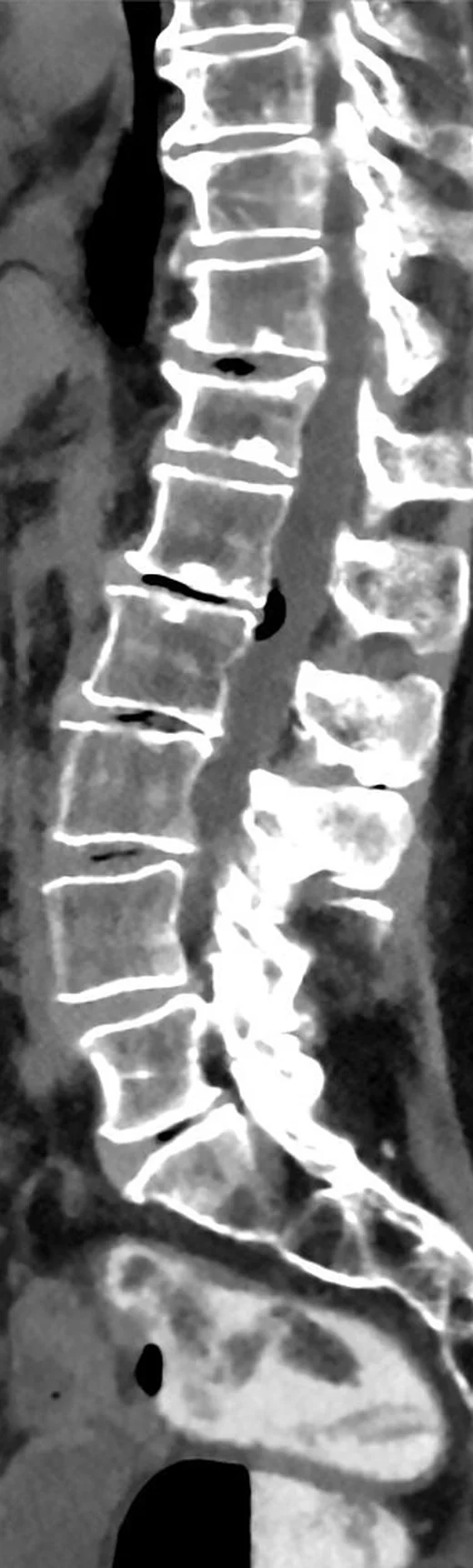
Bel veya boyun ağrısı nedeniyle BT çekilen erişkinde disk dejenerasyonu sık rastlanan kronik bir bulgudur ve görüntüdeki her dejenerasyon semptomun nedeni değildir. Kontrastsız BT disk aralığı, son plak ve osteofitleri iyi gösterir; dejeneratif fissürlerdeki azot ağırlıklı gazı, yani vakum fenomenini, özellikle duyarlı biçimde ortaya koyar. BT, diskin su içeriğini ve sinir dokusu etkilenmesini MR kadar değerlendiremez; belirgin gazı tek başına instabilite ya da ağrı kanıtı saymak doğru değildir. Dejeneratif vakumun enfeksiyon içi gazla veya eşlik eden kemik yıkımının gözden kaçması, kronik değişikliğin yanlış sınıflanmasına yol açabilir.
Faz ve pencere
- Kontrastsız tanısal
- İntradiskal gaz, disk aralığı içinde çok düşük atenüasyonlu siyah odak veya ince yarık biçiminde görünür; doğrusal/yarımay biçimli gaz birden fazla kesitte izlenebilir. Dejeneratif bağlamda disk yüksekliği kaybı, son plak sklerozu ve marjinal osteofitler eşlik edebilir; vakum fenomeni en iyi kontrastsız BT ile güvenilir biçimde ortaya konur.
- Kemik algoritması tanısal
- Sagittal ve koronal rekonstrüksiyonlarda disk aralığı boyunca gazın dağılımı, son plak korteksindeki düzensizlik veya skleroz ve osteofitlerin düzeyi belirginleşir; gazın vertebra gövdesi ya da paravertebral yumuşak dokuya uzanıp uzanmadığı ayrıca kontrol edilir.
Önerilen pencereler: Kemik (G 1800 / M 400), Yumuşak doku (G 400 / M 40).
BT bulguları
- Disk aralığı kaybı — komşu vertebra son plakları birbirine yaklaşmış ve disk yüksekliği azalmıştır.
- İntradiskal vakum — diskin içinde keskin sınırlı, hava atenüasyonunda lineer veya fokal gaz bulunur.
- Son plak sklerozu — dejeneratif süreçte komşu vertebral son plaklarda görülen subkondral kemik yoğunlaşmasıdır.
- Marjinal osteofit — vertebra düzeyinde görülebilen bir osteofit oluşumudur.
- Disk kalsifikasyonu — gazdan daha yoğun, kemik atenüasyonlu materyal disk içinde veya annulus boyunca izlenir.
- Faset eklem artrozu — posterior eklemlerde dejenerasyona bağlı olarak gelişen osteoartritik değişikliklerdir.
- İntradiskal gazın kanala göçü — nadiren epidural gaz odağı kitle etkisi yapabilir; gazın diskten devamlılığı araştırılır.
Ölçütler ve sınıflamalar
- Pfirrmann disk dejenerasyonu sınıflaması (MR temelli)
- I: homojen parlak disk, nükleus-annulus ayrımı net ve yükseklik normal; II: hafif heterojenlik/bantlar, ayrım korunur; III: gri heterojen sinyal ve belirsizleşen ayrım; IV: koyu heterojen disk, ayrım kayıp ve yükseklik azalabilir; V: ileri sinyal kaybı ve kollabe disk aralığı. Bu derecelendirme MR sinyaline dayanır, BT'de doğrudan uygulanmaz.
Normalde
Aynı seviyedeki normal diskin yüksekliği komşu seviyelerle uyumludur; vertebral son plaklar düzgün ve kesintisiz, kenarlar belirgin osteofitsiz görünür. Normal disk aralığında vakum fenomeni gözlenmez; vakumun varlığı ileri derecede dejenerasyonun göstergesidir.
Normal BT ile kıyasla
Aynı bölgenin, kaynak veri setinde patoloji içermediği belirtilen bir BT incelemesini kesit kesit kaydırın; organ sınırlarını açarak anatomiyi hasta görüntüsüyle karşılaştırın. Küçük rastlantısal bulgular tümüyle dışlanmamıştır.
Kaynak: TotalSegmentator v2.01 veri seti (Wasserthal ve ark., Radiology: Artificial Intelligence 2023), CC BY 4.0, vaka s1338; organ sınırları veri setinin otomatik segmentasyonundan, birleştirilerek sadeleştirildi. Görüntüler 2,5 mm kesit aralığına yeniden örneklendi.
Ayırıcı tanı
- Disk aralığı enfeksiyonu
- düzensiz/destrüktif son plak erozyonu ve paravertebral koleksiyon, basit dejeneratif sklerozdan daha kuşkuludur.
- Vertebra korpus vakumu
- gaz disk aralığında değil, çökmüş korpus içindeki yarıkta yer alır; kırık ve osteonekroz bağlamı aranır.
- Epidural gaz
- spinal kanalda diskten ayrılmış gaz odağı görülebilir; olası intradiskal kaynakla süreklilik ve kanal içi yerleşim gösterilir.
- Disk kalsifikasyonu
- kemik atenüasyonlu yoğunluk gaz gibi siyah değildir ve annulus boyunca plak/çizgi biçiminde uzanabilir.
- İşlem sonrası disk içi hava
- yakın tarihli girişim ve cerrahi öyküsü dejeneratif spontan vakum yorumunu değiştirir.
Tuzaklar
- Tek kesitte görülen siyah odak parsiyel hacim veya görüntü gürültüsü olabilir; komşu aksiyel kesitlerde ve sagittal planda disk içinde devamlılığını doğrula.
- Vakum fenomeni ileri dejenerasyonla ilişkili olsa da ağrılı seviyeyi tek başına belirlemez; semptom tarafı ve nöral etkilenme BT ile kanıtlanamayabilir.
- Disk ve son plak çevresindeki gazı spondilodiskit olarak adlandırmadan önce son plak yıkımı, paravertebral yumuşak doku ve işlem öyküsünü birlikte gözden geçir.
- Dekübit pozisyon ve segment hareketi intradiskal gazın biçimini değiştirebilir; küçük gaz odağı yokluğu dejenerasyonu dışlamaz.
Kendini dene
Bel ağrılı hastanın kontrastsız BT'sinde L5-S1 diskinde siyah yarık ve karşılıklı son plak sklerozu var. En olası bulgu nedir?
Cevabı göster
Vakum fenomeni. Disk aralığı içindeki hava atenüasyonlu yarık, dejeneratif daralma ve sklerozla birlikte vakum fenomenini destekler. Disk kalsifikasyonu dejeneratif değişikliklerde gelişebilir ve en sık annulus fibrosusu tutar; enfeksiyöz spondilodiskitte son plak yıkımı ve paravertebral apse görülebilir.
Diskte gazla birlikte son plaklarda düzensiz yıkım ve paravertebral koleksiyon görülüyor. Hangi tanı öncelikle düşünülür?
Cevabı göster
Spondilodiskit. Destrüktif son plak değişikliği ve paravertebral koleksiyon enfeksiyonu destekler. Dejeneratif vakumda tipik olarak disk aralığı daralması, skleroz ve osteofitler öne çıkar; faset artrozu posterior eklemdedir, çökme ise korpus yüksekliğini azaltır.
Kaynaklar
Bu sayfadaki 41 cümle ve 2 quiz sorusu aşağıdaki kaynaklardan alıntılarla tek tek karşılaştırıldı; 6 cümle bu karşılaştırmada düzeltildi (2026-10-09).
- ABCs of the degenerative spinepmc.ncbi.nlm.nih.gov
- Intra-discal vacuum phenomenon with advanced lumbar spine disc degeneration: complementary findings from both MRI and CTpmc.ncbi.nlm.nih.gov
- Imaging Evaluation of Intervertebral Disc Degeneration and Painful Discs—Advances and Challenges in Quantitative MRIpmc.ncbi.nlm.nih.gov
- Intradiscal vacuum phenomenon matches lumbar spine degeneration patterns in an ageing population.pubmed.ncbi.nlm.nih.gov
- The new imaging findings: "Passing spine" without kissing.pubmed.ncbi.nlm.nih.gov
- Sciatica caused by lumbar epidural gas.pubmed.ncbi.nlm.nih.gov
- Mediastinal vacuum phenomenon: atypical pneumomediastinum caused by gas replacement of diminished fat.pubmed.ncbi.nlm.nih.gov
- Morphology of intervertebral disc ruptures evaluated by vacuum phenomenon using multi-detector computed tomography: association with lumbar disc degeneration and canal stenosis.pubmed.ncbi.nlm.nih.gov
- Effects of intradiscal vacuum phenomenon on surgical outcome of lateral interbody fusion for degenerative lumbar disease.pubmed.ncbi.nlm.nih.gov
- Intradiscal vacuum phenomenon and spinal degeneration: a cross-sectional analysis of 219 subjects.pubmed.ncbi.nlm.nih.gov
- The vacuum phenomenon in intervertebral disc disease of dogs based on computed tomography images.pubmed.ncbi.nlm.nih.gov
- Comprehensive review on intravertebral intraspinal, intrajoint, and intradiscal vacuum phenomenon: From anatomy and physiology to pathology.pubmed.ncbi.nlm.nih.gov
- Biomechanical consequences of cement discoplasty: An in vitro study on thoraco-lumbar human spines.pubmed.ncbi.nlm.nih.gov
- Correlation between vacuum phenomenon on CT and fluid on MRI in degenerative disks.pubmed.ncbi.nlm.nih.gov
- Disc regeneration therapy using marrow mesenchymal cell transplantation: a report of two case studies.pubmed.ncbi.nlm.nih.gov
- Association between Modic changes and intervertebral vacuum phenomenon severity in patients undergoing percutaneous cement discoplasty.pubmed.ncbi.nlm.nih.gov
- Association between non-traumatic vertebral fractures and adjacent discs degeneration: a cross-sectional study and literature review.pubmed.ncbi.nlm.nih.gov
- Lumbar Provocative Discographypubmed.ncbi.nlm.nih.gov
- Re-examining the Disc-Centric Interpretation of Chronic Low Back Pain: A Narrative Review.pubmed.ncbi.nlm.nih.gov
- Radiomics in spinal research: a narrative review.pubmed.ncbi.nlm.nih.gov
- A Primer on Anatomy, Biophysics, Pathology, Imaging and Treatment of the Intervertebral Disc and the Anterior Spinal Column: The Discogenic, Intervertebral, Spinal Column (DISC) ASPN Workgroup.pubmed.ncbi.nlm.nih.gov
- Spinal granulocytic sarcoma with both extradural and intradural involvement: a case report.pubmed.ncbi.nlm.nih.gov
- Irreversible blindness from hydrocephalus in recurrent pediatric pilocytic astrocytoma: a case report.pubmed.ncbi.nlm.nih.gov
- Idiopathic Intracranial Hypertension with and Without Papilledema: A Comparative Cohort Study.pubmed.ncbi.nlm.nih.gov
- Infectious Spondylodiscitis of Bacterial Causes in Adults: Epidemiology, Pathophysiology, Diagnostic and Treatment Challenges.pubmed.ncbi.nlm.nih.gov
- Imaging clues for the diagnosis of various pathogenic causes of infectious spondylitis.pubmed.ncbi.nlm.nih.gov
- Imaging of spinal and central nervous system brucellosis: a review.pubmed.ncbi.nlm.nih.gov
- Parametric Finite Element Evaluation of Load Redistribution Under Progressive Lumbar Disc Degeneration.pubmed.ncbi.nlm.nih.gov
- A Novel Scoring System for Predicting Procedural Difficulty in Supraneural L5 TFESI: The L5 TFESI Difficulty Score (LTDS).pubmed.ncbi.nlm.nih.gov
- Low-Profile Posterior Lumbar Fusion Combined With Proximal Interlaminar Coflex Dynamic Fixation for Lumbar Degenerative Diseases: A Comparative Study.pubmed.ncbi.nlm.nih.gov
- How Safe Are Oxygen-Ozone Therapy Procedures for Spine Disc Herniation? The SIOOT Protocols for Treating Spine Disorders.pubmed.ncbi.nlm.nih.gov
- Beyond ulcers and osteomyelitis: imaging of less common musculoskeletal complications in diabetes mellitus.pubmed.ncbi.nlm.nih.gov
- Long-term safety and effectiveness of the "OptEase" vena cava filter.pubmed.ncbi.nlm.nih.gov
- Biomaterials for vertebral body repair: interior augmentation and total replacement-a literature review of bone fusion outcomes in clinical studies.pubmed.ncbi.nlm.nih.gov
- ESWT attenuates compressive stress-induced cartilaginous endplate degeneration via modulation of the <i>SOST/Wnt/β-catenin</i> signaling pathway.pubmed.ncbi.nlm.nih.gov
- Impact of endplate-graft geometric matching on cage subsidence following stand-alone lateral lumbar interbody fusion: a finite element analysis.pubmed.ncbi.nlm.nih.gov
- Temporomandibular Joint Disorders and Orofacial Pain.pubmed.ncbi.nlm.nih.gov
- Stepwise micro-CT analysis of sample processing effects on the 3D morphology of human intervertebral discs.pubmed.ncbi.nlm.nih.gov
- Microstructural imaging of the cartilaginous endplate in the intervertebral disc.pubmed.ncbi.nlm.nih.gov
- Paravertebral crystal deposition disease: a retrospective study of clinical presentation, prevalence, and CT imaging findings.pubmed.ncbi.nlm.nih.gov
- Quantitative Facet Joint Effusion on Magnetic Resonance Imaging Is Associated With Dynamic Segmental Instability and Pain Severity in Degenerative Lumbar Spondylolisthesis.pubmed.ncbi.nlm.nih.gov
- Radiologic and Clinical Predictors of Reoperation Following Unilateral Biportal Endoscopic Spine Surgery: A Retrospective Cohort Study.pubmed.ncbi.nlm.nih.gov
- Comparison of computed tomography and magnetic resonance imaging findings in patients with lumbar facet joint arthropathy.pubmed.ncbi.nlm.nih.gov
- Lumbar Degenerative Disease Part 1: Anatomy and Pathophysiology of Intervertebral Discogenic Pain and Radiofrequency Ablation of Basivertebral and Sinuvertebral Nerve Treatment for Chronic Discogenic Back Pain: A Prospective Case Series and Review of Literature.pubmed.ncbi.nlm.nih.gov
- Unveiling the role of lumbar intervertebral space morphology: a novel classification and its impact on cage migration in lumbar fusion surgery.pubmed.ncbi.nlm.nih.gov
- Establishment and validation of a three-dimensional finite element model for degenerative lumbar scoliosis.pubmed.ncbi.nlm.nih.gov
- Automated Analysis of Vertebral Body Surface Roughness for Adult Age Estimation: Ellipse Fitting and Machine-Learning Approach.pubmed.ncbi.nlm.nih.gov
- Vertebral body osteonecrosis: Evolving imaging features over time.pubmed.ncbi.nlm.nih.gov
- Advancements in biomaterials and bioactive solutions for lumbar spine fusion cages: Current trends and future perspectives.pubmed.ncbi.nlm.nih.gov
- Semi-quantitative assessment of paraspinal muscle fat infiltration in single-level C5-6 cervical spondylosis using gray-level thresholding on conventional MRI: associations with disc degeneration and posture-related segmental angular change.pubmed.ncbi.nlm.nih.gov
- Preoperative mid-cervical disc degeneration is associated with residual cervical kyphosis after surgery for adolescent idiopathic scoliosis.pubmed.ncbi.nlm.nih.gov
- The Association Between Lumbar Disc Degeneration and Paraspinal Muscle Morphology: The Role of Age in a Quantitative Magnetic Resonance Imaging-Based Study.pubmed.ncbi.nlm.nih.gov
- Quantification of intervertebral disc degeneration using dual-energy computed tomography collagen maps: a comparative study with MRI Pfirrmann grading.pubmed.ncbi.nlm.nih.gov
- Post-mortem evaluation of intervertebral disc degeneration using magnetic resonance imaging and magnetisation transfer ratio in chondrodystrophic and non-chondrodystrophic dogs: a pilot study.pubmed.ncbi.nlm.nih.gov
- Clinical application of intervertebral disc to spinal cord signal ratio based on T2-weighted imaging in assessing disc degeneration.pubmed.ncbi.nlm.nih.gov
- Spectral CT electron density for evaluation of lumbar intervertebral disk degeneration.pubmed.ncbi.nlm.nih.gov
- Artificial Intelligence in Spine Neuroimaging: Diagnostic and Prognostic Utility of Novel Biomarkers in Lower Back Pain.pubmed.ncbi.nlm.nih.gov
- Differentiating Tuberculous and Pyogenic Spondylodiscitis: Part II: MRI/CT Features, Prediction Models, and the Role of PET/CT-A Narrative Review.pubmed.ncbi.nlm.nih.gov
- Streptomyces morookaense spinal suppurative infection: a case report.pubmed.ncbi.nlm.nih.gov
- Non-Infectious Spinal Diseases Mimicking Infection: A Pictorial Essay.pubmed.ncbi.nlm.nih.gov
- Anatomy of the intraosseous arterial microvasculature of the adult lumbar vertebral body and its role in fracture healing: a literature review and historical perspective.pubmed.ncbi.nlm.nih.gov
- Multidisciplinary expert consensus on clinical diagnosis and therapies for low back pain.pubmed.ncbi.nlm.nih.gov
- Degenerative Disc Disease of the Spine: From Anatomy to Pathophysiology and Radiological Appearance, with Morphological and Functional Considerations.pubmed.ncbi.nlm.nih.gov
- High-affinity alphavbeta3 integrin targeted optical probe as a new imaging biomarker for early atherosclerosis: initial studies in Watanabe rabbits.pubmed.ncbi.nlm.nih.gov
- A Comprehensive Review of the Role of the Latest Minimally Invasive Neurosurgery Techniques and Outcomes for Brain and Spinal Surgeries.pubmed.ncbi.nlm.nih.gov
- Conference Proceedings: Select Abstracts Presented at the 2025 Advocate Aurora Scientific Day.pubmed.ncbi.nlm.nih.gov
- Magnetic resonance imaging of musculoskeletal infections.pubmed.ncbi.nlm.nih.gov
- Commentary: an eye on PET quantification.pubmed.ncbi.nlm.nih.gov
- Invited review: Recommendations for reporting intervention studies on reproductive performance in dairy cattle: Improving design, analysis, and interpretation of research on reproduction.pubmed.ncbi.nlm.nih.gov
- Adult degenerative scoliosis: challenges in diagnosis, pain management, and surgical decision-making.pubmed.ncbi.nlm.nih.gov
- Oblique lateral interbody fusion versus transforaminal lumbar interbody fusion for single-level lumbar adjacent segment disease: a retrospective comparative study of clinical and radiographic outcomes.pubmed.ncbi.nlm.nih.gov
- Long-term clinical and radiographic outcomes of interlaminar coflex dynamic stabilization versus posterior lumbar interbody fusion for lumbar spinal stenosis: a comparative study with minimum 15-year follow-up.pubmed.ncbi.nlm.nih.gov
- Traction-Induced Avulsion of an Iliocaval Venous Branch During Multilevel OLIF for Degenerative Scoliosis: Case Report.pubmed.ncbi.nlm.nih.gov
- Severe Disc degeneration is associated with lower caudal subendplate hounsfield unit values in degenerative lumbar spinal stenosis.pubmed.ncbi.nlm.nih.gov
- Differentiation of Native Vertebral Osteomyelitis: A Comprehensive Review of Imaging Techniques and Future Applications.pubmed.ncbi.nlm.nih.gov
- Magnetic resonance imaging of rheumatological diseases.pubmed.ncbi.nlm.nih.gov
- MRI Findings in Axial Psoriatic Spondylarthritis.pubmed.ncbi.nlm.nih.gov
- Uniportal non-coaxial endoscopic posterior cervical discectomy with annular suture repair for C6/C7 disc herniation: a case report.pubmed.ncbi.nlm.nih.gov
- The role of radiography in the study of spinal disorders.pubmed.ncbi.nlm.nih.gov
- Single-incision four-level oblique lateral interbody fusion and cement-augmented fixation in a severely osteoporotic lumbar spine: a case report.pubmed.ncbi.nlm.nih.gov
- Comparison of Three Evaluation Methods for the Lumbar Intervertebral Disc Vacuum Phenomenon in Predicting Postoperative Residual Lower Back Pain.pubmed.ncbi.nlm.nih.gov
- Critical infections in the head and neck: A pictorial review of acute presentations and complications.pubmed.ncbi.nlm.nih.gov
- Imaging for Pediatric Head and Neck Emergencies: Critical Insights.pubmed.ncbi.nlm.nih.gov
- A diagnostic approach to mediastinal masses in clinical practice.pubmed.ncbi.nlm.nih.gov
- A Quick and Comprehensive Guide to Differential Diagnosis of Neck and Back Pain: a Narrative Review.pubmed.ncbi.nlm.nih.gov
- Purely osteolytic bone lesions in the early osteoarticular phase of synovitis, acne, pustulosis, hyperostosis and osteitis syndrome.pubmed.ncbi.nlm.nih.gov
- Cervical Pyogenic Spondylitis: A Comprehensive Review of Diagnosis and Treatment Strategy.pubmed.ncbi.nlm.nih.gov
- Imaging in spinal infections: Current status and future directions.pubmed.ncbi.nlm.nih.gov
- Differentiation between infectious spondylodiscitis versus inflammatory or degenerative spinal changes: How can magnetic resonance imaging help the clinician?pubmed.ncbi.nlm.nih.gov
- Musculoskeletal Infection: The Great Mimickers on Imaging.pubmed.ncbi.nlm.nih.gov
- Direct Endoscopic Visualization of Gas Release in a Lumbar Disc Herniation: A Case Report.pubmed.ncbi.nlm.nih.gov
- Association Between Adjacent Disc Vacuum Phenomenon and Adjacent Vertebral Fracture After Balloon Kyphoplasty for Osteoporotic Vertebral Fractures: A Retrospective Multicenter Study.pubmed.ncbi.nlm.nih.gov
- Delayed diagnosis of spinal tuberculosis mimicking spondyloarthritis: a case report.pubmed.ncbi.nlm.nih.gov
- Post-vertebroplasty lumbar spondylodiscitis due to <i>Cutibacterium modestum</i>.pubmed.ncbi.nlm.nih.gov
- <i>Mycobacteroides abscessus</i> complex vertebral osteomyelitis and discitis of the thoracolumbar spine: a systematic review of management and outcomes with illustrative case.pubmed.ncbi.nlm.nih.gov
- Clinical and radiological predictors of adverse outcomes after unilateral biportal endoscopic surgery for short-segment degenerative lumbar spinal stenosis.pubmed.ncbi.nlm.nih.gov
- Conservative Management of a Symptomatic Anterior Limbus Vertebra in a Non-athletic Patient: A Case Report.pubmed.ncbi.nlm.nih.gov
- Seeding the Spine: Salmonella Java Discitis and Osteomyelitis After Traveller's Bacteraemia.pubmed.ncbi.nlm.nih.gov
- A Challenge-Oriented Review of Delivery Systems for Cell and Gene Therapies in Intervertebral Disc Degeneration.pubmed.ncbi.nlm.nih.gov
- Modic changes and their role in vertebrogenic back pain: a literature review.pubmed.ncbi.nlm.nih.gov
- Effects of Parameter Combinations in Cervical Rotation-Traction Manipulation on Intervertebral Foramen Opening and Biomechanical Responses: A Finite Element Study.pubmed.ncbi.nlm.nih.gov
- Bottom-to-top: A case report for treating esophageal cervical spondylosis with giant osteophytes.pubmed.ncbi.nlm.nih.gov
- Case Report: Experience in surgical management of vertebral posterior marginal osteophytes completely encasing the nerve root: a report of two cases.pubmed.ncbi.nlm.nih.gov
- Laminectomy alone <i>vs</i> laminectomy with posterior fusion in lumbar spinal stenosis: The role of instability.pubmed.ncbi.nlm.nih.gov
- Intraosseous Pneumatocysts of the Scapula Mimicking Bone Tumors: A Report of Two Rare Cases Along with Elucidation of Their Etiology.pubmed.ncbi.nlm.nih.gov
- Association between cervical spinal cord plaque length and adjacent degenerative cervical changes in multiple sclerosis: a cross-sectional MRI study.pubmed.ncbi.nlm.nih.gov
- Magnetic resonance imaging of the spine.pubmed.ncbi.nlm.nih.gov
- Intracanal bridging ossification after lumbar decompression: a case report and imaging analysis of postoperative bone regrowth.pubmed.ncbi.nlm.nih.gov
- Multiparametric CT-Based Adult Age Estimation Using Thoracic Vertebral Degenerative Changes, Vertebral Bone and Paraspinal Muscle Attenuation: A Regression-Based Approach.pubmed.ncbi.nlm.nih.gov
- Comparative efficacy of unilateral biportal endoscopy versus endoscopic foraminoplasty decompression for single-level lumbar spinal stenosis: a retrospective cohort study.pubmed.ncbi.nlm.nih.gov
Eğitim amaçlıdır; hasta başında tanı ve tedavi kararının yerine geçmez. İçerik yapay zekâ destekli bir süreçle güncel literatüre göre cümle cümle kaynaklarla karşılaştırıldı, ancak uzman radyolog incelemesinden geçmedi. Klinik kararlarda güncel kılavuzları, kurum protokollerini ve radyoloji raporunu esas alın.