
Özet
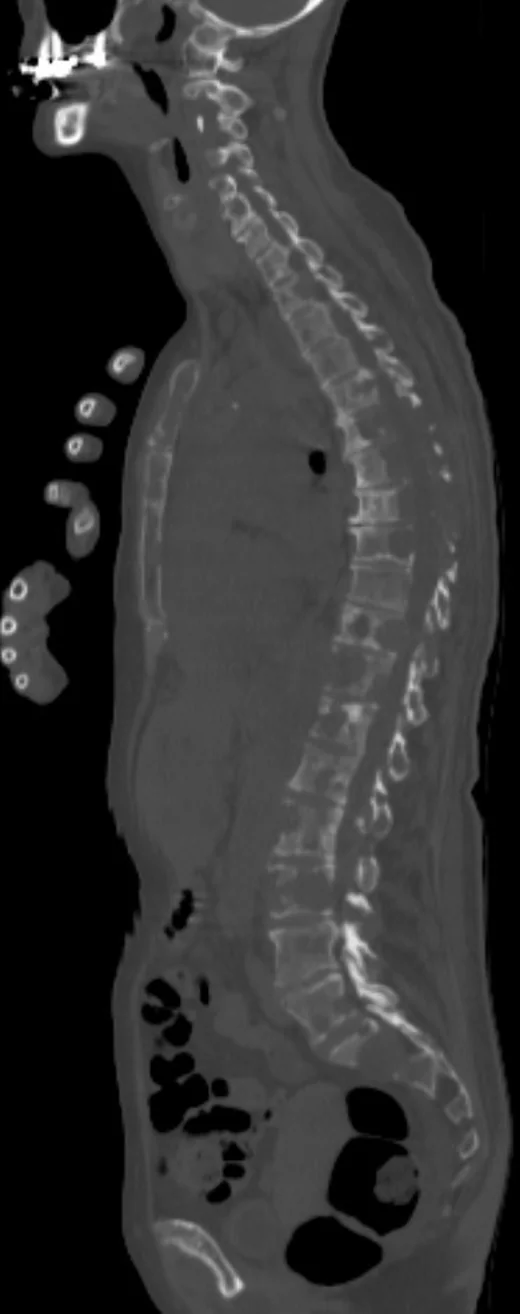
Bilinen veya olası malignitesi olan hastada vertebra içindeki osteolitik odak, kemik dayanıklılığını azaltıp patolojik çökme ve epidural yayılıma zemin hazırlayabilir. Bilgisayarlı tomografi, özellikle kemik penceresinde kullanıldığında kortikal ve trabeküler yıkımı belirgin biçimde gösterir. Pedikül, arka korteks ve yumuşak doku bileşeninin tutulumu lezyonun spinal kanala uzanma riskini ve yapısal etkisini tarif etmeye yardım eder. Lezyonun ve çökme bulgularının atlanması instabilite veya malign kord basısının gecikmiş fark edilmesine yol açabilir.
Faz ve pencere
- Kontrastsız tanısal
- Kemik penceresinde vertebra trabeküllerinde fokal kemik kaybı, coğrafi ya da permeatif litik alan, kortikal kesinti ve varsa patolojik çökme doğrudan görülür; yumuşak doku/epidural uzanımı sınırlı seçilir.
- Kemik algoritması tanısal
- Aksiyel kesitler ve sagittal/koronal kemik rekonstrüksiyonları litik alanın korpus, pedikül ve posterior korteksteki yayılımını; korteksin sürekliliğini ve vertebra yüksekliğini gösterir.
Önerilen pencereler: Kemik (G 1800 / M 400), Yumuşak doku (G 400 / M 40).
BT bulguları
- Osteolitik odak — normal trabeküler yapı yerini fokal kemik kaybına bırakır; lezyon sınırları komşu sağlam kemikle kıyaslanarak değerlendirilir.
- Posterior korteks yıkımı — korpusun spinal kanala bakan arka duvarındaki kesinti, epidural uzanım için doğrudan geçiş yolu oluşturabilir.
- Pedikül tutulumu — pedikülde litik kayıp veya kontur bozulması posterior eleman hastalığını gösterir.
- Patolojik kompresyon — korpus yüksekliğinde azalma, son plak çökmesi veya arka korteks çıkıntısı gibi bulgular, tümörle zayışlamış kemiğin kırığını gösterir.
- Epidural/paravertebral yumuşak doku — arka korteksi aşan doku veya vertebra yanında kitle komponenti varsa yumuşak doku penceresinde izlenir.
- Çok odaklı dağılım — diğer vertebra düzeyleri ve görüntü alanındaki kemiklerde ek litik odaklar aranır.
- Retropulse kemik parçası ile epidural tümör kitlesi farklı doku özellikleri gösterir; her ikisinin spinal kanala yaptığı baskı ayrı ayrı tanımlanmalıdır.
Ölçütler ve sınıflamalar
- Radyolojik kemik metastazı paterni
- Metastatik lezyonlar primer tümöre bağlı olarak litik (korpus ve pedikülde yıkım), blastik (nodüler veya mavile skleroz) veya mikst (litik ve sklerotik komponentlerin bir arada olduğu) paternlerde görülebilir.
Normalde
Normal kemik iliği ile metastatik odaklar arasındaki yoğunluk/sinyal farkı, lezyonun saptanmasında temel referanstır; lezyonlar normal iliğe göre hipodens/hipojintens görünür. Lezyonun sınırlarını belirlemek ve maligniteyi doğrulamak için komşu sağlam vertebralar ve normal kemik iliği yoğunluğu/sinyali referans alınır.
Normal BT ile kıyasla
Aynı bölgenin, kaynak veri setinde patoloji içermediği belirtilen bir BT incelemesini kesit kesit kaydırın; organ sınırlarını açarak anatomiyi hasta görüntüsüyle karşılaştırın. Küçük rastlantısal bulgular tümüyle dışlanmamıştır.
Kaynak: TotalSegmentator v2.01 veri seti (Wasserthal ve ark., Radiology: Artificial Intelligence 2023), CC BY 4.0, vaka s1338; organ sınırları veri setinin otomatik segmentasyonundan, birleştirilerek sadeleştirildi. Görüntüler 2,5 mm kesit aralığına yeniden örneklendi.
Ayırıcı tanı
- Vertebral hemanjiyom
- tipik olguda kalınlaşmış trabeküllerin aksiyel polka-dot görünümü ve sagittal çizgilenme vardır; kortikal yıkımlı litik kitle beklenmez.
- Enfeksiyöz osteomiyelit
- disk aralığı ve karşılıklı son plakların birlikte etkilenmesi metastazdan daha çok spondilodiskiti destekler.
- Multipl miyelom/plazmasitom
- iyi sınırlı litik odak veya vertebrada yaygın litik değişiklik yapabilir; klinik ve sistemik bulgularla ayrılır.
- Tipik hemanjiyomlar ve notokord kalıntı tümörleri genellikle asemptomatiktir, uzun dönemli stabilite gösterir ve metastazlarda görülen agresif kortikal yıkımı oluşturmaz.
- Osteoporotik kompresyon kırığı
- trabeküler impaksiyon ve kırık hattı görülebilir; fokal destrüktif odak ya da yumuşak doku kitlesi beklenmez.
Tuzaklar
- BT'de kemik iliği metastazı korteks yıkımından önce görünmeyebilir; normal BT, klinik şüphe yüksekken erken iliği tutan hastalığı dışlamaz.
- Yalnız korpus gövdesine bakıp pedikülü atlamayın; pedikül ve posterior korteks tutulumu spinal kanal riskini etkiler.
- Retropulse kemik parçası ile epidural tümör kitlesi farklı doku özellikleri gösterir; her ikisinin spinal kanala yaptığı baskı ayrı ayrı tanımlanmalıdır.
- Litik alanı otomatik olarak tek metastaz saymayın; hemangiom, enfeksiyon ve plazma hücreli lezyonların morfolojisini ve diğer düzeyleri karşılaştırın.
Kendini dene
Bilinen akciğer kanserinde L2 korpusunda trabeküler kayıplı litik odak, pedikül tutulumu ve arka korteks kesintisi var. En olası tanı nedir?
Cevabı göster
Litik vertebral metastaz. Agresif litik odak, pedikül tutulumu ve arka korteks yıkımı patolojik kırık/metastazı gösterir. Tipik vertebral hemanjiyomda aksiyel kesitlerde kalınlaşmış trabeküllerin noktalı görünümü ile sagittal kesitlerde dikey çizgiler izlenir; osteoporotik çökmede ise paravertebral yumuşak doku kütlesi veya pedikül tutulumu gibi malignite bulguları beklenmez.
Litik vertebra lezyonunda spinal kanal yönünde doğrudan kemik geçişini gösteren bulgu hangisidir?
Cevabı göster
Posterior korteks kesintisi. Posterior korteks kesintisi tümörün vertebra dışına, epidural alana uzanabileceği kemik sınırını gösterir. Diğer seçenekler spinal kanala metastatik geçişi tanımlamaz.
Kaynaklar
Bu sayfadaki 39 cümle ve 2 quiz sorusu aşağıdaki kaynaklardan alıntılarla tek tek karşılaştırıldı; 10 cümle bu karşılaştırmada düzeltildi (2026-10-08).
- Imaging of Spinal Metastatic Diseasepmc.ncbi.nlm.nih.gov
- Bone Density Changes Following Radiotherapy to Vertebral Metastases.pubmed.ncbi.nlm.nih.gov
- Tuberculosis presenting as metastatic lung cancer.pubmed.ncbi.nlm.nih.gov
- The "numb chin syndrome": A case report.pubmed.ncbi.nlm.nih.gov
- Calcaneal acrometastasis from urothelial carcinoma of the ureter: a case report and literature review.pubmed.ncbi.nlm.nih.gov
- Multiple extraneural metastasis of glioblastoma multiforme.pubmed.ncbi.nlm.nih.gov
- Type, size, and position of metastatic lesions explain the deformation of the vertebrae under complex loading conditions.pubmed.ncbi.nlm.nih.gov
- Radiological changes on CT after stereotactic body radiation therapy to non-spine bone metastases: a descriptive series.pubmed.ncbi.nlm.nih.gov
- Vertebral Metastasis from Primary Parotid Adenocarcinoma.pubmed.ncbi.nlm.nih.gov
- Occult esophageal squamous cell carcinoma with metastases to the spine and central nervous system.pubmed.ncbi.nlm.nih.gov
- Cholangiocarcinoma Metastasis to the Spine and Cranium.pubmed.ncbi.nlm.nih.gov
- Bladder metastasis presenting as neck, arm and thorax pain: a case report.pubmed.ncbi.nlm.nih.gov
- A Unique Case of Metastatic, Functional, Hereditary Paraganglioma Associated With an SDHC Germline Mutation.pubmed.ncbi.nlm.nih.gov
- Metastatic mucinous cystadenocarcinoma of the pancreas presenting as intractable back pain.pubmed.ncbi.nlm.nih.gov
- AI-Assisted Detection and Localization of Spinal Metastatic Lesions.pubmed.ncbi.nlm.nih.gov
- Bone metastases from hepatocellular carcinoma: Guidance on the management of spinal and long bone lesions.pubmed.ncbi.nlm.nih.gov
- Pseudomyogenic hemangioendothelioma of the thoracolumbar spine: A case-based review of a rare cause of vertebral collapse and neurological deficit.pubmed.ncbi.nlm.nih.gov
- Vertebral metastasis with spinal cord compression as the first manifestation of hepatocellular carcinoma: a case report.pubmed.ncbi.nlm.nih.gov
- Beyond Chordoma: A Comprehensive Review of Sacral Lesions.pubmed.ncbi.nlm.nih.gov
- Diffuse Bilateral Pseudo-Cystic Pulmonary Lesions Revealing Metastatic Lung Adenocarcinoma: A Case Report and Literature Review.pubmed.ncbi.nlm.nih.gov
- Unveiling Primary Bone Tumors of the Spine: A Review of Essential Imaging Clues.pubmed.ncbi.nlm.nih.gov
- Spinal lesions: a comprehensive radiologic overview.pubmed.ncbi.nlm.nih.gov
- Use of Carbon Fiber Implants to Improve the Safety and Efficacy of Radiation Therapy for Spine Tumor Patients.pubmed.ncbi.nlm.nih.gov
- Combination radiofrequency ablation and vertebral cement augmentation for spinal metastatic tumors: A systematic review and meta-analysis of safety and treatment outcomes.pubmed.ncbi.nlm.nih.gov
- Acute management of spinal fractures: What you need to know.pubmed.ncbi.nlm.nih.gov
- Management of metastatic spinal disease in low- and middle-income countries: an international survey of practices and challenges in Latin America.pubmed.ncbi.nlm.nih.gov
- Recognizing Sacral Insufficiency Fractures Hidden in Plain Sight: An Illustrative Case Report.pubmed.ncbi.nlm.nih.gov
- Distinguishing Benign Notochordal Cell Tumors From Chordoma in a Patient With Multicentric Spinal Lesions.pubmed.ncbi.nlm.nih.gov
- Multifocal Skeletal Tuberculosis Mimicking Metastatic Malignancy: A Case Report.pubmed.ncbi.nlm.nih.gov
- Morphology analysis of the C2 pediculoisthmic component and feasibility of safe C2 pedicle screw placement: comparison of multiplanar reconstruction versus traditional radiographic methods.pubmed.ncbi.nlm.nih.gov
- Clinical Rationale of Using Steerable Technologies for Radiofrequency Ablation Followed by Cavity Creation and Cement Augmentation in the Treatment of Painful Spinal Metastases.pubmed.ncbi.nlm.nih.gov
- Imaging features of the postoperative spine: a guide to basic understanding of spine surgical procedures.pubmed.ncbi.nlm.nih.gov
- Multimodal Imaging of Osteosarcoma: From First Diagnosis to Radiomics.pubmed.ncbi.nlm.nih.gov
- Understanding a mass in the paraspinal region: an anatomical approach.pubmed.ncbi.nlm.nih.gov
- Sacral benign notochordal cell tumor with atypical imaging features and 16-year spontaneous partial regression: A case report.pubmed.ncbi.nlm.nih.gov
- Partial C2 corpectomy with iliac/fibula bone graft and posterior instrumented fusion for C2 vertebral body lesions: An innovative approach.pubmed.ncbi.nlm.nih.gov
- A rare case of multi-segmental lumbar intradural ependymoma: clinical presentation and surgical management: a case report.pubmed.ncbi.nlm.nih.gov
- Case Report: Giant L1 dumbbell-shaped spinal schwannoma with osteolytic destruction and intense [<sup>18</sup>F]FDG uptake on PET/CT mimicking a malignant tumor.pubmed.ncbi.nlm.nih.gov
- Shaping the future of spinal implants: advancing bioactive composites with 3D printing for next-generation surgical care.pubmed.ncbi.nlm.nih.gov
- Pre-resection Embolization of a Focal Lumbar Chordoma.pubmed.ncbi.nlm.nih.gov
- Acute Spinal Cord Injury in the Setting of C6 Pathologic Fracture Secondary to Metastatic Paraganglioma: A Case Report and Review of Literature.pubmed.ncbi.nlm.nih.gov
- Biomaterials for vertebral body repair: interior augmentation and total replacement-a literature review of bone fusion outcomes in clinical studies.pubmed.ncbi.nlm.nih.gov
- Application of deformity principles in the management of spinal neoplasms: A Primer.pubmed.ncbi.nlm.nih.gov
- Spinal hydatid disease with epidural extension and spinal cord compression: A radiology case report.pubmed.ncbi.nlm.nih.gov
- Spinal granulocytic sarcoma with both extradural and intradural involvement: a case report.pubmed.ncbi.nlm.nih.gov
- Complications of vertebral augmentation in metastatic spinal fractures: a systematic review of multiple study designs.pubmed.ncbi.nlm.nih.gov
- Synchronous Bilateral Carotid Body and Bilateral Vagal Paragangliomas: A Case Report and Literature Review.pubmed.ncbi.nlm.nih.gov
- CT and MRI features of SAPHO syndrome: a report of 6 cases.pubmed.ncbi.nlm.nih.gov
- Diagnostic value of quantitative SPECT/CT integrated parameters for differentiating spinal tuberculosis from spinal metastases.pubmed.ncbi.nlm.nih.gov
- Rugby Injury Imaging.pubmed.ncbi.nlm.nih.gov
- Identifying osteoporotic vertebral endplate and cortex fractures.pubmed.ncbi.nlm.nih.gov
- Atypical imaging features of tuberculous spondylitis: case report with literature review.pubmed.ncbi.nlm.nih.gov
- Clinical evaluation and finite element analysis of bone cement-augmented anterolateral screw fixation versus percutaneous bilateral pedicle screw fixation co-applied with oblique lumbar interbody fusion for single-level lumbar degenerative diseases with osteoporosis.pubmed.ncbi.nlm.nih.gov
- Bone marrow magnetic resonance imaging (MRI): morphological and functional features from reconversion to infiltration.pubmed.ncbi.nlm.nih.gov
- Vertebral hemangiomas: a review on diagnosis and management.pubmed.ncbi.nlm.nih.gov
- Multidisciplinary Exploration of Computed-Tomographic and Ancient-DNA Data of an Iron Age Skull From Latvia With Multiple Lytic Bone Lesions: Differential Diagnosis Between Metastatic Carcinoma, Multiple Myeloma and Skeletal Tuberculosis.pubmed.ncbi.nlm.nih.gov
- Microstructure of the human metastatic vertebral body.pubmed.ncbi.nlm.nih.gov
- Vertebral Metastasis in a Bronchial Carcinoid: A Rare Case Report with More than 3-Year Follow-Up and Review of the Literature.pubmed.ncbi.nlm.nih.gov
- Extensive thoracic vertebral and chest wall metastases as the initial presentation of breast cancer: a case report and literature review.pubmed.ncbi.nlm.nih.gov
- Anatomy and Pathologies of the Spinous Process.pubmed.ncbi.nlm.nih.gov
- Aggressive thoracic vertebral hemangioma managed with preoperative embolization and surgical decompression: A case report.pubmed.ncbi.nlm.nih.gov
- Recommendations of the International Consensus Meeting (ICM) 2025 on Spinal Infections: Part B Tubercular Spondylodiscitis.pubmed.ncbi.nlm.nih.gov
- Discitis, Diabetes, and Endocarditis: A Challenging Clinical Triad.pubmed.ncbi.nlm.nih.gov
- A transformer-based deep learning algorithm for diagnosing spinal infections on axial non-contrast computed tomography images: a dual-center retrospective study.pubmed.ncbi.nlm.nih.gov
- Atypical presentation of intraosseous plasmacytoma in a patient with POEMS syndrome.pubmed.ncbi.nlm.nih.gov
- A Missed Clue in Plain Sight: Hyperproteinemia and Nonlytic Skeletal Disease Revealing Immunoglobulin A Multiple Myeloma.pubmed.ncbi.nlm.nih.gov
- POEMS syndrome: A case report.pubmed.ncbi.nlm.nih.gov
- Foregut mediastinal cysts: a narrative review.pubmed.ncbi.nlm.nih.gov
- Magnetic resonance bone imaging: applications to vertebral lesions.pubmed.ncbi.nlm.nih.gov
- Glossary of terms for musculoskeletal radiology.pubmed.ncbi.nlm.nih.gov
- Bone metastases from endocrine cancer: advances in diagnosis, treatment, and prevention.pubmed.ncbi.nlm.nih.gov
- Safety assessment of autologous ovarian tissue cryopreservation and transplantation in cancer patients: an updated review.pubmed.ncbi.nlm.nih.gov
- Paget's Disease of the Spine as a Catalyst for Osteosarcoma: A Narrative Review.pubmed.ncbi.nlm.nih.gov
- Occipital plate-assisted posterior reduction for tumor-related severe atlantoaxial dislocation: a single-case surgical technique.pubmed.ncbi.nlm.nih.gov
- Management of skeletal metastases: An orthopaedic surgeon's guide.pubmed.ncbi.nlm.nih.gov
- Spinal Castleman disease: An imposter-A rare case from Ethiopia.pubmed.ncbi.nlm.nih.gov
- Clinical Feasibility Studies and Potential Applications of Cone-Beam Computed Tomography Integrated in Multimodality X-Ray System for Small Animals.pubmed.ncbi.nlm.nih.gov
- The spinal lymphatic system: an emerging pathway bridging fluid homeostasis, immunity, and disease.pubmed.ncbi.nlm.nih.gov
- Minimal kyphotic progression following pediatric vertebral fractures: implications for reduced radiographic surveillance.pubmed.ncbi.nlm.nih.gov
- Radiomics in spinal research: a narrative review.pubmed.ncbi.nlm.nih.gov
- Magnetic Resonance Imaging-Based Assessment of Bone Quality Using Vertebral Bone Quality (VBQ) Scores in Spine Surgery-A Critical Assessment and Narrative Review.pubmed.ncbi.nlm.nih.gov
- Case report: Tumor-like mediastinal tuberculous lymphadenitis with paravertebral cold abscess under cumulative immunosuppression: a case highlighting altered host-pathogen interactions.pubmed.ncbi.nlm.nih.gov
- Right Upper Lobe Pulmonary Spindle Cell Neoplasm With Rhabdoid Differentiation and Spinal Canal Invasion in a 19-Year-Old Female: A Case Report.pubmed.ncbi.nlm.nih.gov
- Differential diagnosis of benign and malignant vertebral compression fractures based on CT radiomics model.pubmed.ncbi.nlm.nih.gov
- International Society of Paediatric Surgical Oncology (IPSO) Minimally Invasive Surgery (MIS) Guidelines.pubmed.ncbi.nlm.nih.gov
- Schmorl's Node Mimicking Spinal Metastatic Disease: A Case Report and Review of the Literature.pubmed.ncbi.nlm.nih.gov
- Diagnostic Accuracy of Quantitative Imaging Biomarkers in the Differentiation of Benign and Malignant Vertebral Lesions : Combination of Diffusion-Weighted and Proton Density Fat Fraction Spine MRI.pubmed.ncbi.nlm.nih.gov
- The value of magnetic resonance imaging and computed tomography in the study of spinal disorders.pubmed.ncbi.nlm.nih.gov
- Imaging Evaluation of Bone Tumors in the Cervical Spine: A Comprehensive Review.pubmed.ncbi.nlm.nih.gov
- Robot-assisted versus conventional fluoroscopy-guided percutaneous pediculoplasty for symptomatic chronic thoracic and lumbar osteoporotic vertebral fracture without neurological deficits.pubmed.ncbi.nlm.nih.gov
- <sup>99 m</sup>Tc-MDP Bone Scan Staging of Vertebral Chordoma.pubmed.ncbi.nlm.nih.gov
- Occult Esophageal Squamous Cell Carcinoma Presenting as Bone-Predominant Carcinoma of Unknown Primary: A Case Report of a p40-Negative Vertebral Metastasis.pubmed.ncbi.nlm.nih.gov
- Case review of 3 patients with musculoskeletal manifestation of human immunodeficiency virus and highly active antiretroviral therapy in the form of osteopenia and insufficiency fractures.pubmed.ncbi.nlm.nih.gov
- Multiphysics finite element analysis of vertebral stability in simulated osteolytic lumbar defects treated with <sup>125</sup>I brachytherapy and vertebroplasty.pubmed.ncbi.nlm.nih.gov
- Osteosarcoma: A Comprehensive Morphological and Molecular Review with Prognostic Implications.pubmed.ncbi.nlm.nih.gov
- Malignant Bone-Forming Neoplasm With NIPBL::BEND2 Fusion.pubmed.ncbi.nlm.nih.gov
- Clinical, Radiological, and Pathological Features of Intraosseous Hibernoma: A Systematic Review of Case Reports and Case Series.pubmed.ncbi.nlm.nih.gov
- Implant failure and postoperative complications after stabilization surgery for spinal metastases: A single-center cohort study.pubmed.ncbi.nlm.nih.gov
- Conventional radiography for the assessment of focal bone lesions of the appendicular skeleton: fundamental concepts in the modern imaging era.pubmed.ncbi.nlm.nih.gov
- Intraosseous tumours of the knee.pubmed.ncbi.nlm.nih.gov
Eğitim amaçlıdır; hasta başında tanı ve tedavi kararının yerine geçmez. İçerik yapay zekâ destekli bir süreçle güncel literatüre göre cümle cümle kaynaklarla karşılaştırıldı, ancak uzman radyolog incelemesinden geçmedi. Klinik kararlarda güncel kılavuzları, kurum protokollerini ve radyoloji raporunu esas alın.