Özet
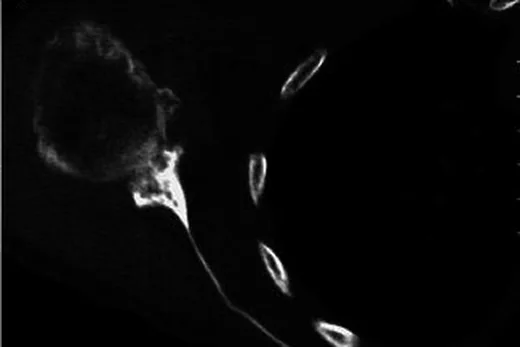
Glenoid gelişimsel displazisi, posteroinferior glenoid ve komşu skapula boynunun kemikleşme yetersizliğiyle karakterize bir anomali olup uzun süre belirtisiz kalarak görüntülemede tesadüfen saptanabilir. Kontrastsız ince kesit BT, eklem kenarının gelişimsel biçimini, glenoid yönelimini ve humerus başının glenoide göre konumunu kemik ayrıntısıyla ortaya koyar. Gelişimsel hipoplaziyi edinsel kemik kaybı sanmamak için konturun biçimi ve eklem ilişkisi birlikte değerlendirilir; posterior baş desantralizasyonu ve sekonder dejeneratif bulgular ayrıca belirtilir.
Faz ve pencere
- Kontrastsız tanısal
- Skapula düzlemine göre oluşturulmuş ince aksiyel kesitlerde posteroinferior glenoid kenarı, eklem yüzü yönelimi ve humerus başı ilişkisi kemik penceresinde incelenir; gelişimsel kemik biçimi için damar içi kontrast gerekmez.
Önerilen pencereler G genişlik, M merkez; değerler Hounsfield birimi (HU)
- KemikG 1800 / M +400
BT bulguları
- Posteroinferior kontur hipoplazisi — arka glenoid kenarı tipik olarak yuvarlaklaşmış ('lazy-J' morfolojisi) veya üçgen biçimli kemik eksikliği şeklinde izlenir.
- Glenoid retroversiyonu — eklem yüzünün yönelimi, skapula eksenine dik referans çizgiye göre açı olarak belirlenir; ölçüm aynı aksiyel kemik düzleminde yapılır.
- Alt eklem aralığı — inferior glenohumeral aralık genişleyebilir; kıkırdak ve labrumun katkısı BT'de sınırlı değerlendirilir.
- Posterior humerus başı konumu — baş merkezi glenoide göre arkaya desantralize olabilir; subluksasyon ile tam çıkığı ayırmak için glenohumeral eklem uyumunu değerlendirin.
- Skapula boynu biçimi — displastik glenoidde skapula boynu belirgin biçimde yetersiz veya eksik olabilir ve çanak derinliğinde azalma eşlik edebilir.
- Glenoid displazisine glenoid boyun yetersizliği ve humerus başı biçim değişikliği ve/veya posterior subluksasyon eşlik edebilir.
- Glenoid gelişimsel displazisine erken glenohumeral osteoartrit eşlik edebilir; osteoartritte osteofit, kemik sklerozu ve subkondral kistler görülebilir.
- Displastik glenoid morfolojisinde (Walch Tip C), posteroinferior kenar yetersizliğine belirgin glenoid retroversiyonu eşlik edebilir.
Ölçütler ve sınıflamalar
- 410 normal omuz BT'sinde, skapula eğimi için 3B düzeltilmiş kesitlerde ölçülen glenoid retroversiyonu
- Kontrol grubunda alt glenoid versiyonu −8,5° ile 9,2° arasında olup ortalama −0,25°'dir.
Normalde
Normal glenoid eklem yüzü hafifçe çukur ve süreklidir; humerus başı bu yüz üzerinde uyumlu biçimde merkezlenir. Aynı skapula düzlemindeki karşı omuzla arka-alt kenarın dolgunluğunu, eklem yüzü doğrultusunu ve baş merkezinin konumunu karşılaştırın; tek başına retroversiyon açısı gelişimsel displazi demek için yeterli değildir.
Ayırıcı tanı
- Edinsel posterior glenoid kemik kaybı
- travma veya instabiliteye sekonder post-travmatik kemik kaybı gelişebilir; yapısal displazide ise kemik eksikliğine eşlik eden posterior labrum hipertrofisi MRG veya BT artrografide saptanabilir.
- Posterior glenoid kenar kırığı
- posterior glenoid kırığı, posterior instabiliteyle ilişkili kemik bulguları arasında yer alabilir.
- Glenohumeral osteoartrit
- eklem aralığı kaybı, subkondral değişiklikler ve marjinal kemik çıkıntıları baskın hale gelir.
- Posterior glenohumeral çıkık
- parsiyel subluksasyondan farklı olarak humerus başı glenoid eklem yüzüyle ilişkisinden tamamen arkaya yer değiştirmiştir.
- İnferior kıkırdak ve posterior labrum hipertrofisi glenoid displazisine eşlik edebilir; posterior labrum ve diğer eklem içi yumuşak dokular MR ile değerlendirilir.
Tuzaklar
- Arka-alt glenoidin düzgün yuvarlak eksikliğini travma sonrası erozyon diye yorumlamadan önce skapula boynu ve karşı tarafın biçimini kıyaslayın.
- Hasta rotasyonu ve aksiyel kesit eğimi glenoid versiyon ölçümünü etkileyebilir; skapula ekseni ve glenoid eklem yüzünü aynı, skapula düzlemine göre düzeltilmiş kesitte değerlendirin.
- Kontrastsız BT posterior labrum, kapsül ve eklem kıkırdağını doğrudan güvenilir biçimde göstermez; kemik görünümünden bu yapıların sağlam olduğu sonucunu çıkarmayın.
- Ölçülen retroversiyon açısını tek başına displazi tanısı için kullanmayın; düzgün konturlu kemik hipoplazisi, eklem uyumu ve baş konumunu birlikte değerlendirin.
Kendini dene
BT'de arka-alt glenoid kenarı düzgün biçimde yuvarlak ve sığ; eklem yüzü arkaya yönelmiş, baş hafif posterior konumda. En olası açıklama nedir?
Cevabı göster
Gelişimsel glenoid biçim farkı. Yaygın ve düzgün arka-alt hipoplazi, eklem yüzünün posterior yönelimiyle birlikte gelişimsel biçimi destekler. Osteoartritte eklem aralığında daralma, skleroz ve subkondral kistler, tam çıkıkta ise humerus başının glenoid eklem yüzünden tamamen ayrılması beklenir.
Posterior omuz instabilitesinde glenoid kemik defektleri öngörülebilir biçimde hangi kadranda yerleşim gösterir?
Cevabı göster
Posteroinferior kadranda. Posterior omuz instabilitesinde kemik defektleri öngörülebilir bir patern halinde glenoid yüzünün posteroinferior kadranında yerleşim gösterir.
İlgili konular
Kaynaklar
Bu sayfadaki 36 cümle ve 2 quiz sorusu aşağıdaki kaynaklardan alıntılarla otomatik olarak karşılaştırıldı; 19 cümle bu karşılaştırmada düzeltildi (2026-10-10).
- Radiographic and Advanced Imaging Evaluation of Posterior Shoulder Instabilitypubmed.ncbi.nlm.nih.gov
- Morphologic features of humeral head and glenoid version in the normal glenohumeral jointpubmed.ncbi.nlm.nih.gov
- Glenoid hypoplasia: A case series of ten shouldersscielo.org.za
- Imaging of shoulder instabilitypubmed.ncbi.nlm.nih.gov
- Posterior shoulder instability in the contact athlete: a review of the diagnosis, management and outcomespmc.ncbi.nlm.nih.gov
- Comprehensive management of posterior shoulder instability: diagnosis, indications, and technique for arthroscopic bone block augmentationpmc.ncbi.nlm.nih.gov
- Posterior Shoulder Instabilitypmc.ncbi.nlm.nih.gov
- Retroglenoid osteotomy with capsular shift for posterior shoulder instability: technical note and short-term resultspmc.ncbi.nlm.nih.gov
- Shoulder arthroplasty for the management of glenoid dysplasia: a systematic reviewpmc.ncbi.nlm.nih.gov
- Imaging of shoulder instability.pubmed.ncbi.nlm.nih.gov
- Posterior Shoulder Instability.pubmed.ncbi.nlm.nih.gov
- Glenoid Dysplasia: Pathophysiology, Diagnosis, and Management.pubmed.ncbi.nlm.nih.gov
- Comprehensive management of posterior shoulder instability: diagnosis, indications, and technique for arthroscopic bone block augmentation.pubmed.ncbi.nlm.nih.gov
- Characterization of the dysplastic Walch type C glenoid.pubmed.ncbi.nlm.nih.gov
- Prospective Evaluation of Posterior Glenoid Bone Loss After First-time and Recurrent Posterior Glenohumeral Instability Events.pubmed.ncbi.nlm.nih.gov
- Shoulder arthroplasty in the presence of posterior glenoid bone loss.pubmed.ncbi.nlm.nih.gov
- A new form of shoulder dysplasia in an 11-year-old boy.pubmed.ncbi.nlm.nih.gov
- Three-Dimensional Magnetic Resonance Imaging of Glenohumeral Dysplasia in Neonatal Brachial Plexus Palsy.pubmed.ncbi.nlm.nih.gov
- High incidence of posterior glenoid dysplasia of the shoulder in young baseball players.pubmed.ncbi.nlm.nih.gov
- Glenoid retroversion is an important factor for humeral head centration and the biomechanics of posterior shoulder stability.pubmed.ncbi.nlm.nih.gov
- Shoulder arthroplasty in dwarfism: A case report of pseudoachondroplasia with 17-year follow-up.pubmed.ncbi.nlm.nih.gov
- Glenoid dysplasia and osteochondritis dissecans in a cat.pubmed.ncbi.nlm.nih.gov
- Is three-dimensional reconstruction really necessary for glenoid version measurement on magnetic resonance imaging in patients with glenohumeral instability?pubmed.ncbi.nlm.nih.gov
- MR arthrographic examination of the association with glenohumeral instability of posterior labroligamentous i̇nsertion types and posterior labrum anatomical variants.pubmed.ncbi.nlm.nih.gov
- Prediction of humeral torsion from proximal humerus computed tomography is enabled by three-dimensional estimation of the transepicondylar axis using deep learning.pubmed.ncbi.nlm.nih.gov
- Acromial Osteotomy for Dynamic Posterior Shoulder Instability.pubmed.ncbi.nlm.nih.gov
- Quantitative Musculoskeletal Imaging of the Pediatric Shoulder.pubmed.ncbi.nlm.nih.gov
- Preoperative glenoid considerations for shoulder arthroplasty: a review.pubmed.ncbi.nlm.nih.gov
- Glenohumeral cartilage lesions: reviewing diagnostic imaging strategies and preoperative evaluation.pubmed.ncbi.nlm.nih.gov
- Subchondral Bone Cyst Development in Osteoarthritis: From Pathophysiology to Bone Microarchitecture Changes and Clinical Implementations.pubmed.ncbi.nlm.nih.gov
- Glossary of terms for musculoskeletal radiology.pubmed.ncbi.nlm.nih.gov
- Anterior coracoid coverage and the glenoid roof morphometry: a radiographic model of directional shoulder instability.pubmed.ncbi.nlm.nih.gov
- Arthroscopic Dynamic Anterior Stabilization and Augmentation of Bony Bankart Lesions With Transfer of the Long Head of the Biceps.pubmed.ncbi.nlm.nih.gov
- Shifting paradigms: how the glenoid track changed the concept of shoulder instability.pubmed.ncbi.nlm.nih.gov
- Addition of a second double-row reduces fragment micromotion and increases fixation strength in suture fixation of a bony Bankart injury: A biomechanical study.pubmed.ncbi.nlm.nih.gov
- Humeral Head Diameter-to-Glenoid Surface Area Ratio as a Morphometric Risk Factor for Posterior Labral Tears: A Retrospective Computed Tomography Analysis.pubmed.ncbi.nlm.nih.gov
- Posterior shoulder instability: An overview.pubmed.ncbi.nlm.nih.gov
- Introducing posterior glenoid dysplasia with novel classification: comparison of proportion and morphology between young baseball players and other athletes.pubmed.ncbi.nlm.nih.gov
- Posterior Shoulder Instability in Contact Athletes: Recognition, Evaluation, and Management.pubmed.ncbi.nlm.nih.gov
- Computed Tomography (CT)-Based Morphometric Analysis of the Glenoid Fossa and Its Clinical Significance in the Lucknow Region, Uttar Pradesh.pubmed.ncbi.nlm.nih.gov
- The role of glenoid version in arthroplasty.pubmed.ncbi.nlm.nih.gov
- Scapular Morphology and Posterior Shoulder Stability: Biomechanical Evidence From an Advanced Cadaveric Shoulder Simulator.pubmed.ncbi.nlm.nih.gov
- Glenoid version and recurrent anterior shoulder dislocation: a case-control study.pubmed.ncbi.nlm.nih.gov
- Comparative Study of Trans-Axillary Approach and Delto-Pectoral Approach to the Treatment of Ideberg Types I and II Scapular Glenoid Fractures.pubmed.ncbi.nlm.nih.gov
- Osteotomies: Indications, Imaging Appearance, Surgical Techniques, and Complications.pubmed.ncbi.nlm.nih.gov
- Two Cases of Anterior Shoulder Dislocation and Fracture Secondary to Generalized Tonic-Clonic Seizure.pubmed.ncbi.nlm.nih.gov
- Clavicle length and scapulothoracic angle in young children with internal rotation contracture secondary to brachial plexus birth palsy: a bilateral MRI study.pubmed.ncbi.nlm.nih.gov
- Retroglenoid osteotomy with capsular shift for posterior shoulder instability: technical note and short-term results.pubmed.ncbi.nlm.nih.gov
- Preosteoarthritic static posterior humeral subluxation in young adults (posterior shoulder instability type C1): associative factors, diagnosis, and treatment.pubmed.ncbi.nlm.nih.gov
- Influence of inferior glenoid version and glenoid index on recurrent anterior shoulder dislocation.pubmed.ncbi.nlm.nih.gov
- Gender-specific factors influencing the glenoid version and reference values for it.pubmed.ncbi.nlm.nih.gov
- Indications and outcomes of glenoid osteotomy for posterior shoulder instability: a systematic review.pubmed.ncbi.nlm.nih.gov
- Demographic and structural indicators of temporomandibular joint osteoarthritis in asymptomatic adults: a cone-beam computed tomography-based multivariate analysis.pubmed.ncbi.nlm.nih.gov
- Current Landscape of Short-T2 Imaging Techniques in the Musculoskeletal System: The Past, Present and Future.pubmed.ncbi.nlm.nih.gov
- Primary osteoarthritis of the shoulder: are there differences in scapular morphology, orientation, and rotator cuff action lines between patients and healthy controls?pubmed.ncbi.nlm.nih.gov
- Long-term Outcomes and Conversion to Total Hip Arthroplasty Based on Acetabular Labral Tear Size: Minimum 8-Year Follow-up.pubmed.ncbi.nlm.nih.gov
- Differences in Osseous Shoulder Morphology, Scapulothoracic Orientation, and Muscle Volume in Patients With Constitutional Static Posterior Shoulder Instability (Type C1) Compared With Healthy Controls.pubmed.ncbi.nlm.nih.gov
- Arthroscopic Posterior Glenoid Bone Block Using an Adapted Anterior Glenoid Guide and Independent Cortical Button Fixation.pubmed.ncbi.nlm.nih.gov
- Chronic posterior shoulder dislocation: Current evidence, treatment options, and a decision-making algorithm.pubmed.ncbi.nlm.nih.gov
- Posterior shoulder instability in the contact athlete: a review of the diagnosis, management and outcomes.pubmed.ncbi.nlm.nih.gov
- Comparison of glenohumeral joint kinematics between swimmers clinically classified with multidirectional instability and asymptomatic controls.pubmed.ncbi.nlm.nih.gov
- Shoulder arthroplasty for the management of glenoid dysplasia: a systematic review.pubmed.ncbi.nlm.nih.gov
- Evolving concepts in the treatment of posterior shoulder instability with glenohumeral bone loss.pubmed.ncbi.nlm.nih.gov
- A narrative review of little league shoulder: proximal humeral physis widening is only one piece of the puzzle, it is time to consider posterior glenoid dysplasia.pubmed.ncbi.nlm.nih.gov
- Glenoid hypoplasia.pubmed.ncbi.nlm.nih.gov
- Glenoid morphology variation between patients with hypermobile shoulder joints and controls: Identification of hyperlaxity-related morphologic bone changes.pubmed.ncbi.nlm.nih.gov
- A deep learning approach for automatic 3D segmentation of hip cartilage and labrum from direct hip MR arthrography.pubmed.ncbi.nlm.nih.gov
- Comparison of the Glenoid Index by Computed Tomography With Magnetic Resonance Imaging.pubmed.ncbi.nlm.nih.gov
- [Posterior shoulder instability : Epidemiology, examination, and diagnostics].pubmed.ncbi.nlm.nih.gov
- Shoulder Anatomy and Normal Variants.pubmed.ncbi.nlm.nih.gov
- The outcome of soft-tissue release and tendon transfer in shoulders with brachial plexus birth palsy.pubmed.ncbi.nlm.nih.gov
- Report of two cases of Schaaf-Yang syndrome: Same genotype and different phenotype.pubmed.ncbi.nlm.nih.gov
- Three-Dimensional CT Planning for Anatomic Shoulder Arthroplasty: Reliability of Version Correction With Short-Term Clinical Outcomes.pubmed.ncbi.nlm.nih.gov
- Suspected Posttraumatic Mandibular Coronoid Hyperplasia and Condylar Hypoplasia: Two Case Reports and Literature Review.pubmed.ncbi.nlm.nih.gov
- Botulinum Toxin in Children and Adolescents-A Comprehensive Review of Clinical Applications.pubmed.ncbi.nlm.nih.gov
- Case Report: Revision surgery for a missed posterior dislocation of the humeral head in a shoulder fracture-dislocation and literature review.pubmed.ncbi.nlm.nih.gov
- Progressive Soft Tissue Release and Latarjet Procedure in the Treatment of Neglected Anterior Shoulder Dislocation After Failed ORIF in a Young Active Patient: A Case Report.pubmed.ncbi.nlm.nih.gov
- Managing Shoulder Instability in the Contact and Collision Athlete.pubmed.ncbi.nlm.nih.gov
- Antero-inferior glenohumeral instability is associated with an abnormal position of the coracoid process.pubmed.ncbi.nlm.nih.gov
- Analysis of scapular morphology as a key factor in unstable painful shoulder: an magnetic resonance imaging-based study.pubmed.ncbi.nlm.nih.gov
- Management of Post-stroke Shoulder Subluxation Using Sling Suspension-Based Active Shoulder Exercises: A Case Report.pubmed.ncbi.nlm.nih.gov
- Arthroscopic Rotator Cuff Repair With Collagen Patch Augmentation: An In Vivo Examination of Biologic and Biomechanical Patches.pubmed.ncbi.nlm.nih.gov
- Arthroscopic Fixation of Acute Reverse Bony Bankart Lesion using Cancellous Cannulated Screws: A Rare Case Report.pubmed.ncbi.nlm.nih.gov
- Arthroscopic Free Bone Block Transfer Technique Using Iliac Crest Autograft With Anchor-Button Fixation for Glenohumeral Instability and Glenoid Bone Loss.pubmed.ncbi.nlm.nih.gov
- Characteristics of the Top 50 Most-Cited Arthroscopic Remplissage Articles Reveal Growing Recognition But Persistent Knowledge Gaps.pubmed.ncbi.nlm.nih.gov
- Arthroscopic Iliac Crest Bone Grafting for Shoulder Glenoid Defect Augmentation Using a "Three-Pulley Four-Point Antirotation" Suture Anchor Technique.pubmed.ncbi.nlm.nih.gov
- Natural History of Nonoperatively Treated Borderline Acetabular Dysplasia in Young Adults and Factors Associated With Inferior Functional Outcome.pubmed.ncbi.nlm.nih.gov
- Imaging in the surgical management of developmental dislocation of the hip.pubmed.ncbi.nlm.nih.gov
- An increased McKibbin Index is associated with anterosuperior labral hypertrophy in the context of non-dysplastic hips.pubmed.ncbi.nlm.nih.gov
- pubmed.ncbi.nlm.nih.govpubmed.ncbi.nlm.nih.gov
- upload.orthobullets.comupload.orthobullets.com
- pmc.ncbi.nlm.nih.govpmc.ncbi.nlm.nih.gov
Eğitim amaçlıdır; hasta başında tanı ve tedavi kararının yerine geçmez, tıbbi tavsiye değildir. Metinler yapay zekâ desteğiyle yazıldı ve otomatik bir adımda kaynak alıntılarıyla karşılaştırıldı; bu bir tıbbi doğrulama değildir ve içerik uzman radyolog incelemesinden geçmedi. Klinik kararlarda güncel kılavuzları, kurum protokollerini ve radyoloji raporunu esas alın.