Özet
Hill-Sachs lezyonu, omuz çıkığı sırasında humerus başı posteriorunun anterior glenoid kenarına çarpmasıyla oluşan bir impaksiyon defektidir. Kemik BT, humerus başı ve glenoid kemik defektlerinin varlığını, boyutunu ve yerini saptar ve ölçer. Hill-Sachs lezyonunun klinik önemi glenoid morfolojisine bağlı olduğundan, instabilite değerlendirmesinde her iki lezyon eş zamanlı incelenmelidir. Glenoid track sınırlarının medialine uzanan off-track Hill-Sachs lezyonlarında glenoid kenarıyla angajman riski bulunur.
Faz ve pencere
- Kontrastsız tanısal
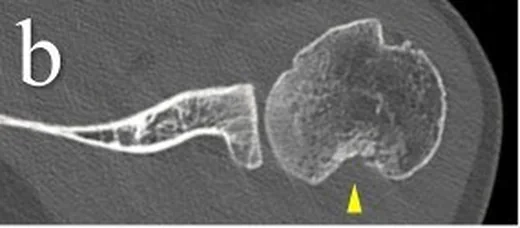
- Aksiyel ve 3B kemik BT'de humerus başı posterolateralindeki subkondral çökme oluğu ile eşlik eden glenoid kemik kaybı görüntülenebilir ve ölçülebilir.
Önerilen pencereler G genişlik, M merkez; değerler Hounsfield birimi (HU)
- KemikG 1800 / M +400
- Yumuşak dokuG 400 / M +40
BT bulguları
- Posterolateral impaksiyon lezyonu — humerus başı eklem yüzünün posterosüperolateralinde kemik defekti şeklinde izlenir.
- Defekt genişliği — aksiyel BT kesitinde humerus başı eklem yüzeyi dairesi üzerinde kemik defektinin her iki ucu arasındaki mesafe olarak tanımlanır.
- Bipolar kemik lezyonu — glenoid kemik kaybı ile humerus başı Hill-Sachs lezyonunun birlikte bulunmasıdır.
- Glenoid track ilişkisi — Hill-Sachs intervali glenoid track genişliğine eşit veya daha büyükse off-track olarak sınıflanır; glenoid kemik kaybı gerçek track genişliğini daraltır.
- Anterior omuz çıkığıyla ilişkili Hill-Sachs lezyonu, humerus başının posterolateral (posterosuperolateral) bölümündeki kemik defektidir.
- Hill-Sachs lezyonu — önceki anteroinferior glenohumeral çıkık atakları sonucu humerus başının posterosüperolateralinde oluşan kemik defektidir.
- On-track/off-track sınıflaması yalnız oluğun genişliğine değil, Hill-Sachs lezyonunun medial kenarının glenoid track'e göre konumuna dayanır.
Ölçütler ve sınıflamalar
- Glenoid track genişliği (lineer yöntem)
- GTW = (0,83 × D) − d; D: glenoid eklem yüzünün çapı, d: glenoid rim defektinin en geniş çapı.
- On-track / off-track karşılaştırması
- HSI ≥ glenoid track: off-track; HSI < glenoid track: on-track. Hill-Sachs interval, 3B BT'de ölçülerek glenoid track genişliğiyle karşılaştırılır; HSI'nin glenoid track genişliğine oranı Hill-Sachs occupancy olarak adlandırılır.
- Glenoid track ilişkisi
- Hill-Sachs intervali glenoid track genişliğine eşit veya daha büyükse off-track, daha küçükse on-track olarak tanımlanır. Hill-Sachs intervali glenoid track genişliğine eşit veya daha büyük olduğunda (DTD ≤ 0) lezyon off-track kabul edilir. Bu ölçüm ilişkisi bipolar kemik lezyonunu değerlendirir; glenoid ve Hill-Sachs lezyonu birlikte değerlendirilmelidir.
Normalde
Normal veya sağlam karşı taraf omuz BT'sinde humerus başı eklem yüzeyi aksiyel kesitte sanal bir daire oluşturur ve kemik kaybı bulunmayan sağlam glenoidde toplam eklem genişliği korunur. Defektin derinliği, humerus başı eklem yüzündeki konumu ve eşlik eden glenoid kemik kaybı incelenir.
Ayırıcı tanı
- Reverse Hill-Sachs
- çökme humerus başının posterolateralinde değil anteromedialindedir ve posterior çıkıkla ilişkilidir.
- Humerus başında benign kemik kistleri
- travmatik Hill-Sachs lezyonunu taklit edebilen benign kemik kistleri ayırıcı tanıda dikkate alınmalıdır.
- Proksimal humerus kırığı
- karmaşık kırık hatları çıkık ve lezyon bulgularını maskeleyebilir veya görüntülemede karışıklığa yol açabilir.
- Glenoid displazisi ve retroversiyonu
- instabiliteye zemin hazırlayabilen displazi veya aşırı retroversiyon gibi kemik faktörleri BT ile değerlendirilir.
Tuzaklar
- Humerus başının küresel yapısı ve lezyonun 3B özellikleri nedeniyle değerlendirme zorluklarını aşmak için çok düzlemli rekonstrüksiyon (MPR) ve 3B BT birlikte kullanılmalıdır.
- Hill-Sachs lezyonlarının çoğu küçük veya orta boyuttadır ve tek başına cerrahi gerektirmez; lezyonun instabilite riski glenoid morfolojisiyle birlikte değerlendirilmelidir.
- Glenoid track hesabında glenoid kenar kaybını dışarıda bırakmak track'i olduğundan geniş gösterebilir; D ve d ölçümlerini aynı en-face glenoid referansında yapın.
- Hill-Sachs lezyonunun uzunluk ve genişliği 3B BT'de ölçülürken, lezyon derinliği humerus şaft aksına dik aksiyel kesitlerde ölçülmelidir.
Kendini dene
Anterior çıkık sonrası BT'de posterolateral humerus başında oluk var; HSI, glenoid track değerinden büyük. Sınıfı nedir?
Cevabı göster
Off-track Hill-Sachs. HSI'nin GT'yi aşması off-track tanımına uyar ve defektin glenoid kenarıyla angajman olasılığını artırır. On-track durumda lezyonun medial kenarı glenoid track içinde kalır; reverse Hill-Sachs lezyonu humerus başının anteromedialindedir.
Redüksiyon sonrası humerus başı yerinde; arka-dış eklem yüzünde kemik oluk/defekt izleniyor, glenoid ön-alt kenarı korunmuş. En olası bulgu nedir?
Cevabı göster
Kronik Hill-Sachs defekti. Arka-dış humerus başındaki kemik defekt, önceki anteroinferior çıkığa bağlı Hill-Sachs lezyonudur. Reverse Hill-Sachs anteromedial yerleşimlidir ve posterior çıkıkla ilişkilidir.
İlgili konular
Kaynaklar
Bu sayfadaki 42 cümle ve 2 quiz sorusu aşağıdaki kaynaklardan alıntılarla otomatik olarak karşılaştırıldı; 24 cümle bu karşılaştırmada düzeltildi (2026-10-10).
- Chronic posterior shoulder dislocation: Current evidence, treatment options, and a decision-making algorithmpmc.ncbi.nlm.nih.gov
- Glenoid track and subcritical Hill-Sachs lesionpmc.ncbi.nlm.nih.gov
- Shifting paradigms: how the glenoid track changed the concept of shoulder instabilitypmc.ncbi.nlm.nih.gov
- Variability in quantifying the Hill-Sachs lesion: A scoping reviewpmc.ncbi.nlm.nih.gov
- Management of anterior shoulder instability in the contact athlete: a narrative reviewpmc.ncbi.nlm.nih.gov
- Traumatic Anterior Shoulder Dislocation: Epidemiology, Diagnosis, and Treatment.pubmed.ncbi.nlm.nih.gov
- Acute Shoulder Injury.pubmed.ncbi.nlm.nih.gov
- Failure of coracoid bone-block.pubmed.ncbi.nlm.nih.gov
- Glenoid track revisited.pubmed.ncbi.nlm.nih.gov
- Arthroscopic Findings in Anterior Shoulder Instability.pubmed.ncbi.nlm.nih.gov
- Batter's Shoulder: Diagnosis, Management, and Outcomes.pubmed.ncbi.nlm.nih.gov
- Osseous injuries associated with anterior shoulder instability: what the radiologist should know.pubmed.ncbi.nlm.nih.gov
- Clinical and radiological examination of bony-mediated shoulder instability.pubmed.ncbi.nlm.nih.gov
- Glenoid track and subcritical Hill-Sachs lesion.pubmed.ncbi.nlm.nih.gov
- [Recurrent instability and instability arthropathy].pubmed.ncbi.nlm.nih.gov
- Assessment of bone defects in anterior shoulder instability.pubmed.ncbi.nlm.nih.gov
- How to measure a Hill-Sachs lesion: a systematic review.pubmed.ncbi.nlm.nih.gov
- Measuring Bone Loss in the Unstable Shoulder: Understanding and Applying the Track Concept.pubmed.ncbi.nlm.nih.gov
- Understanding the Hill-Sachs Lesion in Its Role in Patients with Recurrent Anterior Shoulder Instability.pubmed.ncbi.nlm.nih.gov
- Assessing Bone Loss in the Unstable Shoulder: a Scoping Review.pubmed.ncbi.nlm.nih.gov
- Accuracy and Reliability of Imaging Modalities for the Diagnosis and Quantification of Hill-Sachs Lesions: A Systematic Review.pubmed.ncbi.nlm.nih.gov
- Variability in quantifying the Hill-Sachs lesion: A scoping review.pubmed.ncbi.nlm.nih.gov
- Arthroscopic Bone Graft Remplissage Using Flexible Bone Allograft for Treatment of Hill-Sachs Lesions in Anterior Shoulder Instability.pubmed.ncbi.nlm.nih.gov
- Modified McLaughlin procedure combined with proximal humeral locking plate for proximal humeral fractures with posterior shoulder dislocation and reverse Hill-Sachs lesion: a retrospective case series.pubmed.ncbi.nlm.nih.gov
- Rare Presentation of Chronic Anterior Instability with Concomitant Triad of Anterior Labral Periosteal Sleeve Avulsion, Hill-Sachs, and Humeral Avulsion of the Glenohumeral Ligament Lesions: A Case Report.pubmed.ncbi.nlm.nih.gov
- Clinical Outcomes of an Improved Arthroscopic Suture-Bridge Technique Assisted by a "5 O'clock" Portal for Acute Bony Bankart Lesions.pubmed.ncbi.nlm.nih.gov
- Arthroscopic Fixation of Acute Reverse Bony Bankart Lesion using Cancellous Cannulated Screws: A Rare Case Report.pubmed.ncbi.nlm.nih.gov
- EVIDENCE-BASED REVIEW & RECOMMENDATIONS FROM THE BRAZILIAN SOCIETY OF SHOULDER AND ELBOW SURGERY: BANKART REPAIR WITH REMPLISSAGE FOR RECURRENT GLENOHUMERAL INSTABILITY WITH BONE LOSS.pubmed.ncbi.nlm.nih.gov
- Indications for Isolated Arthroscopic Bankart Repair in the Adolescent Shoulder May Be Limited: Bipolar Bone Loss and Low Distance to Dislocation Found Commonly in an Adolescent Population With Glenohumeral Instability.pubmed.ncbi.nlm.nih.gov
- Evidence-Based Risk Factors for Failure of Arthroscopic Labral Repair.pubmed.ncbi.nlm.nih.gov
- Management of Labral Tears Associated with Glenohumeral Instability in Athletes.pubmed.ncbi.nlm.nih.gov
- Posterior shoulder instability: An overview.pubmed.ncbi.nlm.nih.gov
- Hill-Sachs Lesion: Diagnosis, Classification, and Treatment.pubmed.ncbi.nlm.nih.gov
- Shoulder Anatomy and Normal Variants.pubmed.ncbi.nlm.nih.gov
- Glenohumeral cartilage lesions: reviewing diagnostic imaging strategies and preoperative evaluation.pubmed.ncbi.nlm.nih.gov
- Stop Searching under the Streetlight! A Primer and Practical Guide to the Diagnosis of Joint Pain and Inflammation.pubmed.ncbi.nlm.nih.gov
- Mimickers of Hill-Sachs Lesions.pubmed.ncbi.nlm.nih.gov
- Bony Lesion Severity in First-Time Posterior Shoulder Dislocation: The Role of Glenoid and Acromial Morphology.pubmed.ncbi.nlm.nih.gov
- Case Report: Revision surgery for a missed posterior dislocation of the humeral head in a shoulder fracture-dislocation and literature review.pubmed.ncbi.nlm.nih.gov
- Anatomical reduction and fixation of reverse Hill-Sachs lesion: description of a surgical technique.pubmed.ncbi.nlm.nih.gov
- Shifting paradigms: how the glenoid track changed the concept of shoulder instability.pubmed.ncbi.nlm.nih.gov
- Intra- and Interobserver Reliability of the CT-Based Glenoid Arc-Angle Method Using Injured-Side and Contralateral Reference Circles: A Diagnostic Reliability Study.pubmed.ncbi.nlm.nih.gov
- A comprehensive review of dynamic anterior stabilization of the long head of the biceps.pubmed.ncbi.nlm.nih.gov
- Deep Learning-Based Automatic Glenohumeral Joint Segmentation for Determining Whether the Hill-Sachs Lesion Is On-Track or Off-Track.pubmed.ncbi.nlm.nih.gov
- Arthroscopic Rotator Cuff Remplissage Technique to Limit Soft Tissue Interposition.pubmed.ncbi.nlm.nih.gov
- Arthroscopic Remplissage With Knotless All-Suture Anchors and Concomitant Bankart Repair: Technical Considerations.pubmed.ncbi.nlm.nih.gov
- When an Isolated Bankart Repair is Not Enough: Comparing Latarjet Versus Augmentation with Remplissage.pubmed.ncbi.nlm.nih.gov
- Osborne-Cotterill Lesion a Forgotten Injury: Review Article and Case Report.pubmed.ncbi.nlm.nih.gov
- Managing Bony Defects of the Shoulder Joint that Occur in Association with Dislocation.pubmed.ncbi.nlm.nih.gov
- Glossary of terms for musculoskeletal radiology.pubmed.ncbi.nlm.nih.gov
- Unperceived First-Time Anterior Shoulder Subluxation: The Role of MRI in Detection and Characterization of Pathoanatomy.pubmed.ncbi.nlm.nih.gov
- Posterior Shoulder Instability and Glenoid Bone Loss: A Review and a Free Bone Graft Technique.pubmed.ncbi.nlm.nih.gov
- Arthroscopic Bankart Repair and Open Bristow Procedure in the Treatment of Anterior Shoulder Instability With Osseous Glenoid Lesions in Collision Athletes.pubmed.ncbi.nlm.nih.gov
- Bilateral posterior shoulder dislocations with reverse Hill-Sachs lesions: a report of two cases and a literature review.pubmed.ncbi.nlm.nih.gov
- Arthroscopic Humeroplasty in the Treatment of Acute Reverse Hill-Sachs Lesion Associated With Posterior Shoulder Instability.pubmed.ncbi.nlm.nih.gov
- Soft tissue abnormalities in the congenital limb malformation radial dysplasia (RD): Their clinical impact and treatment significance.pubmed.ncbi.nlm.nih.gov
- Debilitating Musculoskeletal Disease in Two Free-Ranging Juvenile American Black Bears ( Ursus americanus ).pubmed.ncbi.nlm.nih.gov
- Osteotomies: Indications, Imaging Appearance, Surgical Techniques, and Complications.pubmed.ncbi.nlm.nih.gov
- Effective Reduction Techniques for Irreducible Distal Radioulnar Joint Dislocations: A Case Report.pubmed.ncbi.nlm.nih.gov
- Common Upper Extremity Injuries in Pediatric Athletes.pubmed.ncbi.nlm.nih.gov
- Magnetic resonance imaging of the shoulder.pubmed.ncbi.nlm.nih.gov
- Sex- and Population-Specific Formulas for Glenoid Height-Based Assessment of Glenoid Bone Loss: A Systematic Review and Meta-analysis.pubmed.ncbi.nlm.nih.gov
- Mathematical modeling of glenoid bone loss demonstrate differences in calculations that May affect surgical decision making.pubmed.ncbi.nlm.nih.gov
- The diet of early birds based on modern and fossil evidence and a new framework for its reconstruction.pubmed.ncbi.nlm.nih.gov
- Best Practice Recommendations for Infertility Management.pubmed.ncbi.nlm.nih.gov
- Modified Latarjet with or without remplissage for recurrent anterior shoulder instability: a prospective randomized trial.pubmed.ncbi.nlm.nih.gov
- Cost-effectiveness of Adding Remplissage to Bankart Repair for On-track Hill-Sachs Lesions: A Markov Decision Analysis.pubmed.ncbi.nlm.nih.gov
- The Role of Arthroscopy As Minimal Invasive for Shoulder Trauma: Literature Review.pubmed.ncbi.nlm.nih.gov
- Imaging of traumatic shoulder injuries - Understanding the surgeon's perspective.pubmed.ncbi.nlm.nih.gov
- Long-term safety and effectiveness of the "OptEase" vena cava filter.pubmed.ncbi.nlm.nih.gov
- Irreducible Anterior Shoulder Dislocation with Greater Tuberosity Fracture: Joystick Reduction and Biceps Preservation in an Elderly Female -A Case Report.pubmed.ncbi.nlm.nih.gov
- Arthroscopic Bankart Repair With Hill-Sachs Remplissage Shows Low Recurrence and Excellent Outcomes for Primary and Revision Surgery at Midterm Follow-Up.pubmed.ncbi.nlm.nih.gov
- The relationship between Hill-Sachs lesion and scapular morphology in anterior shoulder instability.pubmed.ncbi.nlm.nih.gov
- Chronic posterior shoulder dislocation: Current evidence, treatment options, and a decision-making algorithm.pubmed.ncbi.nlm.nih.gov
- Evolving concepts in the treatment of posterior shoulder instability with glenohumeral bone loss.pubmed.ncbi.nlm.nih.gov
- Rugby Injury Imaging.pubmed.ncbi.nlm.nih.gov
- Current Concepts in the Measurement of Glenohumeral Bone Loss.pubmed.ncbi.nlm.nih.gov
- Responses From ChatGPT-4 Show Limited Correlation With Expert Consensus Statement on Anterior Shoulder Instability.pubmed.ncbi.nlm.nih.gov
- Delayed Diagnosis of Bilateral Posterior Shoulder Fracture-Dislocation Following a Seizure: A Case Report.pubmed.ncbi.nlm.nih.gov
- Two Cases of Anterior Shoulder Dislocation and Fracture Secondary to Generalized Tonic-Clonic Seizure.pubmed.ncbi.nlm.nih.gov
- Bilateral neglected posterior dislocation of the shoulder treated by reverse arthroplasty and contralateral osteochondral autograft. A case report.pubmed.ncbi.nlm.nih.gov
- 2025 Heart Disease and Stroke Statistics: A Report of US and Global Data From the American Heart Association.pubmed.ncbi.nlm.nih.gov
- 2024 Heart Disease and Stroke Statistics: A Report of US and Global Data From the American Heart Association.pubmed.ncbi.nlm.nih.gov
- Heart Disease and Stroke Statistics-2023 Update: A Report From the American Heart Association.pubmed.ncbi.nlm.nih.gov
- Radiographic and Advanced Imaging Evaluation of Posterior Shoulder Instability.pubmed.ncbi.nlm.nih.gov
- Lemon Wedge Humeral Head Allograft Reconstruction Technique for Large Reverse Hill-Sachs Lesion.pubmed.ncbi.nlm.nih.gov
- An Evidence-Based Approach to Indication for Remplissage.pubmed.ncbi.nlm.nih.gov
- Combined Hill-Sachs remplissage and Latarjet procedure: does glenoid track help decision making?pubmed.ncbi.nlm.nih.gov
- Characteristics of the Top 50 Most-Cited Arthroscopic Remplissage Articles Reveal Growing Recognition But Persistent Knowledge Gaps.pubmed.ncbi.nlm.nih.gov
- Hill-Sachs Lesion Size Is Not Associated With Chronicity of Anterior Shoulder Instability But Is Larger After Anterior Shoulder Dislocation Versus Subluxation.pubmed.ncbi.nlm.nih.gov
- Editorial Commentary: Does Size Matter? Evaluating Hill-Sachs Lesion Size in Shoulder Instability.pubmed.ncbi.nlm.nih.gov
- Fresh Talus Allograft Preparation for the Treatment of a Large Off-Track Hill-Sachs Lesion.pubmed.ncbi.nlm.nih.gov
- Arthroscopic Bone Block Procedure Using Iliac Crest Autograft and Labral Advancement and Repair.pubmed.ncbi.nlm.nih.gov
- Fractures of the coronoid process: state of the art.pubmed.ncbi.nlm.nih.gov
- Guided to Success: Optimizing Implant Positioning With Global Positioning System (GPS) Navigation in Total Shoulder Arthroplasty.pubmed.ncbi.nlm.nih.gov
- Diagnostic imaging findings and management of osteoarthritis in pigs with image-guided intra-articular injections.pubmed.ncbi.nlm.nih.gov
- Examination of degenerative and damaged glenohumeral joint tissue samples with calorimetric analyses.pubmed.ncbi.nlm.nih.gov
- Concomitant Coracoid Process Fracture and Massive Rotator Cuff Tear: A Rare Case Report and Surgical Management Approach.pubmed.ncbi.nlm.nih.gov
- Magnetic Resonance Neurography of Sports-Related Peripheral Nerve Injuries of the Shoulder Region.pubmed.ncbi.nlm.nih.gov
- "Sprengel's Deformity in children" -A Case Series with an Evidence - Based Approach in Diagnosis and it's Surgical Management.pubmed.ncbi.nlm.nih.gov
- [Posterior shoulder instability : Epidemiology, examination, and diagnostics].pubmed.ncbi.nlm.nih.gov
- Arthroscopic Autologous Iliac Crest Bone Augmentation for Restoring Engaging Reverse Hill-Sachs Lesion With Anterior Capsular Tightening in Posterior Shoulder Dislocation.pubmed.ncbi.nlm.nih.gov
- Do Hyperlaxity, Sex, and Number of Dislocations Have an Impact on the Characteristics of Patients With Chronic Anterior Shoulder Instability?pubmed.ncbi.nlm.nih.gov
- Long-Term Outcomes following Instability After Isolated Arthroscopic Bankart Repair for On-Track Hill-Sachs Lesions With <20% Glenoid Bone Loss.pubmed.ncbi.nlm.nih.gov
- Progressive Soft Tissue Release and Latarjet Procedure in the Treatment of Neglected Anterior Shoulder Dislocation After Failed ORIF in a Young Active Patient: A Case Report.pubmed.ncbi.nlm.nih.gov
- Late-presenting chronic humeral head collapse, Cruess stage V, managed with modular uncemented hemiarthroplasty.pubmed.ncbi.nlm.nih.gov
- Mechanisms of shoulder trauma: Current concepts.pubmed.ncbi.nlm.nih.gov
- Modified Dynamic Anterior Stabilization (DAS) and Hill-Sachs Remplissage for the Treatment of Recurrent Anterior Shoulder Dislocation.pubmed.ncbi.nlm.nih.gov
- Ultrasound-Assisted Arthroscopic Remplissage.pubmed.ncbi.nlm.nih.gov
- FUNCTIONAL OUTCOME OF WEBER OSTEOTOMY IN CHRONIC ANTERIOR GLENOHUMERAL DISLOCATION IN YOUNG PATIENTS.pubmed.ncbi.nlm.nih.gov
- Four-dimensional computed tomography can visualise the in vivo glenoid track and quantify dynamic glenohumeral contact mechanics during active motion in subjects with shoulder instability: A preliminary study.pubmed.ncbi.nlm.nih.gov
- Diagnosis and treatment of posterior shoulder instability based on the ABC classification.pubmed.ncbi.nlm.nih.gov
Eğitim amaçlıdır; hasta başında tanı ve tedavi kararının yerine geçmez, tıbbi tavsiye değildir. Metinler yapay zekâ desteğiyle yazıldı ve otomatik bir adımda kaynak alıntılarıyla karşılaştırıldı; bu bir tıbbi doğrulama değildir ve içerik uzman radyolog incelemesinden geçmedi. Klinik kararlarda güncel kılavuzları, kurum protokollerini ve radyoloji raporunu esas alın.