Özet
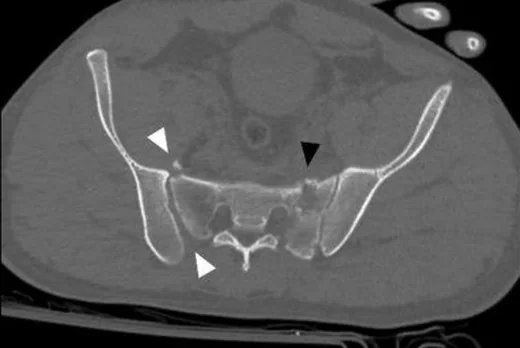
Dikey makaslama yaralanması, posterior sakroiliak bağlantı bozulması ve hemipelvisin dikey yer değiştirmesiyle karakterizedir. BT, bu vertikal seviye farkını ve kopmanın SI eklemden, sakrumdan ya da iliak kemikten geçtiği yolu çok düzlemli olarak gösterir; ön halka kırığı da aynı yaralanma örüntüsüne eşlik edebilir. Posterior sakroiliak bağlantı bozulmasıyla birlikte dikey yer değiştirme, mekanik olarak instabil bir pelvis yaralanmasını düşündürür. Pelvik travma BT'sinde damar ve mesane/üretra yaralanmaları ile büyük yumuşak doku kanaması; sakral kırıklarda ise nörolojik durum ve olası kauda ekuina veya pleksus komplikasyonları açısından incelenmelidir.
Faz ve pencere
- Kontrastsız tanısal
- BT, pelvik halka kırıklarını saptama ve karakterize etmede yüksek duyarlılık ve özgüllük sağlar; pelvik travmada aktif kanama ve eşlik eden yaralanmaların değerlendirilmesine de katkıda bulunur. BT, sakral kırıkların tanı ve karakterizasyonunda standart incelemedir; sakral kırıkların kanal ve sinir yapılarıyla ilişkili komplikasyonları ayrıca değerlendirilmelidir.
- Portal tanısal
- İntravenöz kontrastlı travma taramasında posterior kopma çevresindeki presakral ve retroperitoneal hematom ile mesane, bağırsak ve diğer pelvik organların eşlik eden yaralanması değerlendirilir.
- Arteriyel tanısal
- Arteriyel yaralanma şüphesinde hematom içindeki damar yoğunluğuna yakın kontrast odağı, damar kontur bozukluğu veya psödoanevrizma aranır; bu faz kemik yer değiştirmesini sınıflamak için gerekli değildir.
Önerilen pencereler G genişlik, M merkez; değerler Hounsfield birimi (HU)
- KemikG 1800 / M +400
- Yumuşak dokuG 400 / M +40
- AnjiyoG 600 / M +150
BT bulguları
- Kraniyal hemipelvis yer değiştirmesi — iliak kret ve asetabular çatı seviyelerinin karşı tarafa göre yukarı basamaklanması koronal planda izlenir.
- Sakroiliak eklem kopması — eklem yüzlerinde açılma veya basamaklanmaya, iliak kemiğin sakruma göre kraniyal translasyonu eşlik edebilir.
- Vertikal sakral kırık — kırık örüntüsünün nörolojik yaralanma ve spinopelvik stabilite açısından önemi nedeniyle değerlendirmede bu ilişkiler belirtilir.
- Posterior iliak kırık — iliak kanat kırığı sakroiliak ekleme uzanarak posterior sakroiliak kırık-çıkığı oluşturabilir.
- Ön halka eşlikçisi — dikey makaslama yaralanması olgu bildiriminde aynı ve karşı tarafta pubik ramus kırıkları tanımlanmıştır.
- Asimetrik pelvik konturlar — pelvik asimetri ve dikey yer değiştirme, pelvik deformiteyi destekleyen bulgulardır.
- Presakral kanama — sakrum önündeki ekstraperitoneal hematom yumuşak doku penceresinde kopma hattına komşu izlenir.
- Damar kaynaklı kontrast odağı — hematom içinde damar dışına taşan kontrast ya da psödoanevrizma arteriyel değerlendirmede gösterilebilir.
Ölçütler ve sınıflamalar
- Young–Burgess dikey makaslama
- Dikey makaslama yaralanmaları posterior sakroiliak bozulma ve dikey yer değiştirmeyle karakterizedir; ön halka yaralanması da eşlik edebilir. Dikey makaslama yaralanması, posterior sakroiliak bozulma ve dikey yer değiştirmeyle karakterizedir.
- Tile
- Tip A mekanik olarak stabil; tip B rotasyonel instabil ama vertikal stabil; tip C hem rotasyonel hem vertikal instabildir. Tile sınıflamasında tip C yaralanmalar tamamen instabildir; bir olgu bildiriminde dikey makaslama yaralanması Tile C1 olarak sınıflandırılmıştır.
- AO/OTA 2018 pelvis halka sınıflaması
- Tile sınıflamasında posterior arkın tam kesildiği, vertikal ve rotasyonel instabil yaralanmalar tip C olarak sınıflandırılır. AO/OTA, pelvik halka yaralanmaları için kapsamlı bir sınıflamadır.
Normalde
Pelvik simetriyi değerlendirirken iliak ve asetabular seviyeleri karşılaştırın; pelvik halka yaralanmalarında dikey yer değiştirme ve pelvik asimetri görülebilir. Pelvik halka BT'sinde kırık ve yer değiştirme bulgularını değerlendirip yaralanmayı sınıflandırın.
Normal BT ile kıyasla
Aynı bölgenin, kaynak veri setinde patoloji içermediği belirtilen bir BT incelemesini kesit kesit kaydırın; organ sınırlarını açarak anatomiyi hasta görüntüsüyle karşılaştırın. Küçük rastlantısal bulgular tümüyle dışlanmamıştır.
Kaynak: TotalSegmentator v2.01 veri seti (Wasserthal ve ark., Radiology: Artificial Intelligence 2023), CC BY 4.0, vaka s1256; organ sınırları veri setinin otomatik segmentasyonundan, birleştirilerek sadeleştirildi. Görüntüler 2,5 mm kesit aralığına yeniden örneklendi.
Ayırıcı tanı
- APC-III ile ayırıcı tanıda, dikey makaslama lehine posterior sakroiliak bozulma ve dikey yer değiştirme aranır.
- LC yaralanması
- sakral ala kompresyonu ve hemipelvisin iç rotasyonu öne çıkar; yukarı translasyon tipik deformasyon değildir.
- Pelvik pozisyon asimetrisi
- ölçümlerde pozisyon veya projeksiyon farklılıkları küçük değişikliklere yol açabilir.
- Sakral yetersizlik kırığı
- sakral kırık örüntüleri nörolojik yaralanma ve spinopelvik stabilite açısından değerlendirilmelidir.
Tuzaklar
- Pelvis çıkış görüntüsünde dikey deplasmanı değerlendirin; BT, pelvik halka kırıklarını saptama ve karakterize etmede yüksek duyarlılık ve özgüllük sağlar.
- Dikey makaslama yaralanmasında posterior sakroiliak bozulma ile dikey yer değiştirmeyi birlikte arayın.
- Sakral kırıkların sınıflandırılması nörolojik yaralanma ve spinopelvik stabilite açısından önemlidir; muayene edilemeyen hastada BT, sinir basısı veya traksiyon yaralanması için dolaylı bir belirteç sağlayabilir.
- Pelvik halka yaralanmasının anatomik örüntüsü ile damar yaralanmasının şiddetini ayrı değerlendirin; BT'de hematomla birlikte kontrast birikmesi ağır damar yaralanması bulgusu olarak tanımlanmıştır.
Kendini dene
BT'de posterior sakroiliak bağlantı bozulması ve dikey hemipelvis yer değiştirmesi saptanmıştır. En uygun yaralanma örüntüsü hangisidir?
Cevabı göster
Dikey makaslama. Posterior sakroiliak bağlantı bozulması ve dikey yer değiştirme, dikey makaslama yaralanmasının tanımlayıcı özellikleridir.
BT'de posterior SI taşıyıcı bağlantısı kopmuş ve hemipelvis vertikal olarak instabildir. Tile sınıflamasında bu mekanik grup hangisidir?
Cevabı göster
Tile C. Tile C, vertikal instabilitenin bulunduğu bu yaralanma örüntüsünü tamamen instabil grupta sınıflandırır. Tile A stabil, Tile B rotasyonel instabil ve Tile C tamamen instabil yaralanma grubudur. Young–Burgess yaralanma mekanizmasına, Tile ise pelvik halka stabilitesine göre sınıflandırır.
İlgili konular
- Pelvik halka kırıkları
- Ön-arka kompresyon (açık kitap) yaralanması
- Kombine mekanizmalı pelvik yaralanma
Kaynaklar
Bu sayfadaki 48 cümle ve 2 quiz sorusu aşağıdaki kaynaklardan alıntılarla otomatik olarak karşılaştırıldı; 33 cümle bu karşılaştırmada düzeltildi (2026-10-09).
- Atypical Pelvic Crescent Fracture Caused by Vertical Shear Forcepmc.ncbi.nlm.nih.gov
- A rare traumatic triad: Open bicondylar non-conjoint Hoffa fracture with partial tibial tubercle and medial epicondyle avulsions – A case report and biomechanical analysispmc.ncbi.nlm.nih.gov
- Quantitatively Extreme Sagittal Orientation of the L5-S1 Facet Joints in Adolescent Dysplastic Spondylolisthesis: A Case Report and Mechanistic Considerationspmc.ncbi.nlm.nih.gov
- W-shaped double plating for symphyseal diastasis in vertical shear pelvic ring injury: 12-month radiographic stability — a case reportpmc.ncbi.nlm.nih.gov
- Hip position may be associated with susceptibility to Rommens type IIIa fragility fractures of the pelvis during lateral falls: a quantitative computed tomography-based finite element analysispmc.ncbi.nlm.nih.gov
- The incidence and the risk factors of venous thromboembolism in Korean patients with pelvic or acetabular fractures.pubmed.ncbi.nlm.nih.gov
- Anterior subcutaneous internal fixation for a complex vertical shear pelvic fracture with Morel-Lavallée lesion: a case report.pubmed.ncbi.nlm.nih.gov
- [Radiological diagnosis of pelvic ring fractures].pubmed.ncbi.nlm.nih.gov
- Biomechanical comparison of five cannulated screw fixation strategies for young vertical femoral neck fractures.pubmed.ncbi.nlm.nih.gov
- Pelvic injury prognosis is more closely related to vascular injury severity than anatomical fracture complexity: the WSES classification for pelvic trauma makes sense.pubmed.ncbi.nlm.nih.gov
- An international survey of pelvic trauma surgeons on the management of pelvic ring injuries.pubmed.ncbi.nlm.nih.gov
- Assessment of osseous corridor for transiliac-transsacral screws and clinical applications: Computational simulation study.pubmed.ncbi.nlm.nih.gov
- Incidence rate and topography of intra-pelvic arterial lesions associated with high-energy blunt pelvic ring injuries: a retrospective cohort study.pubmed.ncbi.nlm.nih.gov
- Biomechanical analysis of stiffness and fracture displacement after using PMMA-augmented sacroiliac screw fixation for sacrum fractures.pubmed.ncbi.nlm.nih.gov
- Coronal plane partial articular fractures of the distal femoral condyle: current concepts in management.pubmed.ncbi.nlm.nih.gov
- Influence of energy absorbers on Malgaigne fracture mechanism in lumbar-pelvic system under vertical impact load.pubmed.ncbi.nlm.nih.gov
- INFIX-safe and effective surgical option for complex fracture patterns of the anterior pelvic ring: A prospective single center study.pubmed.ncbi.nlm.nih.gov
- Intraoperative computed tomography with integrated navigation in percutaneous iliosacral screwing.pubmed.ncbi.nlm.nih.gov
- Temporal corridors of forces and moments, and injuries to pelvis-lumbar spine in vertical impact simulating underbody blast.pubmed.ncbi.nlm.nih.gov
- CT incidence of Morel-Lavallee lesions in patients with pelvic fractures: a 4-year experience at a level 1 trauma center.pubmed.ncbi.nlm.nih.gov
- Exploratory Biomechanical Comparison of Three Posterior Pelvic Ring Fixation Strategies in a Standardized Tile C1.2 Synthetic Model.pubmed.ncbi.nlm.nih.gov
- Knowledge gaps in high-energy sacral fracture treatment and management.pubmed.ncbi.nlm.nih.gov
- Development of a pelvic musculoskeletal model based on statistical shape modelling for estimating sacroiliac and pubic joint reaction forces in females.pubmed.ncbi.nlm.nih.gov
- Risser growth plate injury in unstable paediatric pelvic fractures: a multicentre retrospective study.pubmed.ncbi.nlm.nih.gov
- Staged management of a Tile C3 pelvic ring injury with bilateral sacroiliac disruption and T-shaped sacral fracture.pubmed.ncbi.nlm.nih.gov
- Biomechanical Comparison of Three Fixation Constructs for Tile Type C1.2 Pelvic Ring Fractures: A Finite Element Analysis.pubmed.ncbi.nlm.nih.gov
- Minimally invasive circumferential fixation using TIFI and INFIX for unstable pelvic ring injuries: a prospective evaluation of clinical and radiological outcomes.pubmed.ncbi.nlm.nih.gov
- Denis pattern-dependent biomechanical behavior of posterior trans-iliac plate fixation compared with bilateral triangular osteosynthesis in unilateral sacral fractures: a finite element study.pubmed.ncbi.nlm.nih.gov
- Finite element analysis of sacral fixation strategies for fragility fractures of the pelvis.pubmed.ncbi.nlm.nih.gov
- Long-term safety and effectiveness of the "OptEase" vena cava filter.pubmed.ncbi.nlm.nih.gov
- Traumatic lumbosacral instability: part 2-indications and techniques for surgical management.pubmed.ncbi.nlm.nih.gov
- A novel three-dimensional evaluation protocol to assess the consistency of critical screw angles between preoperative planning and 3d-printed patient-specific acetabular revision prostheses.pubmed.ncbi.nlm.nih.gov
- CT of Sacral Fractures: Classification Systems and Management.pubmed.ncbi.nlm.nih.gov
- Computed tomography of pediatric abdominal trauma: optimizing utilization and enhancing diagnostic interpretation.pubmed.ncbi.nlm.nih.gov
- Damage Control Surgery in Obstetrics and Gynecology: Abdomino-Pelvic Packing in Multimodal Hemorrhage Management.pubmed.ncbi.nlm.nih.gov
- Firearm injury to the left buttock with uterus penetrating trauma.pubmed.ncbi.nlm.nih.gov
- Combined Post-traumatic Pseudoaneurysms of the Superior Gluteal and Aberrant Obturator Arteries: A Case Report.pubmed.ncbi.nlm.nih.gov
- Collateral-pathway-oriented clinico-angiographic framework for inferior epigastric artery-related hemorrhage: embolization planning and clinical outcomes.pubmed.ncbi.nlm.nih.gov
- Transarterial embolization in musculoskeletal care: an indication-stratified narrative review.pubmed.ncbi.nlm.nih.gov
- Anterior Sacroiliac Fracture Dislocation: A Comparative Radiologic analysis of Crescent Fractures in Pelvic Ring Injuries: A Retrospective Study.pubmed.ncbi.nlm.nih.gov
- Effect of coronal plane acetabular correction on joint contact pressure in Periacetabular osteotomy: a finite-element analysis.pubmed.ncbi.nlm.nih.gov
- The myth of 2.5 cm symphyseal diastasis.pubmed.ncbi.nlm.nih.gov
- Atypical APC-1 pelvic fracture presenting with pelvic instability: successful management with pubic symphysis fusion.pubmed.ncbi.nlm.nih.gov
- The Method of Portal Making in Lumbar Unilateral Biportal Endoscopic Surgery with Different Operative Approaches According to the Constant Anatomical Landmarks of the Lumbar Spine: A Review of the Literature.pubmed.ncbi.nlm.nih.gov
- Surgical Management of a Lateral Compression (LC)III Pelvic Ring Fracture With Type I Crescent Fracture-Dislocation: A Case Report.pubmed.ncbi.nlm.nih.gov
- W-shaped double plating for symphyseal diastasis in vertical shear pelvic ring injury: 12-month radiographic stability - a case report.pubmed.ncbi.nlm.nih.gov
- Clinical Outcomes of Straddle Fracture Patterns: A Retrospective Multicenter Analysis Based on a New Descriptive Classification Framework.pubmed.ncbi.nlm.nih.gov
- Imaging Review of Pelvic Ring Fractures and Its Complications in High-Energy Trauma.pubmed.ncbi.nlm.nih.gov
- A Case Report of a Vertical Zone III Sacral Fracture Due to Acute Lower Extremity Hyperabduction While Windsurfing.pubmed.ncbi.nlm.nih.gov
- The Interface of Trauma Surgery and Interventional Radiology: The Trauma Surgeon's Perspective.pubmed.ncbi.nlm.nih.gov
- Comprehensive Management of Different Types of Pelvic Fractures Through Multiple Disciplines: A Case Series.pubmed.ncbi.nlm.nih.gov
- Biomechanical and clinical analysis of pelvic stability and the role of internal fixation after debridement for sacroiliac joint tuberculosis with different degrees of bone destruction.pubmed.ncbi.nlm.nih.gov
- Congenital and Breed-Associated Vertebral Anomalies in Dogs and Cats: Developmental Anatomy, Genetic Determinants, and Biological Significance.pubmed.ncbi.nlm.nih.gov
- The Role of MRI in Groin Pain Syndrome in Athletes.pubmed.ncbi.nlm.nih.gov
- Special screw corridors and imaging in pelvic ring trauma.pubmed.ncbi.nlm.nih.gov
- Use of calcaneal plates in the treatment of posterior pelvic ring injuries and displaced iliac blade fractures- A case series.pubmed.ncbi.nlm.nih.gov
- A Primer on Anatomy, Biophysics, Pathology, Imaging and Treatment of the Intervertebral Disc and the Anterior Spinal Column: The Discogenic, Intervertebral, Spinal Column (DISC) ASPN Workgroup.pubmed.ncbi.nlm.nih.gov
- Magnetic resonance imaging (MRI) vs. computed tomography (CT) in the diagnosis and classification of spondylolysis and spondylolisthesis-a narrative review.pubmed.ncbi.nlm.nih.gov
- Osteoarthritis: Epidemiology, Diagnosis, and Treatment.pubmed.ncbi.nlm.nih.gov
- Minimally invasive percutaneous cannulated screw fixation for pelvic fractures: a retrospective case cohort study of clinical and radiological outcomes.pubmed.ncbi.nlm.nih.gov
- Isolated Unilateral Posterior Sacroiliac Dislocation With an Intact Anterior Pelvic Ring: Case Report of an Unusual Injury Pattern.pubmed.ncbi.nlm.nih.gov
- Functional and Radiological Outcome of Anterior Plate Stabilisation of the Sacroiliac Joint in Unstable Pelvic Injury.pubmed.ncbi.nlm.nih.gov
- Sacroiliac Joint Anatomical Variants and Their Association with Spinopelvic Alignment: A Whole-Spine CT Study.pubmed.ncbi.nlm.nih.gov
- Fatal Injuries Caused by Falling Trees: Correlation Between Postmortem Computed Tomography and Forensic Autopsy Findings in Eight Cases.pubmed.ncbi.nlm.nih.gov
- Sacroiliac Joint Ankylosis in Pelvic Ring Injuries with Posterior Ilium Fractures.pubmed.ncbi.nlm.nih.gov
- Lateral rectus abdominis approach fixation of a high-energy both-column acetabular fracture after total hip arthroplasty with retention of a stable acetabular cup: a case report.pubmed.ncbi.nlm.nih.gov
- Traumatic Bilateral Asymmetrical Hip Dislocation with Acetabular Fracture: A Case Report and Review of Current Evidence.pubmed.ncbi.nlm.nih.gov
- Case Report: Direct anterior approach with surgical hip dislocation for management of juvenile femoral head chondroblastoma: a case series and systematic review of the literature.pubmed.ncbi.nlm.nih.gov
- High-affinity alphavbeta3 integrin targeted optical probe as a new imaging biomarker for early atherosclerosis: initial studies in Watanabe rabbits.pubmed.ncbi.nlm.nih.gov
- Total laparoscopic radical hysterectomy for cervical cancer in prolapsed uterus.pubmed.ncbi.nlm.nih.gov
- Dural tears from traumatic spinal fractures: an illustrative case and systematic review of its incidence, diagnosis, risk factors, and management.pubmed.ncbi.nlm.nih.gov
- Transverse Process Fractures in Athletes: Mechanisms, Management and Return-to-Play Considerations.pubmed.ncbi.nlm.nih.gov
- Orthopedic preoperative evaluation and surgical strategies of hereditary multiple osteochondromas involving the spinal region.pubmed.ncbi.nlm.nih.gov
- Evolution of the reduction technique for unstable pelvic ring fractures: a narrative review.pubmed.ncbi.nlm.nih.gov
- Spinal manifestations of Paget's disease: Case presentation and systematic review.pubmed.ncbi.nlm.nih.gov
- Spectrum of neuropathic skeletal injuries in children: a pictorial essay.pubmed.ncbi.nlm.nih.gov
- Intrapelvic Cup Migration Following Revision Total Hip Arthroplasty: A Case Report and Review of the Literature.pubmed.ncbi.nlm.nih.gov
- PI-RADS Prostate Imaging - Reporting and Data System: 2015, Version 2.pubmed.ncbi.nlm.nih.gov
- Patterns of injury and violence in Yaoundé Cameroon: an analysis of hospital data.pubmed.ncbi.nlm.nih.gov
- Digital measurement and safety parameter analysis of the infra-acetabular screw pathway.pubmed.ncbi.nlm.nih.gov
- Impact of pubic cut position on pubic root displacement in periacetabular osteotomy : a 3D CT simulation study.pubmed.ncbi.nlm.nih.gov
- Biomechanical Comparisons of Two Types of Tuina in Treating Lumbar Disc Herniation: A Finite Element Analysis.pubmed.ncbi.nlm.nih.gov
- Autologous osteoperiosteal graft shows superior outcomes to bone graft in shelf acetabuloplasty for acetabular dysplasia : a rabbit model study.pubmed.ncbi.nlm.nih.gov
- Rabbits as preclinical animal models of cam morphology: proof of concept.pubmed.ncbi.nlm.nih.gov
- Clinical efficacy and biomechanical analysis of 3D-printed guide plate-assisted cannulated screw fixation compared with conventional fixation in complex acetabular fractures.pubmed.ncbi.nlm.nih.gov
- Historical Perspectives on the Evolution of Spino-Pelvic Fixation and its Implications on Clinical Care A Narrative Review.pubmed.ncbi.nlm.nih.gov
- Safe definitive surgery in unstable pelvic ring injuries - a retrospective cohort study.pubmed.ncbi.nlm.nih.gov
- Hip position may be associated with susceptibility to Rommens type IIIa fragility fractures of the pelvis during lateral falls: a quantitative computed tomography-based finite element analysis.pubmed.ncbi.nlm.nih.gov
- Quantitatively Extreme Sagittal Orientation of the L5-S1 Facet Joints in Adolescent Dysplastic Spondylolisthesis: A Case Report and Mechanistic Considerations.pubmed.ncbi.nlm.nih.gov
- The Effect of Head-Forward Posture on Lower Neck Loads and Dislocation Risk in Head-First Impact: A Computational and Experimental Investigation.pubmed.ncbi.nlm.nih.gov
- Emergency radiology of severe acute injury in extreme alpine summer sports: a pictorial essay.pubmed.ncbi.nlm.nih.gov
- Pathogenic mechanisms of adult degenerative scoliosis.pubmed.ncbi.nlm.nih.gov
- Point-of-Care Ultrasound in Blunt Chest Trauma: Diagnostic Performance and Clinical Relevance.pubmed.ncbi.nlm.nih.gov
- Special Issue: EACR 2026 Congress: Innovative Cancer Science, 8-11 June 2026.pubmed.ncbi.nlm.nih.gov
- Effect of Early Pelvic Binder Use in the Emergency Management of Suspected Pelvic Trauma: A Retrospective Cohort Study.pubmed.ncbi.nlm.nih.gov
- Sacral and Pelvic Fractures: Historical Systems and Advancements with the AO Spine Classification.pubmed.ncbi.nlm.nih.gov
- Matched pair analysis of the accuracy and outcome of navigated screw fixation of the posterior pelvic ring.pubmed.ncbi.nlm.nih.gov
- Age and fixation strategy as associated factors for sacroiliac joint dysfunction after posterior pelvic ring fixation.pubmed.ncbi.nlm.nih.gov
- Minimally invasive stabilisation of anterior pelvic ring injuries through anterior infix versus percutaneous anterior retrograde pubic screw: a prospective comparative cohort study.pubmed.ncbi.nlm.nih.gov
- Surgical Management of a Malunited Vertically Displaced Sacral Fracture: A Case Report.pubmed.ncbi.nlm.nih.gov
- Staged management of a compound combined pelvi-acetabular injury with perineal degloving in a young female: a case report and literature review.pubmed.ncbi.nlm.nih.gov
- A novel internal fixation system for sacral fractures: a finite element biomechanical study.pubmed.ncbi.nlm.nih.gov
- Fragility Fractures of the Pelvis-Current Understanding and Open Questions.pubmed.ncbi.nlm.nih.gov
- Commentary: an eye on PET quantification.pubmed.ncbi.nlm.nih.gov
- Functional status and health-related quality of life following Young and Burgess classified pelvic ring injuries.pubmed.ncbi.nlm.nih.gov
- Machine Learning-based Radiomic Model for Early Diagnosis of Male Urethral Injury in Pelvic Fracture Patients.pubmed.ncbi.nlm.nih.gov
- Percutaneous pelvic ring fracture reduction using an external fixator: a technical trick and case series.pubmed.ncbi.nlm.nih.gov
- WFC'S 13th Biennial Congress Proceedings Athens, Greece, 10-13, 2013: Abstracts of the Scientific Sessions.pubmed.ncbi.nlm.nih.gov
- Porous Ti-6Al-4V Architectures in Load-Bearing Orthopedic Reconstruction: A Critical Narrative Review of the Translational Gap Across Microstructure, Fatigue, Surface Function, and Clinical Failure Modes.pubmed.ncbi.nlm.nih.gov
- The relation between surgical approaches for pelvic ring and acetabular fractures and postoperative complications: a systematic review.pubmed.ncbi.nlm.nih.gov
- Additively manufactured metallic biomaterials.pubmed.ncbi.nlm.nih.gov
- Occult bladder injury in low displacement anterior-posterior compression pelvic fractures type I: a retrospective analysis of incidence and predictors.pubmed.ncbi.nlm.nih.gov
- Open Book on the Water Slide: A Case Series of APC2 Pelvic Ring Injuries from High-Energy Aquatic Accidents.pubmed.ncbi.nlm.nih.gov
- Contemporary clinical perspectives on chronic low back pain: The biology, mechanics, etc. underpinning clinical and radiological evaluation.pubmed.ncbi.nlm.nih.gov
- Emergency treatment of pelvic ring injuries: state of the art.pubmed.ncbi.nlm.nih.gov
Eğitim amaçlıdır; hasta başında tanı ve tedavi kararının yerine geçmez, tıbbi tavsiye değildir. Metinler yapay zekâ desteğiyle yazıldı ve otomatik bir adımda kaynak alıntılarıyla karşılaştırıldı; bu bir tıbbi doğrulama değildir ve içerik uzman radyolog incelemesinden geçmedi. Klinik kararlarda güncel kılavuzları, kurum protokollerini ve radyoloji raporunu esas alın.