Özet
Yüksek enerjili pelvik halka yaralanmalarında aynı olguda birden fazla kuvvet vektörü ve farklı yönlü deformasyonlar bulunabilir. Young–Burgess sınıflaması APC, LC, vertikal shear ve kombine mekanizma (CM) kategorilerini içerir. BT, ön ve arka halka kırıklarını ve yer değiştirme yönlerini multiplanar rekonstrüksiyonlarda göstererek örüntünün haritalanmasına katkı sağlar. Young–Burgess sınıflaması kombine mekanizma (CM) kategorisini içerir; bu kategori LC-I–III alt tiplerinden ayrı olarak adlandırılır. Arka halka yaralanması, aktif kanama ve eşlik eden organ yaralanmaları ayrı değerlendirilmezse BT’de yaralanma kapsamı eksik kalabilir.
Okuma sırası
- Ön halka ve pubik ramuslar. Pelvik BT’de halka kırıklarını sistematik biçimde değerlendirin; BT bu kırıkları hızlı ve doğru biçimde saptayabilir.
- İpsilateral sakral ala, posterior iliak kanat ve SI eklemi. Ramus bulgusuna eşlik edebilecek posterior halka yaralanmasını BT’de dikkatle arayın; pelvis halka biçimli olduğundan izole ramus kırıkları posterior halka bozulması açısından değerlendirilmelidir.
- İpsilateral posterior halka ve karşı SI eklemi. Posterior halka yaralanmasının derecesini değerlendirerek LC alt tipini belirleyin; LC kırıkları I–III olarak bu ölçüte göre sınıflandırılır.
- Hemipelvis yüksekliği ve pelvik yumuşak dokular. Kemik halkayı okuduktan sonra kontrast ekstravazasyonu ve diğer sistemlerdeki yaralanmalar için tüm taramayı yeniden gözden geçirin.
Faz ve pencere
- Kontrastsız tanısal
- Pelvik BT, halka kırıklarını hızlı ve doğru biçimde gösterebilir.
- Arteriyel tanısal
- Kontrastlı BT’de aktif ekstravazasyon veya psödoanevrizma gibi damar yaralanması bulguları aranır; Young–Burgess sınıflaması mekanizma ve kırık stabilitesini birlikte ele alır.
- Portal venöz tanısal
- Pelvik travma BT’sinde halka kırıkları, aktif kanama ve diğer vücut sistemlerindeki yaralanmalar değerlendirilebilir.
- Kemik algoritması tanısal
- Pelvik BT, halka kırıklarını ve eşlik eden yaralanmaları göstermeye katkı sağlar.
Önerilen pencereler G genişlik, M merkez; değerler Hounsfield birimi (HU)
- KemikG 1800 / M +400
- Yumuşak dokuG 400 / M +40
- AnjiyoG 600 / M +150
BT bulguları
- Birden fazla kuvvet yönü — Young–Burgess sınıflaması APC, LC, vertikal shear ve kombine mekanizma (CM) kategorilerini içerir.
- LC bileşeni — pubik ramus kırıklarıyla aynı tarafta sakral ala impaksiyonu veya posterior iliak crescent (hilal) kırığı LC paternini destekler.
- APC yaralanmalarında pubik diastazla birlikte SI eklem genişlemesi bulunabilir.
- Düz grafide izole pubik ramus kırığı varsa posterior pelvik halka BT ile dikkatle değerlendirilmelidir.
- Vertikal shear yaralanmasında kraniyal hemipelvis göçü ve posterior halka yaralanması birlikte görülebilir.
- Ön halka örüntüsünde pubik ramus kırıkları tanımlanır; düz grafide izole görüldüklerinde posterior halka BT ile dikkatle değerlendirilir.
- Pelvik halka kırıklarında arteriyel ve venöz kanamalar görülebilir; hematomun yeri anatomik konumuyla tarif edilir.
- Pelvik travma BT’sinde aktif kanama ve diğer sistem yaralanmaları değerlendirilir; kontrast ekstravazasyonu veya psödoanevrizma damar yaralanması bulguları arasındadır.
- Young–Burgess sınıflamasında LC-III, LC alt tiplerinden biridir; LC kırıkları posterior halka bozulmasının derecesine göre I–III olarak sınıflandırılır.
Ölçütler ve sınıflamalar
- Young–Burgess pelvis kırığı sınıflaması: kombine mekanizma (CM)
- Young–Burgess sınıflaması APC, LC, vertikal shear ve kombine mekanizma (CM) örüntülerini tanımlar. Young–Burgess sınıflamasında LC kırıkları I–III alt tiplerine ayrılır; bu alt tipler posterior halka hasarının derecesine göre belirlenir. LC-III, LC alt tiplerinden biridir; kombine mekanizma (CM) ise Young–Burgess sınıflamasında ayrı bir kategoridir.
- WSES pelvik travma sınıflaması
- WSES pelvik travma sınıflaması Young–Burgess mekanik örüntülerini hemodinamik durumla birlikte ele alır. WSES pelvik travma yaklaşımında sınıflama ve yönetim, hemodinamik durum ile pelvik halka işlevindeki anatomik bozulmayı ve eşlik eden yaralanmaları birlikte dikkate alır.
Normalde
Pelvik BT’de pelvik halka kırıkları değerlendirilebilir.
Normal BT ile kıyasla
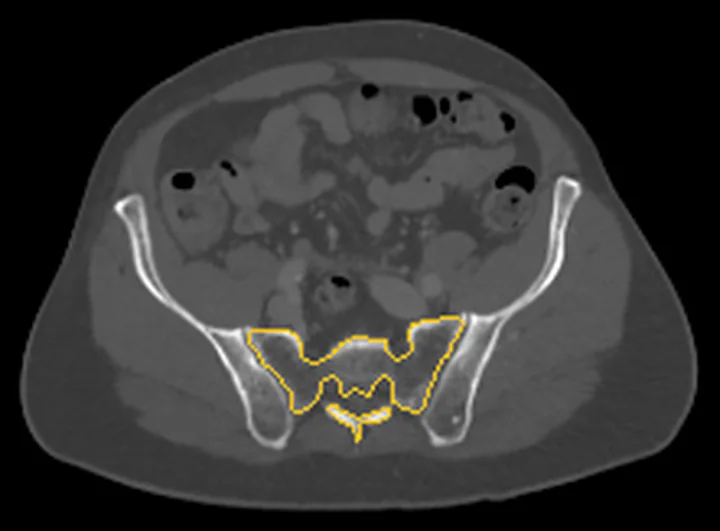
Aynı bölgenin, kaynak veri setinde patoloji içermediği belirtilen bir BT incelemesini kesit kesit kaydırın; organ sınırlarını açarak anatomiyi hasta görüntüsüyle karşılaştırın. Küçük rastlantısal bulgular tümüyle dışlanmamıştır.
Kaynak: TotalSegmentator v2.01 veri seti (Wasserthal ve ark., Radiology: Artificial Intelligence 2023), CC BY 4.0, vaka s1256; organ sınırları veri setinin otomatik segmentasyonundan, birleştirilerek sadeleştirildi. Görüntüler 2,5 mm kesit aralığına yeniden örneklendi.
Ayırıcı tanı
- LC-III
- LC kırıklarının posterior halka hasarı derecesine göre tanımlanan alt tiplerinden biridir.
- Young–Burgess sınıflamasında vertikal shear ayrı bir mekanizma kategorisidir; vertikal instabilite içeren karmaşık pelvik yaralanmalarda kraniyal hemipelvis göçü ve posterior halka yaralanması birlikte görülebilir.
- APC-III, anteroposterior kompresyon tip III pelvik halka yaralanmasıdır.
- LC-II
- LC kırıkları, posterior halka hasarının derecesine göre I–III alt tiplerine ayrılır.
- Çok odaklı ama tek vektörlü halka kırığı
- Young–Burgess CM tanımı birden fazla temel kuvvet vektörünün özelliklerini gerektirir; yalnız kırık sayısı CM demek için yeterli değildir.
Tuzaklar
- Pelvik travma BT’si halka kırıklarını, aktif kanamayı ve diğer vücut sistemlerindeki yaralanmaları saptamaya katkı sağlar.
- LC kırıkları posterior halka bozulmasının derecesine göre I–III olarak alt sınıflara ayrılır; kombine mekanizma Young–Burgess sınıflamasında ayrı bir kategoridir.
- Young–Burgess sınıflaması mekanizma temelli olduğundan, pelvik halka yaralanmasını yalnız kırık sayısına göre sınıflandırmayın.
- Travma BT’sinde standart portal venöz faz kullanılabilir veya split-bolus protokolü arteriyel ve venöz faz değerlendirmesini tek edinimde birleştirebilir.
Kendini dene
Young–Burgess sınıflamasında lateral kompresyon (LC) kırıkları I–III alt tiplerine hangi ölçüte göre ayrılır?
Cevabı göster
Posterior halka yaralanmasının derecesi. LC kırıkları I–III alt tiplerine posterior halka yaralanmasının derecesine göre ayrılır.
Düz grafide izole pubik ramus kırığı görüldüğünde posterior pelvik halka için hangi inceleme önerilir?
Cevabı göster
BT. Pelvis halka biçimli olduğundan, düz grafide izole pubik ramus kırığı olağandışıdır; posterior pelvik halka BT ile dikkatle değerlendirilmelidir.
İlgili konular
- Pelvik halka kırıkları
- Ön-arka kompresyon (açık kitap) yaralanması
- Lateral kompresyon yaralanması
- Dikey makaslama yaralanması
Kaynaklar
Bu sayfadaki 44 cümle ve 2 quiz sorusu aşağıdaki kaynaklardan alıntılarla otomatik olarak karşılaştırıldı; 29 cümle bu karşılaştırmada düzeltildi (2026-10-09).
- Two Cases of Bilateral Ureteral Metastases From Prostate Cancer Initially Presenting With Postrenal Acute Kidney Injurypmc.ncbi.nlm.nih.gov
- Laparoscopic ureteral anastomosis to a bladder diverticulum for the treatment of postoperative ureteral fistula: a case reportpmc.ncbi.nlm.nih.gov
- Hip position may be associated with susceptibility to Rommens type IIIa fragility fractures of the pelvis during lateral falls: a quantitative computed tomography-based finite element analysispmc.ncbi.nlm.nih.gov
- Emergency radiology of severe acute injury in extreme alpine summer sports: a pictorial essaypmc.ncbi.nlm.nih.gov
- Morphology-Guided Surgical Management of Complex Traumatic Hip Fracture-Dislocations and Acetabular Fractures: A Six-Case Series Illustrating Morphology-Based Surgical Approachespmc.ncbi.nlm.nih.gov
- Association between Young-Burgess pelvic ring injury classification and concomitant injuries requiring urgent intervention.pubmed.ncbi.nlm.nih.gov
- Rethinking LC-type in Young-Burgess classification of pelvic fracture: A retrospective study.pubmed.ncbi.nlm.nih.gov
- Incidence rate and topography of intra-pelvic arterial lesions associated with high-energy blunt pelvic ring injuries: a retrospective cohort study.pubmed.ncbi.nlm.nih.gov
- Isolated Unilateral Posterior Sacroiliac Dislocation With an Intact Anterior Pelvic Ring: Case Report of an Unusual Injury Pattern.pubmed.ncbi.nlm.nih.gov
- Robot-assisted closed reduction and navigated fixation for pelvic ring injuries: a focused narrative review of a reduction-fixation-audit framework.pubmed.ncbi.nlm.nih.gov
- Knowledge gaps in high-energy sacral fracture treatment and management.pubmed.ncbi.nlm.nih.gov
- Clinico-demographical Profile of Pelvis and Acetabular Fracture Presenting in Tertiary Care Center of Nepal: An Observational Study.pubmed.ncbi.nlm.nih.gov
- Transcatheter Arterial Embolization for Hemorrhagic Pelvic Fracture: Review Article.pubmed.ncbi.nlm.nih.gov
- Immediate management of a stable patient with unstable pelvis.pubmed.ncbi.nlm.nih.gov
- Surgical Management of a Lateral Compression (LC)III Pelvic Ring Fracture With Type I Crescent Fracture-Dislocation: A Case Report.pubmed.ncbi.nlm.nih.gov
- Morphology-Guided Surgical Management of Complex Traumatic Hip Fracture-Dislocations and Acetabular Fractures: A Six-Case Series Illustrating Morphology-Based Surgical Approaches.pubmed.ncbi.nlm.nih.gov
- Quantitative three-dimensional fracture mapping reveals subtype-specific morphology of acetabular roof column and wall fractures.pubmed.ncbi.nlm.nih.gov
- Traumatic Uterine Rupture in a Nonpregnant Patient: A Case Report.pubmed.ncbi.nlm.nih.gov
- Staged management of a compound combined pelvi-acetabular injury with perineal degloving in a young female: a case report and literature review.pubmed.ncbi.nlm.nih.gov
- Association of prophylactic transcatheter arterial embolization with perioperative blood loss and operative time in complex acetabular fractures: a propensity score-matched retrospective study.pubmed.ncbi.nlm.nih.gov
- Risser growth plate injury in unstable paediatric pelvic fractures: a multicentre retrospective study.pubmed.ncbi.nlm.nih.gov
- Treatment of unstable pelvic fractures with double INFIX.pubmed.ncbi.nlm.nih.gov
- Occult bladder injury in low displacement anterior-posterior compression pelvic fractures type I: a retrospective analysis of incidence and predictors.pubmed.ncbi.nlm.nih.gov
- Examination under anesthesia in anterior posterior compression pelvic ring injuries; additional assessment of the posterior pelvic ring reveals occult sacroiliac joint instability.pubmed.ncbi.nlm.nih.gov
- Assessment of the posterior pelvic ring during examination under anesthesia changes surgeons' classification and treatment decisions of anterior posterior compression pelvic ring injuries.pubmed.ncbi.nlm.nih.gov
- Rotational Stability in a Feline Sacroiliac Luxation Model: Biomechanical Comparison of Cannulated Compression Headless Screws and Cortical Screws Applied in Positional or Lag Fashion.pubmed.ncbi.nlm.nih.gov
- Imaging Review of Pelvic Ring Fractures and Its Complications in High-Energy Trauma.pubmed.ncbi.nlm.nih.gov
- Combined Post-traumatic Pseudoaneurysms of the Superior Gluteal and Aberrant Obturator Arteries: A Case Report.pubmed.ncbi.nlm.nih.gov
- Collateral-pathway-oriented clinico-angiographic framework for inferior epigastric artery-related hemorrhage: embolization planning and clinical outcomes.pubmed.ncbi.nlm.nih.gov
- Transcatheter arterial embolization for traumatic adrenal hemorrhage with contrast extravasation: case series and literature review.pubmed.ncbi.nlm.nih.gov
- Epidemiology and injury patterns of high-energy pediatric pelvic and acetabular fractures: A retrospective study with comparative outcomes.pubmed.ncbi.nlm.nih.gov
- Safe definitive surgery in unstable pelvic ring injuries - a retrospective cohort study.pubmed.ncbi.nlm.nih.gov
- Minimally invasive circumferential fixation using TIFI and INFIX for unstable pelvic ring injuries: a prospective evaluation of clinical and radiological outcomes.pubmed.ncbi.nlm.nih.gov
- ESR Essentials: trauma team and the role of Interventional Radiology-practice recommendations by the Cardiovascular and Interventional Radiological Society of Europe.pubmed.ncbi.nlm.nih.gov
- Duodenal Trauma: Mechanisms of Injury, Diagnosis, and Management.pubmed.ncbi.nlm.nih.gov
- The Efficacy of the World Society of Emergency Surgery Classification in the Management of Splenic Injury: A Validation Study.pubmed.ncbi.nlm.nih.gov
- Diagnostic Value of the Split-Bolus CT Protocol in Blunt Abdominal Trauma: Comparison With Standard Portal Venous Phase Imaging.pubmed.ncbi.nlm.nih.gov
- Imaging of penetrating vascular trauma of the body and extremities secondary to ballistic and stab wounds.pubmed.ncbi.nlm.nih.gov
- Current Standards for and Clinical Impact of Emergency Radiology in Major Trauma.pubmed.ncbi.nlm.nih.gov
- Clinical Characteristics and In-Hospital Outcomes of Traumatic Bladder Rupture: An 11-Year Retrospective Cohort Study at a Single Regional Trauma Center.pubmed.ncbi.nlm.nih.gov
- Emergency radiology of severe acute injury in extreme alpine summer sports: a pictorial essay.pubmed.ncbi.nlm.nih.gov
- Pelvic ring injuries: Emergency assessment and management.pubmed.ncbi.nlm.nih.gov
- Proceedings of the 15th International Congress on Circumpolar Health.pubmed.ncbi.nlm.nih.gov
- Surgical management of severely displaced IPRF: operative technique, indications, and preliminary clinical outcomes.pubmed.ncbi.nlm.nih.gov
- Pelvic Fractures in Adults and the Importance of Associated Injuries-A Current Multi-Disciplinary Approach.pubmed.ncbi.nlm.nih.gov
- Development of a pelvic musculoskeletal model based on statistical shape modelling for estimating sacroiliac and pubic joint reaction forces in females.pubmed.ncbi.nlm.nih.gov
- Proximal junctional kyphosis and failure risk around the thoracolumbar junction: Impact of anterior malalignment, pelvic retroversion, and upper instrumented level selection.pubmed.ncbi.nlm.nih.gov
- Application and value of CT-based 3D surgical modeling in the robotic management of grade V pancreatic trauma and grade III duodenal injury: a case report and literature review.pubmed.ncbi.nlm.nih.gov
- Global practices and attitudes in acute appendicitis management: the PAMAP-W international survey and Delphi consensus study on the WSES appendicitis grading system.pubmed.ncbi.nlm.nih.gov
- Prognostic Factors of Mortality and Clinical Characteristics of Patients Surgically Treated for Blunt Liver Injury-A Single-Center Experience.pubmed.ncbi.nlm.nih.gov
- Comprehensive Management of Different Types of Pelvic Fractures Through Multiple Disciplines: A Case Series.pubmed.ncbi.nlm.nih.gov
- Analysis of risk factors for death during treatment of hemodynamically unstable pelvic fractures.pubmed.ncbi.nlm.nih.gov
- Irreducible Locked Symphysis Pubis Disruption Caused by Incarcerated Urinary Bladder in a 14-year-Old Boy, a Case Report and Review of the Literature.pubmed.ncbi.nlm.nih.gov
- Comparison of the AO/OTA 1996/2007 and 2018 pelvic ring fracture classifications.pubmed.ncbi.nlm.nih.gov
- Decision-making, therapy, and outcome in lateral compression fractures of the pelvis - analysis of a single center treatment.pubmed.ncbi.nlm.nih.gov
- Reliability of interobserver and intraobserver assessments of the Tile versus Young-Burgess classifications for pelvic ring injuries.pubmed.ncbi.nlm.nih.gov
- Porous Ti-6Al-4V Architectures in Load-Bearing Orthopedic Reconstruction: A Critical Narrative Review of the Translational Gap Across Microstructure, Fatigue, Surface Function, and Clinical Failure Modes.pubmed.ncbi.nlm.nih.gov
- ASSERT (Acute Sacral inSufficiEncy fractuRe augmenTation) randomised controlled, feasibility in older people trial: a study protocol.pubmed.ncbi.nlm.nih.gov
- Radiographic Changes After Pubic Symphysis Plating and Their Clinical Relevance: An Exploratory Longitudinal Cohort Study.pubmed.ncbi.nlm.nih.gov
- Lateral Compression Fragility Fractures of the Pelvis: Diagnosis, Classifications, and Modern Management.pubmed.ncbi.nlm.nih.gov
- Stabilization of Osteoporotic Pelvis and Acetabular Fractures.pubmed.ncbi.nlm.nih.gov
- Glossary of terms for musculoskeletal radiology.pubmed.ncbi.nlm.nih.gov
- Iliosacral Screw Fixation for Treating Sacral Fractures: A Modified Pedicle-Guided Fixation Technique in Prone Position.pubmed.ncbi.nlm.nih.gov
- Staged management of a Tile C3 pelvic ring injury with bilateral sacroiliac disruption and T-shaped sacral fracture.pubmed.ncbi.nlm.nih.gov
- Radiographic and Clinical Adjacent Segment Disease After Posterior Instrumented Fusion for Traumatic Thoracolumbar and Lumbar Vertebral Fractures.pubmed.ncbi.nlm.nih.gov
- Clinical Outcomes of Straddle Fracture Patterns: A Retrospective Multicenter Analysis Based on a New Descriptive Classification Framework.pubmed.ncbi.nlm.nih.gov
- Delayed migration of orthopedic screw into the bladder following pelvic fracture fixation.pubmed.ncbi.nlm.nih.gov
- Polymicrobial infection presenting as non-clostridial gas gangrene in a patient with an open pelvic ring fracture accompanied by abdominal evisceration: a case report.pubmed.ncbi.nlm.nih.gov
- Minimally invasive stabilisation of anterior pelvic ring injuries through anterior infix versus percutaneous anterior retrograde pubic screw: a prospective comparative cohort study.pubmed.ncbi.nlm.nih.gov
- Open Book on the Water Slide: A Case Series of APC2 Pelvic Ring Injuries from High-Energy Aquatic Accidents.pubmed.ncbi.nlm.nih.gov
- Anterior Sacroiliac Fracture Dislocation: A Comparative Radiologic analysis of Crescent Fractures in Pelvic Ring Injuries: A Retrospective Study.pubmed.ncbi.nlm.nih.gov
- Long-term safety and effectiveness of the "OptEase" vena cava filter.pubmed.ncbi.nlm.nih.gov
- The myth of 2.5 cm symphyseal diastasis.pubmed.ncbi.nlm.nih.gov
- Use of calcaneal plates in the treatment of posterior pelvic ring injuries and displaced iliac blade fractures- A case series.pubmed.ncbi.nlm.nih.gov
- Combined pelvic and acetabular injuries: clinical features and treatment strategies of a unique injury pattern.pubmed.ncbi.nlm.nih.gov
- Paediatric pelvic fractures - an updated literature review.pubmed.ncbi.nlm.nih.gov
- Transobturator-cable-fixation in pelvic ring injuries with symphyseal disruption - a last resort?pubmed.ncbi.nlm.nih.gov
- Pelvic trauma: WSES classification and guidelines.pubmed.ncbi.nlm.nih.gov
- Pathogenic mechanisms of adult degenerative scoliosis.pubmed.ncbi.nlm.nih.gov
- Factors Associated with Functional Outcomes Following Combined Pelvic Ring and Acetabular Fractures: A 2-Year Retrospective Analysis.pubmed.ncbi.nlm.nih.gov
- Longitudinal Midline Sacral Split Fracture - A Rare Entity.pubmed.ncbi.nlm.nih.gov
- A novel internal fixation system for sacral fractures: a finite element biomechanical study.pubmed.ncbi.nlm.nih.gov
- Long-term musculoskeletal function after Open Pelvic ring fractures in Children (OPEC); a multicentre, retrospective case series with follow-up measurement.pubmed.ncbi.nlm.nih.gov
- Safety and efficacy of 2D-fluoroscopy-based iliosacral screw osteosynthesis: results of a retrospective monocentric study.pubmed.ncbi.nlm.nih.gov
- The incidence, causes, mechanism, risk factors, classification, and diagnosis of pelvic fracture urethral injury.pubmed.ncbi.nlm.nih.gov
- Treatment of blunt splenic injury in children in China.pubmed.ncbi.nlm.nih.gov
- Sacral Fractures: A Review.pubmed.ncbi.nlm.nih.gov
- The European guideline on management of major bleeding and coagulopathy following trauma: fifth edition.pubmed.ncbi.nlm.nih.gov
- Spinopelvic dissociation: extended definition, physical examination, classification, and therapy.pubmed.ncbi.nlm.nih.gov
- Management of Pelvic Ring Injury Patients With Hemodynamic Instability.pubmed.ncbi.nlm.nih.gov
- Turns and Turn-Related Falls: Stepping on a Rotating Platform as a Potential Approach to Foster Adapted Muscular and Neural Plasticity in Fragile Persons and Patients with Motor Impairment.pubmed.ncbi.nlm.nih.gov
- Changes in lower limb muscle strength and corresponding gait changes following hip fractures in older adults: a narrative review.pubmed.ncbi.nlm.nih.gov
- Osteitis Pubis in Athletes in the Era of Pubic-Related Groin Pain: Contemporary Concepts in Diagnosis, Rehabilitation, and Surgical Decision-Making.pubmed.ncbi.nlm.nih.gov
- Biomechanical optimization of iliolumbar fixation strategies for unilateral vertical sacral fractures: Prioritizing stability-mobility balance via finite element analysis.pubmed.ncbi.nlm.nih.gov
- Comparative biomechanical evaluation of the U-shaped lumbopelvic stabilization technique in treating unstable sacral fractures.pubmed.ncbi.nlm.nih.gov
- W-shaped double plating for symphyseal diastasis in vertical shear pelvic ring injury: 12-month radiographic stability - a case report.pubmed.ncbi.nlm.nih.gov
- Haemorrhage control and definitive fixation strategies in unstable pelvic ring fractures: Integrating damage control and endovascular techniques A narrative review.pubmed.ncbi.nlm.nih.gov
- Bilateral traumatic testicular dislocation associated with an unstable pelvic ring injury: a rare case report and literature review.pubmed.ncbi.nlm.nih.gov
- Surgical management and long-term functional outcomes of traumatic pubic symphysis diastasis: a retrospective cohort study.pubmed.ncbi.nlm.nih.gov
- Fragility Fractures of the Pelvis-Current Understanding and Open Questions.pubmed.ncbi.nlm.nih.gov
- Reconstruction of a Pelvic Nonunion Secondary to Metastatic Breast Cancer and Palliative Radiation.pubmed.ncbi.nlm.nih.gov
- Pelvic ring injuries: recent advances in diagnosis and treatment.pubmed.ncbi.nlm.nih.gov
- The approach to hip instability in children with cerebral palsy: an umbrella review.pubmed.ncbi.nlm.nih.gov
- Surgical Treatment of Pubic Symphysis Instability Using Semitendinosus Tendon Grafts: A Two-Case Report with Surgical Technique Description.pubmed.ncbi.nlm.nih.gov
- Canine Cranial Cruciate Ligament Disease (CCLD): A Concise Review of the Recent Literature.pubmed.ncbi.nlm.nih.gov
- 3D-Printed Prosthesis with an Articular Interface for Anatomical Acetabular Reconstruction After Type I + II (+ III) Internal Hemipelvectomy: Clinical Outcomes and Finite Element Analysis.pubmed.ncbi.nlm.nih.gov
- Risk Factors, Clinical Outcomes, and Medical Costs of Pelvic Infection After Open Pelvic Fractures: A 7-Year Retrospective Observational Study at a Single Trauma Center.pubmed.ncbi.nlm.nih.gov
- Impact of COVID-19 pandemic outbreak on pelvic trauma surgical management.pubmed.ncbi.nlm.nih.gov
- Hip position may be associated with susceptibility to Rommens type IIIa fragility fractures of the pelvis during lateral falls: a quantitative computed tomography-based finite element analysis.pubmed.ncbi.nlm.nih.gov
- Biomechanical stability evaluation of isolated straddle fracture using finite element analysis.pubmed.ncbi.nlm.nih.gov
- Denis pattern-dependent biomechanical behavior of posterior trans-iliac plate fixation compared with bilateral triangular osteosynthesis in unilateral sacral fractures: a finite element study.pubmed.ncbi.nlm.nih.gov
- Exploratory Biomechanical Comparison of Three Posterior Pelvic Ring Fixation Strategies in a Standardized Tile C1.2 Synthetic Model.pubmed.ncbi.nlm.nih.gov
- Design of novel plate for fixation of anterior pelvic ring injury: a digital anatomy study and finite element analysis.pubmed.ncbi.nlm.nih.gov
- Pelvic ring fracture and erectile dysfunction (PERFECD) - 3 year follow-up cross sectional study.pubmed.ncbi.nlm.nih.gov
- Thoracic trauma WSES-AAST guidelines.pubmed.ncbi.nlm.nih.gov
Eğitim amaçlıdır; hasta başında tanı ve tedavi kararının yerine geçmez, tıbbi tavsiye değildir. Metinler yapay zekâ desteğiyle yazıldı ve otomatik bir adımda kaynak alıntılarıyla karşılaştırıldı; bu bir tıbbi doğrulama değildir ve içerik uzman radyolog incelemesinden geçmedi. Klinik kararlarda güncel kılavuzları, kurum protokollerini ve radyoloji raporunu esas alın.