Özet
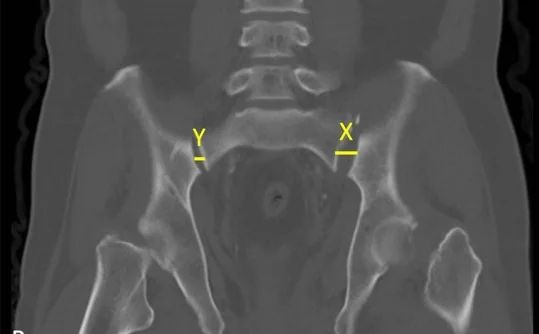
Sakroiliak eklem diastazı, yüksek enerjili travmalarda posterior pelvis halkası yaralanmasının önemli bir bileşeni olarak ortaya çıkar. BT incelemesinde sakroiliak eklem genişlemesi ve aksiyel kesitte iliak kemiğin sakruma göre posterior yer değiştirmesi değerlendirilebilir. Aksiyel BT'de saptanan posterior iliak yer değiştirme, daha yüksek başlangıç pelvik deplasmanı ve erken implant gevşemesi ile ilişkilidir. Pelvik halka kırıklarında instabiliteye intrapelvik vasküler ve viseral komplikasyonlar eşlik edebilir.
Faz ve pencere
- Kontrastsız tanısal
- Aksiyel kemik penceresinde sakroiliak eklem genişlemesi ve iliak kemiğin posterior yer değiştirmesi (posterior iliac offset) değerlendirilir. Pelvik kırık yerleri kontrastsız BT ile kemik penceresinde değerlendirilebilir; intrapelvik aktif kanama ve vasküler lezyonlar için kontrastlı inceleme gerekir.
- Kemik algoritması tanısal
- Çok düzlemli BT incelemesinde aksiyel ve koronal rekonstrüksiyonlar, maksimum sakroiliak eklem diastazını ve sağlıklı taraf ile yaralı taraf arasındaki mesafe farkını ortaya koyar.
Önerilen pencereler G genişlik, M merkez; değerler Hounsfield birimi (HU)
- KemikG 1800 / M +400
BT bulguları
- Anterior SI açılması — anterior sakroiliak ligamentlerin hasarı ve simfizis pubis diastazı ile birlikte görülebilen ventral eklem genişlemesidir.
- Posterior SI ayrışması — aksiyel BT'de eklem düzeyinde iliak kemiğin posterior yer değiştirmesi (posterior iliac offset) ve belirgin pelvik deplasman ile birliktedir.
- İliak yer değiştirme — aksiyel BT kesitlerinde iliak kemiğin sakroiliak eklem düzeyinde sakruma göre arkaya ötelenmesidir (posterior iliac offset).
- Sakral avulsiyon kırığı — anterior sakroiliak ligamentin kaudal bölümü ile ilişkili traksiyon sonucu sakrumda avulsiyon fragmanı izlenebilir.
- İliak kemik kırığı — SI eklem yüzünü kesen posterior iliak kırık ya da crescent fragmanı.
- Karşı halka hasarı — pubik ramus, simfiz veya karşı SI eklemde eşlik eden ikinci halka kesintisi.
- Eklem çevresi hematom — sakroiliak eklem diastazına presakral hematom eşlik edebilir; kontrastlı BT'de intrapelvik aktif kanama ayrıca araştırılır.
Ölçütler ve sınıflamalar
- AO/OTA 2018 pelvik halka stabilitesi
- Pelvik halka sınıflamasında Tip A stabil, Tip B kısmen instabil, Tip C ise instabil (oynak) pelvik halka yaralanmasını ifade eder.
- Young–Burgess sınıflaması
- Young–Burgess sınıflaması, pelvik halka yaralanmalarını kuvvet türü, şiddeti, yönü ve instabilite özelliklerini dikkate alarak sınıflandırır. Young–Burgess sınıflaması; kuvvetin türü, şiddeti, yönü ve yaralanmanın instabilite özelliklerini dikkate alarak pelvik halka hasarlarını gruplandırır.
Normalde
Normal çok düzlemli BT'de iki sakroiliak eklem aksiyel ve koronal düzlemlerde karşılaştırılır; yaralı ve sağlıklı eklem mesafesi arasında anlamlı genişleme veya posterior iliak yer değiştirme izlenmez. Sağlıklı ve yaralı sakroiliak eklem aralıklarını aksiyel ve koronal BT düzlemlerinde karşılaştırın; travma sonrası eklem kırığı veya diastazla ilişkili yapısal değişiklikler inflamatuvar sakroiliiti taklit edebilir.
Normal BT ile kıyasla
Aynı bölgenin, kaynak veri setinde patoloji içermediği belirtilen bir BT incelemesini kesit kesit kaydırın; organ sınırlarını açarak anatomiyi hasta görüntüsüyle karşılaştırın. Küçük rastlantısal bulgular tümüyle dışlanmamıştır.
Kaynak: TotalSegmentator v2.01 veri seti (Wasserthal ve ark., Radiology: Artificial Intelligence 2023), CC BY 4.0, vaka s1256; organ sınırları veri setinin otomatik segmentasyonundan, birleştirilerek sadeleştirildi. Görüntüler 2,5 mm kesit aralığına yeniden örneklendi.
Ayırıcı tanı
- Travma sonrası sakroiliak eklemde görülen skleroz ve erozyonlar inflamatuvar sakroiliiti taklit edebilir.
- İnflamatuvar sakroiliit
- periartiküler skleroz, erozyonlar ve ankiloz ile seyreder; travma sonrası gelişen eklem içi basamaklanma ve diastaz sakroiliiti taklit edebilir.
- Normal anatomik varyasyonlar
- sakroiliak eklemde anatomik varyantlar sık görülebildiğinden iki taraf eklem mesafesi çok düzlemli BT'de aksiyel ve koronal düzlemlerde karşılaştırılmalıdır.
Tuzaklar
- Tek bir plandaki eklem açıklığına dayanarak kesin karar vermeyin; sakroiliak eklem diastazı ve deplasmanını çok düzlemli BT'de aksiyel ve koronal kesitlerde birlikte değerlendirin.
- Sağlıklı ve yaralı sakroiliak eklem arasındaki mesafe farkını çok düzlemli BT'de aksiyel ve koronal rekonstrüksiyonlarda karşılaştırarak doğrulayın.
- Simfizis pubis diastazı 2,5 cm eşik değerinin altında olsa bile gizli sakroiliak eklem diastazını dışlamaz; posterior eklem bütünlüğü anestezi altında obturator inlet görüntüleme ile ayrıca değerlendirilmelidir. Posterior kompleks ve tüm halka morfolojisini birlikte değerlendirin.
- Sakroiliak eklem genişliği belirgin olmasa dahi aksiyel BT'de posterior iliak yer değiştirme veya eşlik eden sakrum kırıkları varlığında posterior halka instabilitesi dışlanamaz.
Kendini dene
Pelvik travmalı bir hastanın aksiyel BT incelemesinde sakroiliak eklem düzeyinde iliak kemiğin sakruma göre arkaya yer değiştirmesi (posterior iliac offset) saptanmıştır. Bu bulgu aşağıdakilerden hangisiyle ilişkilidir?
Cevabı göster
Daha yüksek başlangıç pelvik deplasmanı ve implant gevşemesi riski. Aksiyel BT'de iliak kemiğin sakruma göre posterior yer değiştirmesi (posterior iliac offset), artmış başlangıç pelvik deplasmanı ve daha yüksek implant gevşemesi oranları ile ilişkilidir.
Travmatik sakroiliak eklem diastazında maksimum eklem ayrışması ve sağlıklı ile yaralı taraf arasındaki fark çok düzlemli BT'de (mpCT) hangi iki düzlemde değerlendirilir?
Cevabı göster
Aksiyel ve koronal düzlemler. Maksimum sakroiliak eklem diastazı ve yaralı eklem ile sağlıklı eklem arasındaki mesafe farkı çok düzlemli BT'de (mpCT) aksiyel ve koronal düzlemler birlikte değerlendirilerek ölçülür.
İlgili konular
Kaynaklar
Bu sayfadaki 39 cümle ve 2 quiz sorusu aşağıdaki kaynaklardan alıntılarla otomatik olarak karşılaştırıldı; 18 cümle bu karşılaştırmada düzeltildi (2026-10-12).
- Successful internal fixation of a pelvic ring fracture during pregnancy: a multidisciplinary case reportpmc.ncbi.nlm.nih.gov
- Safe definitive surgery in unstable pelvic ring injuries – a retrospective cohort studypmc.ncbi.nlm.nih.gov
- Comprehensive Orthopedic Management of an Open-Book Pelvic Fracture: A Multidisciplinary Approach in Trauma Carepmc.ncbi.nlm.nih.gov
- Critical distance of the sacroiliac joint for open reduction using screw fixation for traumatic sacroiliac joint diastasis: a retrospective studypmc.ncbi.nlm.nih.gov
- Impact of Pelvic Fracture Sites on Fibrinogen Depletion in Patients with Blunt Trauma: A Single-Center Cohort Studypmc.ncbi.nlm.nih.gov
- CT evaluation of pelvic and hip fractures.pubmed.ncbi.nlm.nih.gov
- Successful internal fixation of a pelvic ring fracture during pregnancy: a multidisciplinary case report.pubmed.ncbi.nlm.nih.gov
- Critical distance of the sacroiliac joint for open reduction using screw fixation for traumatic sacroiliac joint diastasis: a retrospective study.pubmed.ncbi.nlm.nih.gov
- Age-Based Normative Measurements of the Pediatric Pelvis.pubmed.ncbi.nlm.nih.gov
- Radiographic evaluation of reactive osteitis in traumatic injury of sacroiliac joints.pubmed.ncbi.nlm.nih.gov
- Ligament-induced sacral fractures of the pelvis are possible.pubmed.ncbi.nlm.nih.gov
- Postpartum symphysis pubis diastasis.pubmed.ncbi.nlm.nih.gov
- CT-guided percutaneous bilateral sacroiliac joint arthroplasty.pubmed.ncbi.nlm.nih.gov
- Posterior hinge fixation for the treatment of unstable traumatic sacroiliac joint injuries.pubmed.ncbi.nlm.nih.gov
- Post-traumatic arthritis of the sacroiliac joints mimicking inflammatory sacroiliitis: analysis of consecutive computed tomography examinations.pubmed.ncbi.nlm.nih.gov
- Posterior iliac offset: description of a new radiological measurement of sacroiliac joint instability.pubmed.ncbi.nlm.nih.gov
- The Concealment of Significant Pelvic Injuries on Computed Tomography Evaluation by Pelvic Compression Devices.pubmed.ncbi.nlm.nih.gov
- Three-dimensional anatomy of the pelvic bone in bladder exstrophy: comparison between patients managed with osteotomy and pubic symphysis internal fixation using metal plates.pubmed.ncbi.nlm.nih.gov
- Radiological evaluation of the posterior pelvic ring in paediatric patients: Results of a retrospective study developing age- and gender-related non-osseous baseline characteristics in paediatric pelvic computed tomography - References for suspected sacroiliac joint injury.pubmed.ncbi.nlm.nih.gov
- Occult bladder injury in low displacement anterior-posterior compression pelvic fractures type I: a retrospective analysis of incidence and predictors.pubmed.ncbi.nlm.nih.gov
- Clinical Outcomes of Straddle Fracture Patterns: A Retrospective Multicenter Analysis Based on a New Descriptive Classification Framework.pubmed.ncbi.nlm.nih.gov
- Open Book on the Water Slide: A Case Series of APC2 Pelvic Ring Injuries from High-Energy Aquatic Accidents.pubmed.ncbi.nlm.nih.gov
- Comprehensive Management of Different Types of Pelvic Fractures Through Multiple Disciplines: A Case Series.pubmed.ncbi.nlm.nih.gov
- Pelvic Fractures in Adults and the Importance of Associated Injuries-A Current Multi-Disciplinary Approach.pubmed.ncbi.nlm.nih.gov
- Fatal Free Falls: A Clinical and Forensic Analysis of Skeletal Injury Patterns Using PMCT and Autopsy.pubmed.ncbi.nlm.nih.gov
- Examination under anesthesia in anterior posterior compression pelvic ring injuries; additional assessment of the posterior pelvic ring reveals occult sacroiliac joint instability.pubmed.ncbi.nlm.nih.gov
- Staged management of a compound combined pelvi-acetabular injury with perineal degloving in a young female: a case report and literature review.pubmed.ncbi.nlm.nih.gov
- Posterior pelvic ring fixation: evolution of surgical approaches and evidence-based outcomes for unstable fractures.pubmed.ncbi.nlm.nih.gov
- Traumatic lumbosacral instability: part 1 - proposing a definition and identifying underlying injury patterns.pubmed.ncbi.nlm.nih.gov
- Management of floating hip injury: a review of the literature.pubmed.ncbi.nlm.nih.gov
- Nontraumatic unilateral ureteral entrapment at the sacroiliac joint: A rare cause of obstructive uropathy.pubmed.ncbi.nlm.nih.gov
- Endoscopic Management of a Trauma-Induced Urethral Pseudoaneurysm.pubmed.ncbi.nlm.nih.gov
- Computed Tomography: State-of-the-Art Advancements in Musculoskeletal Imaging.pubmed.ncbi.nlm.nih.gov
- An Atraumatic Symphysiolysis with a Unilateral Injured Sacroiliac Joint in a Patient with Cushing's Disease: A Loss of Pelvic Stability Related to Ligamentous Insufficiency?pubmed.ncbi.nlm.nih.gov
- Assessment of the posterior pelvic ring during examination under anesthesia changes surgeons' classification and treatment decisions of anterior posterior compression pelvic ring injuries.pubmed.ncbi.nlm.nih.gov
- W-shaped double plating for symphyseal diastasis in vertical shear pelvic ring injury: 12-month radiographic stability - a case report.pubmed.ncbi.nlm.nih.gov
- Pelvic rotation correction combined with Schroth exercises for pelvic and spinal deformities in mild adolescent idiopathic scoliosis: A randomized controlled trial.pubmed.ncbi.nlm.nih.gov
- Pedicle Subtraction Osteotomy.pubmed.ncbi.nlm.nih.gov
- The Pelvic Bridge: A Subcutaneous Approach for Anterior Pelvic Fixation.pubmed.ncbi.nlm.nih.gov
- Staged management of a Tile C3 pelvic ring injury with bilateral sacroiliac disruption and T-shaped sacral fracture.pubmed.ncbi.nlm.nih.gov
- Isolated Unilateral Posterior Sacroiliac Dislocation With an Intact Anterior Pelvic Ring: Case Report of an Unusual Injury Pattern.pubmed.ncbi.nlm.nih.gov
- Risser growth plate injury in unstable paediatric pelvic fractures: a multicentre retrospective study.pubmed.ncbi.nlm.nih.gov
- Surgical Management of a Lateral Compression (LC)III Pelvic Ring Fracture With Type I Crescent Fracture-Dislocation: A Case Report.pubmed.ncbi.nlm.nih.gov
- Comparative study of modified vs. traditional sacroiliac screw techniques in day type II crescent fracture dislocation of the pelvis.pubmed.ncbi.nlm.nih.gov
- Radiographic Changes After Pubic Symphysis Plating and Their Clinical Relevance: An Exploratory Longitudinal Cohort Study.pubmed.ncbi.nlm.nih.gov
- Computed tomography of pediatric abdominal trauma: optimizing utilization and enhancing diagnostic interpretation.pubmed.ncbi.nlm.nih.gov
- Imaging Review of Pelvic Ring Fractures and Its Complications in High-Energy Trauma.pubmed.ncbi.nlm.nih.gov
- A comparative study of fluoroscopy-guided closed reduction with 3D-printed guide-assisted cannulated screw fixation versus open surgery with a lag screw fixation in 32 cats with sacroiliac luxation-fracture.pubmed.ncbi.nlm.nih.gov
- A Case Report of Rheumatoid Arthritis With a Migratory Pattern.pubmed.ncbi.nlm.nih.gov
- Radiologic Insights: Diagnosing Lumbosacral Transitional Vertebrae. Systematic Review of the Literature.pubmed.ncbi.nlm.nih.gov
- Axial Spondyloarthritis: Mimics and Pitfalls of Imaging Assessment.pubmed.ncbi.nlm.nih.gov
- Surgical management of severely displaced IPRF: operative technique, indications, and preliminary clinical outcomes.pubmed.ncbi.nlm.nih.gov
- Safe definitive surgery in unstable pelvic ring injuries - a retrospective cohort study.pubmed.ncbi.nlm.nih.gov
- Case Report: Ochronotic arthropathy mimicking spondyloarthritis: a case-based review of diagnostic pitfalls and a novel likely pathogenic HGD variant.pubmed.ncbi.nlm.nih.gov
- Differentiating Sciatica from Hip Osteoarthritis: Diagnostic Challenges and the Role of the Athena Sign.pubmed.ncbi.nlm.nih.gov
- Lumbar Superior Articular Process-Pedicle Impingement, a Previously Unrecognized Pathological Cause of Low Back Pain: A Case Report.pubmed.ncbi.nlm.nih.gov
- Case Report: Achilles enthesitis as the presenting clue to occult sacroiliitis in hidradenitis suppurativa.pubmed.ncbi.nlm.nih.gov
- Bilateral Brucellar Sacroiliitis Mimicking Tuberculous or Inflammatory Spondyloarthropathy: A Case Report.pubmed.ncbi.nlm.nih.gov
- Disseminated Skeletal Tuberculosis Presenting as Multifocal Axial and Peripheral Joint Disease: A Diagnostic Challenge.pubmed.ncbi.nlm.nih.gov
- Knowledge gaps in high-energy sacral fracture treatment and management.pubmed.ncbi.nlm.nih.gov
- The Standing Forward Flexion Test in Manual Therapy: A Critical Review and a Functional Reinterpretation.pubmed.ncbi.nlm.nih.gov
- Age and fixation strategy as associated factors for sacroiliac joint dysfunction after posterior pelvic ring fixation.pubmed.ncbi.nlm.nih.gov
- Computed tomography of the equine caudal spine and pelvis. Pathological findings in 56 clinical cases (2018-2023).pubmed.ncbi.nlm.nih.gov
- Comparative Study of Alternative Methods for Measuring Leg Length Discrepancy after Robot-Assisted Total Hip Arthroplasty.pubmed.ncbi.nlm.nih.gov
- Musculoskeletal imaging in the cat: what's normal? What's abnormal?pubmed.ncbi.nlm.nih.gov
- Biomechanical and clinical analysis of pelvic stability and the role of internal fixation after debridement for sacroiliac joint tuberculosis with different degrees of bone destruction.pubmed.ncbi.nlm.nih.gov
- Current State-of-the-Art 3D MRI Sequences for Assessing Bone Morphology with Emphasis on Cranial and Spinal Imaging: A Narrative Review.pubmed.ncbi.nlm.nih.gov
- Noncontact optical 3D strain measurements in cervical soft tissues biomechanics by digital image correlation under tensile test: an experimental approach.pubmed.ncbi.nlm.nih.gov
- Haemorrhage control and definitive fixation strategies in unstable pelvic ring fractures: Integrating damage control and endovascular techniques A narrative review.pubmed.ncbi.nlm.nih.gov
- Congenital and Breed-Associated Vertebral Anomalies in Dogs and Cats: Developmental Anatomy, Genetic Determinants, and Biological Significance.pubmed.ncbi.nlm.nih.gov
- A new SPECT/CT reconstruction algorithm: reliability and accuracy in clinical routine for non-oncologic bone diseases.pubmed.ncbi.nlm.nih.gov
- Treatment of Displaced Sacroiliac Fracture Using the Lateral Window for Short Plate Buttress Reduction and Percutaneous Sacroiliac Screw Fixation.pubmed.ncbi.nlm.nih.gov
- Obstetric sacroiliac joint injury: a case report and discussion.pubmed.ncbi.nlm.nih.gov
- Adult female patient with osteitis pubis and pelvic instability requiring surgery: A case report.pubmed.ncbi.nlm.nih.gov
- Evaluating success rate and comparing complications of operative techniques used to treat chronic syndesmosis injuries.pubmed.ncbi.nlm.nih.gov
- Imaging Insights into Midfoot and Forefoot Disorders.pubmed.ncbi.nlm.nih.gov
- New Minimally Invasive Method for Treating Posterior Pelvic Ring Fractures: Biomechanical Validation and Clinical Application of Sacroiliac Joint Locking Plate.pubmed.ncbi.nlm.nih.gov
- Midline Sacral Fractures: Review of the Literature.pubmed.ncbi.nlm.nih.gov
- Recognizing Sacral Insufficiency Fractures Hidden in Plain Sight: An Illustrative Case Report.pubmed.ncbi.nlm.nih.gov
- Minimally invasive treatment for critical multiple trauma with traumatic diaphragmatic hernia combined with pelvic and acetabular fractures: a rare case report.pubmed.ncbi.nlm.nih.gov
- Minimally Invasive Lumbopelvic and Transiliac-Transsacral Fixation for a Pathological Sacral Fracture Due to Metastatic Breast Cancer: A Case Report.pubmed.ncbi.nlm.nih.gov
- Crowned Dens Syndrome associated with rheumatoid arthritis: A case report of two patients with a systematic literature review.pubmed.ncbi.nlm.nih.gov
- Association between sacroiliac joint reduction quality and acetabular fracture alignment: a comparative study of the lateral window and pararectus approaches.pubmed.ncbi.nlm.nih.gov
- The myth of 2.5 cm symphyseal diastasis.pubmed.ncbi.nlm.nih.gov
- Anterior minimal invasive internal fixator versus open plating in treatment of unstable pelvic ring injuries.pubmed.ncbi.nlm.nih.gov
- Comparative study between anterior symphyseal platting and percutaneous symphyseal screws for treatment of traumatic symphyseal diastasis.pubmed.ncbi.nlm.nih.gov
- Bilateral traumatic testicular dislocation associated with an unstable pelvic ring injury: a rare case report and literature review.pubmed.ncbi.nlm.nih.gov
- Clinical study on the treatment of pubic symphysis diastasis with modified internal fixation.pubmed.ncbi.nlm.nih.gov
- Fatal Injuries Caused by Falling Trees: Correlation Between Postmortem Computed Tomography and Forensic Autopsy Findings in Eight Cases.pubmed.ncbi.nlm.nih.gov
- CT of Sacral Fractures: Classification Systems and Management.pubmed.ncbi.nlm.nih.gov
- A novel internal fixation system for sacral fractures: a finite element biomechanical study.pubmed.ncbi.nlm.nih.gov
- Occult Small Bowel Injury With Delayed Retroperitoneal Abscess Formation After Blunt Trauma: A Case Report.pubmed.ncbi.nlm.nih.gov
- Angioembolization as a life-saving maneuver for unstable pelvic fractures in skeletally immature children: a multicenter case series.pubmed.ncbi.nlm.nih.gov
- Sacroiliac Joint Anatomical Variants and Their Association with Spinopelvic Alignment: A Whole-Spine CT Study.pubmed.ncbi.nlm.nih.gov
- Risk of Total Hip Arthroplasty After Sacroiliac Joint Fusion Surgery: A Nationwide Study.pubmed.ncbi.nlm.nih.gov
- Multi-Detector Helical Computer Tomography, Transrectal Ultrasonography and Histology of the Lumbosacral Area: A Comparative Study in Warmblood Horse Cadavers.pubmed.ncbi.nlm.nih.gov
- Surgical management and long-term functional outcomes of traumatic pubic symphysis diastasis: a retrospective cohort study.pubmed.ncbi.nlm.nih.gov
- Anatomy-driven automated subsegmentation of pelvic and proximal femoral CT into clinically relevant subregions and landmarks.pubmed.ncbi.nlm.nih.gov
- Bridging postural biomechanics and knee arthroplasty success.pubmed.ncbi.nlm.nih.gov
- Ankylosing Spondylitis Presenting as a Severe Kyphotic Deformity Without Pain: A Case Report and Literature Review.pubmed.ncbi.nlm.nih.gov
- Robot-assisted closed reduction and navigated fixation for pelvic ring injuries: a focused narrative review of a reduction-fixation-audit framework.pubmed.ncbi.nlm.nih.gov
- Biomechanical stability evaluation of isolated straddle fracture using finite element analysis.pubmed.ncbi.nlm.nih.gov
- Iliosacral Screw Fixation for Treating Sacral Fractures: A Modified Pedicle-Guided Fixation Technique in Prone Position.pubmed.ncbi.nlm.nih.gov
- Total Hip Arthroplasty for Post-Traumatic Hip Arthritis in Chronic Pubic Diastasis: A Case Report.pubmed.ncbi.nlm.nih.gov
- Development of a pelvic musculoskeletal model based on statistical shape modelling for estimating sacroiliac and pubic joint reaction forces in females.pubmed.ncbi.nlm.nih.gov
- Artificial intelligence in spine care: A scoping review of diagnostic applications.pubmed.ncbi.nlm.nih.gov
- Irreducible Locked Symphysis Pubis Disruption Caused by Incarcerated Urinary Bladder in a 14-year-Old Boy, a Case Report and Review of the Literature.pubmed.ncbi.nlm.nih.gov
- Robot-assisted sacroiliac screw fixation for tile type C posterior pelvic ring injuries: a comparative study.pubmed.ncbi.nlm.nih.gov
- Diastasis of the Pubic Symphysis Without Fall While Horseback Riding: A Case Report.pubmed.ncbi.nlm.nih.gov
- Do we need another screw? Sacroiliac screw fixation in open-book pelvic ring injuries (APC type II).pubmed.ncbi.nlm.nih.gov
- Sacral Slanting in Adolescent Idiopathic Scoliosis: Definition, Pathomechanism, and Surgical Implications: A Narrative Review.pubmed.ncbi.nlm.nih.gov
- CBCT-Guided Iliosacral Screw Osteosynthesis in a Pregnant Woman: A Case Report and Literature Review.pubmed.ncbi.nlm.nih.gov
- An Atypical Hip Pain in a Recreational Athlete: A Case Report.pubmed.ncbi.nlm.nih.gov
- Delayed diagnosis of spinal tuberculosis mimicking spondyloarthritis: a case report.pubmed.ncbi.nlm.nih.gov
- Contemplate iliosacral screw in patients with developmental dysplasia of the hip.pubmed.ncbi.nlm.nih.gov
Eğitim amaçlıdır; hasta başında tanı ve tedavi kararının yerine geçmez, tıbbi tavsiye değildir. Metinler yapay zekâ desteğiyle yazıldı ve otomatik bir adımda kaynak alıntılarıyla karşılaştırıldı; bu bir tıbbi doğrulama değildir ve içerik uzman radyolog incelemesinden geçmedi. Klinik kararlarda güncel kılavuzları, kurum protokollerini ve radyoloji raporunu esas alın.