Özet
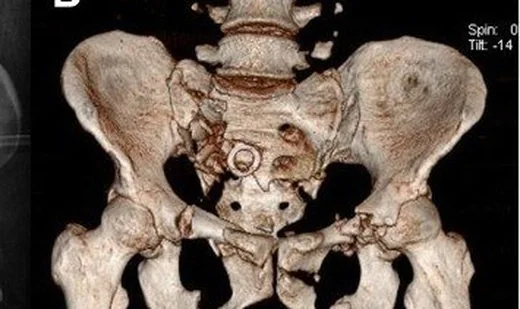
Yüksek enerjili travmada pelvis halkasının stabilitesi, tek bir kırık hattından çok posterior sakroiliak kompleksin ne ölçüde bozulduğuyla anlaşılır. Klasik Tile sınıflaması bu anatomik sürekliliği BT'de görülen kemik ve eklem yaralanmalarıyla ilişkilendirerek stabil, rotasyonel instabil ve hem rotasyonel hem dikey instabil örüntüleri ayırır. BT, özellikle sakrum, sakroiliak eklem ve posterior iliak kemikte grafide örtülebilen yaralanmaları ve halka üzerindeki ikinci hasar odağını gösterir. Posterior halka hasarı atlanırsa yaralanmanın instabil bileşeni ve eşlik edebilen kanama ya da nörolojik risk eksik raporlanabilir.
Faz ve pencere
- Kontrastsız tanısal
- Kemik penceresinde pubik simfiz, iki pubik ramus, sakral ala, sakroiliak eklemler ve iliak kanatlar birlikte izlenir; posterior eklem aralığı, kortikal süreksizlik ve hemipelvisin kraniokaudal ya da ön-arka ötelenmesi stabilite örüntüsünü gösterir. İnce kesitli aksiyal ve koronal/sagittal rekonstrüksiyonlu BT, pelvis halkası sınıflaması için standart görüntüleme yöntemidir.
- Kemik algoritması tanısal
- Standart BT protokolünde aksiyal, koronal ve sagittal rekonstrüksiyonlar birlikte kullanılarak posterior halka yer değiştirmesi, sakral kırık morfolojisi, sakroiliak eklem uyumsuzluğu ve ön halka kopması doğrudan görüntülenebilir.
Önerilen pencereler: Kemik (G 1800 / M 400).
BT bulguları
- Posterior sakroiliak kompleks sürekliliği — posterior SI eklem aralığı ve sakral/iliak korteks boyunca kesinti olup olmadığını belirleyin.
- Rotasyonel instabilite — Tile sınıflamasında rotasyonel ayrışma tahmini için pubik simfiz ve sakroiliak eklem genişlemesi işaretleri kullanılır.
- Hemipelvisin kraniokaudal yer değiştirmesini (örn. cranial migration) ve posterior halkada oluşan dikey instabiliteyi değerlendirin.
- Posterior ark kırığı — sakral ala, sakral foramenler, iliak kanat ve sakroiliak eklem boyunca kırık-disosiyasyon odağını izleyin.
- Anterior halka eşliği — pubik ramus veya simfiz hasarını posterior yaralanmayla aynı tarafta ve karşı tarafta eşleştirin.
- Halka boyunca ikinci hasar — belirgin bir kırığın karşısında sakrum, SI eklem veya pubik ramusta gizli ikinci kesintiyi araştırın.
- Eşlik eden yumuşak doku bulgusu — hematom, ekstravazasyon şüphesi ve mesane komşuluğundaki yaralanmayı kemik örüntüsünden ayrı kaydedin.
Ölçütler ve sınıflamalar
- Tile A
- Posterior sakroiliak kompleks korunmuştur; halka fizyolojik yük altında stabil kabul edilir.
- Tile B
- Posterior kompleks kısmen bozulmuştur; halka rotasyonel olarak instabil, dikey yönde görece stabildir.
- Tile C
- Posterior kompleks tam kesintiye uğramıştır; hem rotasyonel hem dikey instabilite vardır.
- AO/OTA pelvis halka sınıflaması (2018 compendium)
- AO/OTA 2018 Compendium pelvis halkası için ayrı kodlu, morfoloji ve instabiliteyi birlikte ele alan bir sınıflamadır. Bu kodlar klasik Tile A/B/C ile bire bir eşdeğer değildir; raporda kullanılan sistemin adı ve kendi kodu belirtilmelidir.
Normalde
Normal BT'de sakrum iki iliak kemikle simetrik sakroiliak eklemler üzerinden eklemleşir; pubik simfiz ve ramuslar kesintisiz ön halkayı tamamlar. İki tarafın SI eklem aralıklarını, sakral korteksin devamlılığını ve iliak kanatların aynı kraniokaudal seviyede oluşunu karşılaştırarak travmatik açılma veya translasyonu arayın.
Normal BT ile kıyasla
Aynı bölgenin, kaynak veri setinde patoloji içermediği belirtilen bir BT incelemesini kesit kesit kaydırın; organ sınırlarını açarak anatomiyi hasta görüntüsüyle karşılaştırın. Küçük rastlantısal bulgular tümüyle dışlanmamıştır.
Kaynak: TotalSegmentator v2.01 veri seti (Wasserthal ve ark., Radiology: Artificial Intelligence 2023), CC BY 4.0, vaka s1256; organ sınırları veri setinin otomatik segmentasyonundan, birleştirilerek sadeleştirildi. Görüntüler 2,5 mm kesit aralığına yeniden örneklendi.
Ayırıcı tanı
- İzole iliak kanat kırığı
- SI eklem ve sakrum sağlam, halka posterior bağlantısı korunmuş olabilir.
- İzole pubik ramus kırığı
- tek başına stabil görünse de sakrum ve SI eklemde gizli eşlikçi hasar özellikle aranır.
- Sakral yetmezlik kırığı
- sıklıkla ala içinde sklerotik/ince vertikal çizgiler bulunur; akut yüksek enerjili halka ayrışması eşlik etmeyebilir.
- Sakroiliit veya dejeneratif SI değişiklik
- eklem yüzlerinde kronik skleroz, erozyon ya da osteofit vardır; akut hemipelvis ötelenmesi beklenmez.
Tuzaklar
- Anterior halka kırığını tek odak sanıp arka halkayı bırakmayın; halka mekanizması nedeniyle sakral ala ve SI eklemi aynı incelemede tarayın.
- Tile tipi yalnız pubik simfiz açıklığına göre atanamaz; posterior bağ kompleksinin kemik ve eklem bütünlüğünü esas alın.
- Yatış pozisyonu, pelvik binder ve redüksiyon görünür deformiteyi azaltabilir; kırık morfolojisini ve eklem yüzü basamaklarını da inceleyin.
- BT morfolojisi klinik bağ gevşekliğini her zaman tek başına kanıtlamaz; kısmi posterior hasarda stabilite yorumunu kesinlik iddiası olmadan raporlayın.
Kendini dene
BT'de ön halka ayrışmasına eşlik eden kısmi posterior SI kompleks hasarı var; hemipelvis kraniokaudal konumunu koruyor. Tile tipi hangisidir?
Cevabı göster
Tile B. Tile B posterior kompleksin kısmi bozulduğu ve dikey stabilitenin korunduğu örüntüdür. Tile A'da posterior kompleks sağlamdır; Tile C'de dikey instabilite de vardır. Denis zon 2 sakral kırığın foramene göre yerini tanımlar.
Pubik ramus kırığı görülen hastada stabiliteyi sınıflamak için hangi ek bulgu en belirleyicidir?
Cevabı göster
Sakroiliak eklem ayrışması. Posterior sakroiliak kompleksin bütünlüğü Tile stabilite ayrımının temelidir. Diğer seçenekler pelvis halkasının posterior mekanik sürekliliğini göstermez.
Kaynaklar
Bu sayfadaki 47 cümle ve 2 quiz sorusu aşağıdaki kaynaklardan alıntılarla tek tek karşılaştırıldı; 4 cümle bu karşılaştırmada düzeltildi (2026-10-08).
- Surgical management of severely displaced IPRF: operative technique, indications, and preliminary clinical outcomespmc.ncbi.nlm.nih.gov
- pmc.ncbi.nlm.nih.govpmc.ncbi.nlm.nih.gov
- Delayed sacroiliac joint infection after robot-assisted percutaneous iliac screw fixation for tile type C2 pelvic fractures: A case report and literature reviewpmc.ncbi.nlm.nih.gov
- Robot-assisted closed reduction and navigated fixation for pelvic ring injuries: a focused narrative review of a reduction-fixation-audit frameworkpmc.ncbi.nlm.nih.gov
- A positioning method for the transiliac-transsacral screw bone channel based on a manual tracing of a transparent overlay of preoperative computed tomography images in patients with pelvic fracture and a unilateral trans-sacroiliac corridorpmc.ncbi.nlm.nih.gov
- Open reduction and navigated Iliosacral screws for vertically unstable pelvic fractures.pubmed.ncbi.nlm.nih.gov
- [Radiological diagnosis of pelvic ring fractures].pubmed.ncbi.nlm.nih.gov
- Can MDCT Unmask Instability in Binder-Stabilized Pelvic Ring Disruptions?pubmed.ncbi.nlm.nih.gov
- [Percutaneous screw fixation for pelvic fractures with fluoroscopy-based navigation].pubmed.ncbi.nlm.nih.gov
- [Surgical treatment for Tile C type pelvis fracture through posterior approach].pubmed.ncbi.nlm.nih.gov
- [Application of individualized transiliac crest nail-grafting guide plate in deep pelvic external fixator implantation].pubmed.ncbi.nlm.nih.gov
- Critical review of pelvic fractures associated with external iliac artery lesion: a series of six cases.pubmed.ncbi.nlm.nih.gov
- Bilateral testicular dislocation with pelvic ring fracture: a case report and literature review.pubmed.ncbi.nlm.nih.gov
- A retrospective study about functional outcome and quality of life after surgical fixation of insufficiency pelvic ring injuries.pubmed.ncbi.nlm.nih.gov
- Assessing Pediatric Pelvic Fracture Patterns: New Insights and Unique Fracture Characteristics.pubmed.ncbi.nlm.nih.gov
- Examination under anesthesia imaging changes surgeons' classification and treatment decisions of anterior posterior compression pelvic ring injuries.pubmed.ncbi.nlm.nih.gov
- Standard practice in the treatment of unstable pelvic ring injuries: an international survey.pubmed.ncbi.nlm.nih.gov
- Pelvic fracture related hematoma - emergency treatment and bleeding control.pubmed.ncbi.nlm.nih.gov
- Anterior subcutaneous internal fixation for a complex vertical shear pelvic fracture with Morel-Lavallée lesion: a case report.pubmed.ncbi.nlm.nih.gov
- Safe definitive surgery in unstable pelvic ring injuries - a retrospective cohort study.pubmed.ncbi.nlm.nih.gov
- Isolated Unilateral Posterior Sacroiliac Dislocation With an Intact Anterior Pelvic Ring: Case Report of an Unusual Injury Pattern.pubmed.ncbi.nlm.nih.gov
- Minimally invasive circumferential fixation using TIFI and INFIX for unstable pelvic ring injuries: a prospective evaluation of clinical and radiological outcomes.pubmed.ncbi.nlm.nih.gov
- Surgical management of severely displaced IPRF: operative technique, indications, and preliminary clinical outcomes.pubmed.ncbi.nlm.nih.gov
- Robot-assisted closed reduction and navigated fixation for pelvic ring injuries: a focused narrative review of a reduction-fixation-audit framework.pubmed.ncbi.nlm.nih.gov
- Biomechanical stability evaluation of isolated straddle fracture using finite element analysis.pubmed.ncbi.nlm.nih.gov
- Hip position may be associated with susceptibility to Rommens type IIIa fragility fractures of the pelvis during lateral falls: a quantitative computed tomography-based finite element analysis.pubmed.ncbi.nlm.nih.gov
- Occult bladder injury in low displacement anterior-posterior compression pelvic fractures type I: a retrospective analysis of incidence and predictors.pubmed.ncbi.nlm.nih.gov
- Occult contralateral sacroiliac joint injuries missed on single-energy CT of operative pelvis fractures.pubmed.ncbi.nlm.nih.gov
- Occult fractures in low-energy trauma-A retrospective forensic case series.pubmed.ncbi.nlm.nih.gov
- Risser growth plate injury in unstable paediatric pelvic fractures: a multicentre retrospective study.pubmed.ncbi.nlm.nih.gov
- Nontraumatic unilateral ureteral entrapment at the sacroiliac joint: A rare cause of obstructive uropathy.pubmed.ncbi.nlm.nih.gov
- Clinical and 18F-FDG PET/CT Imaging Characteristics of Post-radiotherapy Sacral Insufficiency Fractures in Cervical Cancer Patients.pubmed.ncbi.nlm.nih.gov
- Staged management of severe polytrauma with pericardial and diaphragmatic rupture and open pelvic ring injury: a case report with literature review.pubmed.ncbi.nlm.nih.gov
- Anatomy-driven automated subsegmentation of pelvic and proximal femoral CT into clinically relevant subregions and landmarks.pubmed.ncbi.nlm.nih.gov
- Limitations of CT-based planning in anterior pelvic ring fixation: a study of fluoroscopy-guided pubic ramus screws.pubmed.ncbi.nlm.nih.gov
- Staged management of a Tile C3 pelvic ring injury with bilateral sacroiliac disruption and T-shaped sacral fracture.pubmed.ncbi.nlm.nih.gov
- Preoperative 3D-Planned S1 Corridors Transferred into 2D Fluoroscopy Allow for Safe Intraoperative Large-Diameter Implant Placement: Description of a Novel Sacroiliac Fixation Technique and Proof of Concept in 137 Implantations.pubmed.ncbi.nlm.nih.gov
- The myth of 2.5 cm symphyseal diastasis.pubmed.ncbi.nlm.nih.gov
- Biomechanical optimization of iliolumbar fixation strategies for unilateral vertical sacral fractures: Prioritizing stability-mobility balance via finite element analysis.pubmed.ncbi.nlm.nih.gov
- Rotational Stability in a Feline Sacroiliac Luxation Model: Biomechanical Comparison of Cannulated Compression Headless Screws and Cortical Screws Applied in Positional or Lag Fashion.pubmed.ncbi.nlm.nih.gov
- Evolutionary Specializations of the Human Vertebral Body and Intervertebral Disc in Relation to Bipedalism.pubmed.ncbi.nlm.nih.gov
- Surgical Management of a Lateral Compression (LC)III Pelvic Ring Fracture With Type I Crescent Fracture-Dislocation: A Case Report.pubmed.ncbi.nlm.nih.gov
- Clinical Outcomes of Straddle Fracture Patterns: A Retrospective Multicenter Analysis Based on a New Descriptive Classification Framework.pubmed.ncbi.nlm.nih.gov
- Custom-Made 3D-Printed Implants for Paprosky Type 3A and 3B Acetabular Defects: Early Surgical and Functional Outcomes from a Multicentre Study.pubmed.ncbi.nlm.nih.gov
- Association between sacroiliac joint reduction quality and acetabular fracture alignment: a comparative study of the lateral window and pararectus approaches.pubmed.ncbi.nlm.nih.gov
- Case Report: Life-saving external hemipelvectomy after missed external iliac artery occlusion in severe pelvic trauma.pubmed.ncbi.nlm.nih.gov
- Transarterial embolization in musculoskeletal care: an indication-stratified narrative review.pubmed.ncbi.nlm.nih.gov
- Emergency radiology of severe acute injury in extreme alpine summer sports: a pictorial essay.pubmed.ncbi.nlm.nih.gov
- Development of a pelvic musculoskeletal model based on statistical shape modelling for estimating sacroiliac and pubic joint reaction forces in females.pubmed.ncbi.nlm.nih.gov
- A novel internal fixation system for sacral fractures: a finite element biomechanical study.pubmed.ncbi.nlm.nih.gov
- CT and gross pathology are comparable methods for detecting some degenerative sacroiliac joint lesions in dogs.pubmed.ncbi.nlm.nih.gov
- Biomechanical and clinical analysis of pelvic stability and the role of internal fixation after debridement for sacroiliac joint tuberculosis with different degrees of bone destruction.pubmed.ncbi.nlm.nih.gov
- Denis pattern-dependent biomechanical behavior of posterior trans-iliac plate fixation compared with bilateral triangular osteosynthesis in unilateral sacral fractures: a finite element study.pubmed.ncbi.nlm.nih.gov
- Exploratory Biomechanical Comparison of Three Posterior Pelvic Ring Fixation Strategies in a Standardized Tile C1.2 Synthetic Model.pubmed.ncbi.nlm.nih.gov
- W-shaped double plating for symphyseal diastasis in vertical shear pelvic ring injury: 12-month radiographic stability - a case report.pubmed.ncbi.nlm.nih.gov
- Comparison of the AO/OTA 1996/2007 and 2018 pelvic ring fracture classifications.pubmed.ncbi.nlm.nih.gov
- Outcomes after surgical fixation of lower extremity fractures in patients with chronic kidney disease.pubmed.ncbi.nlm.nih.gov
- Traumatic lumbosacral instability: part 1 - proposing a definition and identifying underlying injury patterns.pubmed.ncbi.nlm.nih.gov
- Neuronavigated placement of iliosacral screws in sacral fractures: an additional tool in the spine surgeon's arsenal.pubmed.ncbi.nlm.nih.gov
- Open reduction and internal fixation versus percutaneous multiple-trajectory screw fixation for unstable pelvic fractures with severe polytrauma: a prospective study.pubmed.ncbi.nlm.nih.gov
- Treatment Strategies for Isolated LC-1 Pelvic Injuries: A Comparative Cohort Study of Percutaneous Posterior-Only vs. Combined Anterior-Posterior Fixation.pubmed.ncbi.nlm.nih.gov
- Minimally Invasive Lumbopelvic and Transiliac-Transsacral Fixation for a Pathological Sacral Fracture Due to Metastatic Breast Cancer: A Case Report.pubmed.ncbi.nlm.nih.gov
- Beyond Chordoma: A Comprehensive Review of Sacral Lesions.pubmed.ncbi.nlm.nih.gov
- Imaging of Sacroiliac Pain: The Current State-of-the-Art.pubmed.ncbi.nlm.nih.gov
- Anatomical Features of the Sacroiliac Joint and Machine Learning-Based Classification of Disease Types.pubmed.ncbi.nlm.nih.gov
- Multi-Detector Helical Computed Tomography, Transrectal Ultrasonography, and Histology of the Sacroiliac Joint: A Comparative Study in Adult Warmblood Horse Cadavers.pubmed.ncbi.nlm.nih.gov
- Diagnostic imaging confusion in infectious spondylitis.pubmed.ncbi.nlm.nih.gov
- Evaluating the necessity of edema-sensitive imaging in assessing fragility fractures of the pelvis: a retrospective cohort study utilizing the OF Pelvis Classification and Score.pubmed.ncbi.nlm.nih.gov
- Traumatic Uterine Rupture in a Nonpregnant Patient: A Case Report.pubmed.ncbi.nlm.nih.gov
- A rare traumatic triad: Open bicondylar non-conjoint Hoffa fracture with partial tibial tubercle and medial epicondyle avulsions - A case report and biomechanical analysis.pubmed.ncbi.nlm.nih.gov
- Isolated Displaced Chaput Fracture (Rammelt Type III) With Significant Intra-articular Displacement: A Case Report.pubmed.ncbi.nlm.nih.gov
- The application of mini T-plate and high-strength suture wires in the surgical treatment of posterior cruciate ligament avulsion fractures: a retrospective case series.pubmed.ncbi.nlm.nih.gov
- Pararectus vs. lateral window approach in AO B2.2 pelvic fractures: impact on short-term functional outcomes.pubmed.ncbi.nlm.nih.gov
- Clinical Guidelines for the Diagnosis and Treatment of Fragility Fractures of the Pelvis.pubmed.ncbi.nlm.nih.gov
- The ideal site of cement application in cement augmented sacroiliac screw fixation: the biomechanical perspective.pubmed.ncbi.nlm.nih.gov
- Robot-assisted Minimally-invasive Internal Fixation of Pelvic Ring Injuries: A Single-center Experience.pubmed.ncbi.nlm.nih.gov
- International Society of Paediatric Surgical Oncology (IPSO) Surgical Practice Guidelines.pubmed.ncbi.nlm.nih.gov
- Trans-symphyseal fixation for complex anterior pelvic fractures: a novel technique guide and case series.pubmed.ncbi.nlm.nih.gov
- Minimally invasive stabilisation of anterior pelvic ring injuries through anterior infix versus percutaneous anterior retrograde pubic screw: a prospective comparative cohort study.pubmed.ncbi.nlm.nih.gov
- Characteristics and evolution of pelvic floor structures in female patients aged over 40 years with constipation-a retrospective cohort study.pubmed.ncbi.nlm.nih.gov
- Biomechanical Comparison of Double 2.3-mm Headless Cannulated Self-Compression Screws and Single 3.5-mm Cortical Screw in Lag Fashion in a Canine Sacroiliac Luxation Model: A Small Dog Cadaveric Study.pubmed.ncbi.nlm.nih.gov
- Biomechanical Comparison of Three Fixation Constructs for Tile Type C1.2 Pelvic Ring Fractures: A Finite Element Analysis.pubmed.ncbi.nlm.nih.gov
- Staged management of a compound combined pelvi-acetabular injury with perineal degloving in a young female: a case report and literature review.pubmed.ncbi.nlm.nih.gov
- Posterior pelvic ring fixation: evolution of surgical approaches and evidence-based outcomes for unstable fractures.pubmed.ncbi.nlm.nih.gov
- Knowledge gaps in high-energy sacral fracture treatment and management.pubmed.ncbi.nlm.nih.gov
- Relationship of posterior superior iliac spine morphology and ideal S1 pedicle screw trajectory: A cross-sectional study of closed versus open posterior superior iliac spine morphology.pubmed.ncbi.nlm.nih.gov
- Application of Three-Dimensionally Printed Surgical Guides in Precise Sacral Tumor Excision and Defect Reconstruction.pubmed.ncbi.nlm.nih.gov
- Total Hip Arthroplasty for Post-Traumatic Hip Arthritis in Chronic Pubic Diastasis: A Case Report.pubmed.ncbi.nlm.nih.gov
- Percutaneous pelvic ring fracture reduction using an external fixator: a technical trick and case series.pubmed.ncbi.nlm.nih.gov
- Bilateral traumatic testicular dislocation associated with an unstable pelvic ring injury: a rare case report and literature review.pubmed.ncbi.nlm.nih.gov
- Finite element analysis of sacral fixation strategies for fragility fractures of the pelvis.pubmed.ncbi.nlm.nih.gov
- Acceptable outcomes after anterior subcutaneous pelvic Internal Fixation (INFIX) for Fragility Fractures of the Pelvis (FFP) type III in elderly patients: a retrospective study.pubmed.ncbi.nlm.nih.gov
- Minimally invasive percutaneous cannulated screw fixation for pelvic fractures: a retrospective case cohort study of clinical and radiological outcomes.pubmed.ncbi.nlm.nih.gov
- Manual therapy for postpartum symphysis pubis diastasis: a case report.pubmed.ncbi.nlm.nih.gov
- Multi-Detector Helical Computer Tomography, Transrectal Ultrasonography and Histology of the Lumbosacral Area: A Comparative Study in Warmblood Horse Cadavers.pubmed.ncbi.nlm.nih.gov
Eğitim amaçlıdır; hasta başında tanı ve tedavi kararının yerine geçmez. İçerik yapay zekâ destekli bir süreçle güncel literatüre göre cümle cümle kaynaklarla karşılaştırıldı, ancak uzman radyolog incelemesinden geçmedi. Klinik kararlarda güncel kılavuzları, kurum protokollerini ve radyoloji raporunu esas alın.