Özet
Burst kırığı, genellikle aksiyel yükün korpusu parçalayarak son plak ve posterior duvarı birlikte tutmasıyla oluşur. Travma BT'si kırık parçalarının dağılımını, retropulsiyonu, kanal daralmasını ve posterior eleman yaralanmasını kemik ayrıntısıyla gösterir. Nörolojik hasar riski yalnız kanal görünümünden çıkarılamaz; BT morfolojisi nörolojik muayene ve gerekirse MR ile tamamlanır. Burst kırığında posterior duvarın kanala doğru çıkıntısı ve spinal kanal daralması, kama kırıklarında bulunmayan ayırt edici bulgulardır; bu yapıların değerlendirilmemesi kırığın tipini yanlış sınıflandırmaya yol açabilir.
Faz ve pencere
- Kontrastsız tanısal
- Kontrastsız BT kemik algoritmasında posterior duvar kırığı, kanala retropulse fragman, interpediküler genişleme ve spinal kanal darlığı gibi burst kırığı bulguları değerlendirilebilir.
Önerilen pencereler: Kemik (G 1800 / M 400), Yumuşak doku (G 400 / M 40).
BT bulguları
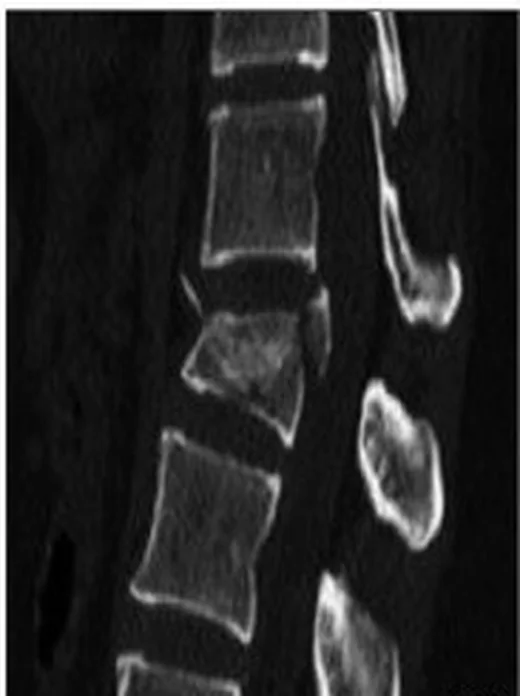
- Posterior korpus duvarında kortikal kırık ve kanala doğru yer değiştirmiş kemik parçası burst yaralanmasının ayırt edici morfolojisidir.
- AO Spine sistemine göre A4 tipi kırıklar, posterior duvar kırığı ve vertebra gövdesinin parçalanması ile seyreden tam (komplet) burst yaralanmalarını ifade eder.
- BT'de spinal kanal ön-arka çapı ve retropulse fragman boyutu ölçülür; spinal kanal darlığı derecelendirilir.
- Aksiyel görüntüde interpediküler mesafe genişlemesi ve korpus korteksinin parçalı kırık yapısı burst kırığında izlenebilir.
- Yerel kifotik açı ve vertebral yükseklik kaybı ölçülür; posterior duvar kırığı ve retropulsiyon tanımlanır.
- Lamina, spinöz çıkıntı ve fasetlerde kırık, ayrışma veya uyumsuzluk ek posterior gergi bandı hasarını düşündürür.
- Retropulsif fragmana eşlik eden epidural yumuşak doku yoğunluğu varsa hematom olasılığı belirtilir; bağ ve nöral yapı değerlendirmesi MR gerektirebilir.
Ölçütler ve sınıflamalar
- AO Spine A3
- Posterior duvar ve tek son plak tutulur; inkomplet burst kırığıdır.
- AO Spine A4
- AO Spine A4, komplet burst kırığı olarak sınıflandırılır.
Normalde
Torakolomber kırık değerlendirmesinde vertebral kama deformitesi, yükseklik kaybı, interpediküler mesafe genişlemesi ve spinal kanal darlığı ölçülebilir. Yaralı seviye komşu sağlam seviyelerle kıyaslanarak vertebral yükseklik kaybı, interpediküler genişleme ve spinal kanal darlığı niceliksel olarak belirlenir.
Normal BT ile kıyasla
Aynı bölgenin, kaynak veri setinde patoloji içermediği belirtilen bir BT incelemesini kesit kesit kaydırın; organ sınırlarını açarak anatomiyi hasta görüntüsüyle karşılaştırın. Küçük rastlantısal bulgular tümüyle dışlanmamıştır.
Kaynak: TotalSegmentator v2.01 veri seti (Wasserthal ve ark., Radiology: Artificial Intelligence 2023), CC BY 4.0, vaka s1338; organ sınırları veri setinin otomatik segmentasyonundan, birleştirilerek sadeleştirildi. Görüntüler 2,5 mm kesit aralığına yeniden örneklendi.
Ayırıcı tanı
- Kama kırıklarında vertebral gövde ön yükseklik kaybı ve belirgin kama deformitesi izlenirken; burst kırıklarından farklı olarak pedikül genişlemesi ve kanal daralması yoktur.
- Patolojik korpus kırığı
- örn. spinal tümör invazyonu — travmatik burst kırığı morfolojisini ve nörolojik kompresyonu taklit edebilir.
- Eski burst deformitesi
- kenarlar kortikeleşmiş ve kanal içi fragman yeniden şekillenmiş olabilir; akut kırık çizgisi ve çevresel hematom desteği yoktur.
Tuzaklar
- Vertebra gövdesindeki kırık hattının yayılımı tek bir düzlemde değerlendirilirse detaylar kaçabilir; üç boyutlu görüntüleme ve çoklu düzlem analizi kırık desenlerinin tam anlaşılmasını sağlar.
- Kanal daralmasını yalnız en dar ölçüyle raporlama; retropulsif parçanın korpusun hangi bölümünden kanala uzandığını ve posterior eleman bütünlüğünü de tarif et.
- Vertikal lamina kırığını otomatik olarak posterior gergi bandı kopması sayma; kırık yönü ve faset-interspinöz hizalanma önemlidir.
- Tüm travma hacminde eşlik eden başka bir vertebra kırığını ara; çok seviyeli omurga yaralanmaları tek seviyeli incelemeyle dışlanamaz.
Kendini dene
Burst kırığının en önemli karakteristik özelliği nedir?
Cevabı göster
Posterior duvar kırığı ve kanala retropulsiyon. Kaynak, burst kırığının en önemli karakteristik özelliğinin vertebral gövde posterior duvarının kırılması ve kemik fragmanlarının medüller kanala retropulse olması olduğunu belirtir.
Korpus kırığına eşlik eden fragman spinal kanal içine doğru yer değiştirmiş. Bu bulgu en çok hangi morfolojiyi destekler?
Cevabı göster
Burst kırığı. Posterior korpus duvarı kırığı ve kanal içine retropulsiyon burst yaralanmasıdır. Diğer seçeneklerde korpus posterior duvarından kanala uzanan fragman beklenmez.
İlgili konular
Kaynaklar
Bu sayfadaki 37 cümle ve 2 quiz sorusu aşağıdaki kaynaklardan alıntılarla tek tek karşılaştırıldı; 16 cümle bu karşılaştırmada düzeltildi (2026-10-08).
- Using Artificial Intelligence to Predict the Development of Kyphosis Disease: A Systematic Reviewpmc.ncbi.nlm.nih.gov
- Thoracolumbar Burst Fractures: A Systematic Review and Meta-Analysis on the Anterior and Posterior Approachespmc.ncbi.nlm.nih.gov
- Short Segment versus Long Segment Pedicle Screws Fixation in Management of Thoracolumbar Burst Fractures: Meta-Analysispmc.ncbi.nlm.nih.gov
- Nomogram that can predict failure of conservative treatment for thoracolumbar burst fracture was establishedpmc.ncbi.nlm.nih.gov
- One-Stage Posterior Open Fixation with SpineJack Expansion Kyphoplasty for Unstable A4 Complete Thoracolumbar Burst Fracture with Neurological Deficit: A Proof-of-Concept Case Seriespmc.ncbi.nlm.nih.gov
- Does Surgical Intervention or Timing of Surgery Have an Effect on Neurological Recovery in the Setting of a Thoracolumbar Burst Fracture?pubmed.ncbi.nlm.nih.gov
- Closed internal degloving associated with a thoracolumbar burst fracture: a case report.pubmed.ncbi.nlm.nih.gov
- Correlations between posterior longitudinal injury and parameters of vertebral body damage.pubmed.ncbi.nlm.nih.gov
- Mono-segment fixation of thoracolumbar burst fractures.pubmed.ncbi.nlm.nih.gov
- Use of Intraoperative Ultrasound During Spinal Surgery.pubmed.ncbi.nlm.nih.gov
- Low-value injury care in the adult orthopaedic trauma population: A systematic review.pubmed.ncbi.nlm.nih.gov
- [Improved method of treating thoracolumbar burst fracture by posterior pedicle fixation and grafting through injured vertebrae].pubmed.ncbi.nlm.nih.gov
- [Treatment of thoracolumbar burst fractures by posterior laminotomy decompression and bone grafting via injured vertebrae].pubmed.ncbi.nlm.nih.gov
- Minimally Invasive Spine Surgery for Unstable Thoracolumbar Burst Fractures: A Case Series.pubmed.ncbi.nlm.nih.gov
- Additional vertebral augmentation with posterior instrumentation for unstable thoracolumbar burst fractures.pubmed.ncbi.nlm.nih.gov
- Multiple parameters for evaluating posterior longitudinal ligaments in thoracolumbar burst fractures.pubmed.ncbi.nlm.nih.gov
- Relationship Between Clinical Outcomes and Spontaneous Canal Remodeling in Thoracolumbar Burst Fracture.pubmed.ncbi.nlm.nih.gov
- The mechanism of thoracolumbar burst fracture may be related to the basivertebral foramen.pubmed.ncbi.nlm.nih.gov
- Radiological study on disc degeneration of thoracolumbar burst fractures treated by percutaneous pedicle screw fixation.pubmed.ncbi.nlm.nih.gov
- Anatomical and biological reconstruction of traumatic complete burst fractures of the thoracolumbar vertebrae using pedicle fixation combined with stent-armed kyphoplasty and intracorporeal bone grafting: technique rationale, 7-year experience and clinical, imaging, and histological outcomes.pubmed.ncbi.nlm.nih.gov
- Intrabody Cage Augmentation in Kümmell Disease and Osteoporotic Burst Fractures: Technical Insights and Narrative Review of Current Evidence.pubmed.ncbi.nlm.nih.gov
- Anterior column reconstruction with mono-segmental fusion and lag screw fixation of sagittal split for burst-split fracture of the thoracolumbar spine.pubmed.ncbi.nlm.nih.gov
- Diagnostic decision-making, vertebral augmentation, and osteoporosis therapy in vertebral compression fractures: a narrative review.pubmed.ncbi.nlm.nih.gov
- Modified Spinous Process-Splitting Approach for Thoracolumbar Burst Fractures With Neurological Deficits: Technical Description and Preliminary Clinical Outcomes.pubmed.ncbi.nlm.nih.gov
- Minimally invasive surgical techniques for the treatment of thoracolumbar burst fractures.pubmed.ncbi.nlm.nih.gov
- A Review of the Literature on Surgical Management in the Acute Phase of Spinal Cord Injury: Expected Outcomes and the Influence of Surgical Timing.pubmed.ncbi.nlm.nih.gov
- Bilateral abducens nerve palsy following ligamentous C1-C2 distraction.pubmed.ncbi.nlm.nih.gov
- Commentary: an eye on PET quantification.pubmed.ncbi.nlm.nih.gov
- Traumatic vertebral fractures involve the anterior end plate more than the posterior end plate: A retrospective study.pubmed.ncbi.nlm.nih.gov
- Imaging update on musculoskeletal infections.pubmed.ncbi.nlm.nih.gov
- Identifying osteoporotic vertebral endplate and cortex fractures.pubmed.ncbi.nlm.nih.gov
- Expandable Intravertebral Implants: A Narrative Review on the Concept, Biomechanics, and Outcomes in Traumatology.pubmed.ncbi.nlm.nih.gov
- Analysis and improvement of the three-column spinal theory.pubmed.ncbi.nlm.nih.gov
- Classifying thoracolumbar fractures: role of quantitative imaging.pubmed.ncbi.nlm.nih.gov
- Cervical spine trauma.pubmed.ncbi.nlm.nih.gov
- Spine Trauma Classifications: Historical, Current, and Emerging Perspectives for Radiologists.pubmed.ncbi.nlm.nih.gov
- Subaxial Cervical Spine Fractures: Historical Systems and Advancements With the AO Spine Classification.pubmed.ncbi.nlm.nih.gov
- Classification of thoracic spine fractures: the four-column theory.pubmed.ncbi.nlm.nih.gov
- Thoracolumbar spine trauma: a guide for the FRCS examination.pubmed.ncbi.nlm.nih.gov
- Early experience with percutaneous balloon kyphoplasty for treatment of osteoporotic vertebral compression fracture in Nepal: A case report.pubmed.ncbi.nlm.nih.gov
- The role of radiography in the study of spinal disorders.pubmed.ncbi.nlm.nih.gov
- Agreement and discordance between the modified thoracolumbar injury classification and severity score and the thoracolumbar AOSpine injury score in guiding surgical decision-making for thoracolumbar fractures: a comparative study.pubmed.ncbi.nlm.nih.gov
- Does Size Matter? Evaluating the Impact of Intermediate Screw Length in Short-Segment Fixation of Thoracolumbar A3-A4 Fractures.pubmed.ncbi.nlm.nih.gov
- The evolution of cervical spine trauma classification: a paradigm shift from morphological description to clinical decision-making.pubmed.ncbi.nlm.nih.gov
- What Factors Contribute to the Poor Prognosis of Conservative Treatment for Osteoporotic Vertebral Compression Fracture (OVCF): A Systematic Review.pubmed.ncbi.nlm.nih.gov
- Inducing thoracolumbar burst fractures in human cadaveric specimens using a combined axial-flexion loading: a fracture simulation.pubmed.ncbi.nlm.nih.gov
- MRI study of post-traumatic incompetence of posterior ligamentous complex: importance of the supraspinous ligament. Prospective study of 74 traumatic fractures.pubmed.ncbi.nlm.nih.gov
- Pseudomyogenic hemangioendothelioma of the thoracolumbar spine: A case-based review of a rare cause of vertebral collapse and neurological deficit.pubmed.ncbi.nlm.nih.gov
- Biomaterials for vertebral body repair: interior augmentation and total replacement-a literature review of bone fusion outcomes in clinical studies.pubmed.ncbi.nlm.nih.gov
- Multifocal tuberculous osteomyelitis mimicking widespread bony metastases: review of literature and case report.pubmed.ncbi.nlm.nih.gov
- Intact Posterior Tension Band in Spinal Fractures in Patients With Spinal Ankylosing Disorders - Is it a Myth or a Reality? A Systematic Review.pubmed.ncbi.nlm.nih.gov
- Role of biophysical stimulation in multimodal management of vertebral compression fractures.pubmed.ncbi.nlm.nih.gov
- The American Society of Pain and Neuroscience (ASPN) Evidence-Based Clinical Guideline of Interventional Treatments for Low Back Pain.pubmed.ncbi.nlm.nih.gov
- An International Continence Society (ICS)/ International Urogynecological Association (IUGA) joint report on the terminology for the assessment and management of obstetric pelvic floor disorders.pubmed.ncbi.nlm.nih.gov
- Percutaneous vertebroplasty for osteoporotic vertebral compression fracture.pubmed.ncbi.nlm.nih.gov
- Efficacy of Proximal Junctional Tethering in Spinal Fusion Surgery for Preventing Proximal Junctional Kyphosis and Proximal Junctional Failure: A Meta-analysis.pubmed.ncbi.nlm.nih.gov
- A Proposal for a Standardized Imaging Algorithm to Improve the Accuracy and Reliability for the Diagnosis of Thoracolumbar Posterior Ligamentous Complex Injury in Computed Tomography and Magnetic Resonance Imaging.pubmed.ncbi.nlm.nih.gov
- Pediatric abusive spine trauma: a review of whole-spine imaging essentials.pubmed.ncbi.nlm.nih.gov
- Acute management of spinal fractures: What you need to know.pubmed.ncbi.nlm.nih.gov
- A Primer on Anatomy, Biophysics, Pathology, Imaging and Treatment of the Intervertebral Disc and the Anterior Spinal Column: The Discogenic, Intervertebral, Spinal Column (DISC) ASPN Workgroup.pubmed.ncbi.nlm.nih.gov
- Multilevel Lumbar CT Attenuation Beyond L1: Comparison with QCT-Derived Volumetric Bone Mineral Density and Prevalent Fragility Fracture Status in a Diagnostic Referral Cohort.pubmed.ncbi.nlm.nih.gov
- Operative Efficiency, Technical Workflow, and Perioperative Outcomes in Minimally Invasive Trans-Kambin Oblique Thoracic Interbody Fusion (MIS-OTIF): A Retrospective Clinical Analysis.pubmed.ncbi.nlm.nih.gov
- Comparative analysis of the efficacy of UBE-PLIF versus conventional PLIF in the treatment of L4-5 degenerative spondylolisthesis.pubmed.ncbi.nlm.nih.gov
- Extrapedicular approach for basivertebral nerve radiofrequency ablation: a conceptual review.pubmed.ncbi.nlm.nih.gov
- Non-Infectious Spinal Diseases Mimicking Infection: A Pictorial Essay.pubmed.ncbi.nlm.nih.gov
- Efficacy and Safety of Percutaneous Pedicle Screw Fixation for Neurologically Intact Thoracolumbar Burst Fractures: A Prospective Interventional Study.pubmed.ncbi.nlm.nih.gov
- Thoracolumbar injuries: non operative treatment: indications, management.pubmed.ncbi.nlm.nih.gov
- Accuracy of mapping results of thoracolumbar vertebral fracture verified using finite element analysis.pubmed.ncbi.nlm.nih.gov
- Dural tears from traumatic spinal fractures: an illustrative case and systematic review of its incidence, diagnosis, risk factors, and management.pubmed.ncbi.nlm.nih.gov
- Percutaneous Treatment of Traumatic A3 Burst Fractures of the Thoracolumbar Junction Without Neurological Impairment: The Role of Timing and Characteristics of Fragment Blocks on Ligamentotaxis Efficiency.pubmed.ncbi.nlm.nih.gov
- A prospective study of anterior versus posterior approach for traumatic thoracolumbar fractures: A systemic review.pubmed.ncbi.nlm.nih.gov
- Surgical management and outcomes analysis of lower lumbar (L3-L5) burst fractures: A single-center experience and meta-analysis.pubmed.ncbi.nlm.nih.gov
- Emergency radiology of severe acute injury in extreme alpine summer sports: a pictorial essay.pubmed.ncbi.nlm.nih.gov
- Reliability of thoracolumbar burst fracture classification in the Swedish Fracture Register.pubmed.ncbi.nlm.nih.gov
- Total laparoscopic radical hysterectomy for cervical cancer in prolapsed uterus.pubmed.ncbi.nlm.nih.gov
- The role of intracorporeal cancellous bone grafting in the biological augmentation of vertebral body fractures: a literature review, historical perspective, and update on imaging and bone healing outcomes.pubmed.ncbi.nlm.nih.gov
- Surgical Correction of Thoracolumbar Kyphosis in Achondroplasia: Complications, Pitfalls, and Reflections on the Pursuit of Maximal Realignment in View of Correction Leading to Functional Disability.pubmed.ncbi.nlm.nih.gov
- Application of the pivot forward combined leveraging technique in the treatment of thoracolumbar fractures: a finite element analysis and clinical study.pubmed.ncbi.nlm.nih.gov
- Short Segment Fixation with Inclusion of the Fractured Vertebra versus Long Segment Fixation for the Treatment of Thoracolumbar Fractures: A Randomized Controlled Trial.pubmed.ncbi.nlm.nih.gov
- 4 pedicle screw mono-segment versus 6 pedicle screw short-segment fixation in the treatment of thoracolumbar endplate fractures: finite element analysis and clinical follow-up.pubmed.ncbi.nlm.nih.gov
- The value of magnetic resonance imaging and computed tomography in the study of spinal disorders.pubmed.ncbi.nlm.nih.gov
- Cortical shell unwrapping for vertebral body abnormality detection on computed tomography.pubmed.ncbi.nlm.nih.gov
- Conservative Treatment of Pediatric Fractures-Narrative Review of Acceptable Deformity and Remodeling Potential.pubmed.ncbi.nlm.nih.gov
- Geriatric spine fractures - Demography, changing trends, challenges and special considerations: A narrative review.pubmed.ncbi.nlm.nih.gov
- Anatomy of the intraosseous arterial microvasculature of the adult lumbar vertebral body and its role in fracture healing: a literature review and historical perspective.pubmed.ncbi.nlm.nih.gov
- Nomogram that can predict failure of conservative treatment for thoracolumbar burst fracture was established.pubmed.ncbi.nlm.nih.gov
- Predictors of failure in posterior short segment instrumentation for thoracolumbar burst fractures: a systematic review and meta-analysis.pubmed.ncbi.nlm.nih.gov
- Spinal lesions: a comprehensive radiologic overview.pubmed.ncbi.nlm.nih.gov
- The association between vertical laminar fracture and recurrent kyphosis after implant removal of Thoracolumbar burst fracture: a retrospective study.pubmed.ncbi.nlm.nih.gov
- Diffusion-Weighted Imaging in the Musculoskeletal System: Evolving Role in Modern Imaging Practice.pubmed.ncbi.nlm.nih.gov
- Skeletal Involvement in Systemic Mastocytosis: Pathophysiology, Clinical Management, Standards of Care, and Novel Therapeutic Strategies.pubmed.ncbi.nlm.nih.gov
- Mechanical Instability After Civilian Thoracolumbar Gunshot Injuries: A Systematic Review to Support Classification Development.pubmed.ncbi.nlm.nih.gov
- Current status of short segment fixation in thoracolumbar spine injuries.pubmed.ncbi.nlm.nih.gov
- Management of Fractures of the Thoracolumbar Spine-A Narrative Review.pubmed.ncbi.nlm.nih.gov
- Determining the need for stabilising therapy of cervical spine injuries on CT: towards standardising decision-making in the emergency department.pubmed.ncbi.nlm.nih.gov
- Successful management of severe pediatric cervical trauma emphasizing the role of surgical stabilization and intensive rehabilitation in achieving complete recovery: a case report.pubmed.ncbi.nlm.nih.gov
- Magnetic Resonance Imaging for Spine Emergencies.pubmed.ncbi.nlm.nih.gov
- Using Equipoise to Determine the Radiographic Characteristics Leading to Agreement on Best Treatment for Thoracolumbar Burst Fractures Without Neurologic Deficits.pubmed.ncbi.nlm.nih.gov
- Fracture Patterns of an Osteolytic Hole Involved Lumbar Vertebra, Assessed for a Case Study by Computational Models.pubmed.ncbi.nlm.nih.gov
- Comparative analysis of two modified TLICS systems in guiding surgical decision-making for thoracolumbar fractures.pubmed.ncbi.nlm.nih.gov
- One-Stage Posterior Open Fixation with SpineJack Expansion Kyphoplasty for Unstable A4 Complete Thoracolumbar Burst Fracture with Neurological Deficit: A Proof-of-Concept Case Series.pubmed.ncbi.nlm.nih.gov
- The AO Spine Thoracolumbar Injury Classification System and Treatment Algorithm in Decision Making for Thoracolumbar Burst Fractures Without Neurologic Deficit.pubmed.ncbi.nlm.nih.gov
- Expert Opinion, Real-World Classification, and Decision-Making in Thoracolumbar Burst Fractures Without Neurologic Deficits?pubmed.ncbi.nlm.nih.gov
- Enhanced Detection Performance of Acute Vertebral Compression Fractures Using a Hybrid Deep Learning and Traditional Quantitative Measurement Approach: Beyond the Limitations of Genant Classification.pubmed.ncbi.nlm.nih.gov
- Improved Detection Accuracy of Chronic Vertebral Compression Fractures by Integrating Height Loss Ratio and Deep Learning Approaches.pubmed.ncbi.nlm.nih.gov
- The Integrated Nerve, Discoligamentous Complex, and Vertebra Scoring System for Thoracolumbar Junction (TLJ) Injury.pubmed.ncbi.nlm.nih.gov
Eğitim amaçlıdır; hasta başında tanı ve tedavi kararının yerine geçmez. İçerik yapay zekâ destekli bir süreçle güncel literatüre göre cümle cümle kaynaklarla karşılaştırıldı, ancak uzman radyolog incelemesinden geçmedi. Klinik kararlarda güncel kılavuzları, kurum protokollerini ve radyoloji raporunu esas alın.