Özet
Kemik Chance kırığı, öne doğru ani gövde fleksiyonunun vertebranın arka kemik gergi bandını çekerek tek seviyede transosseöz biçimde kopardığı travmatik yaralanmadır; kucak kemerinin karın üzerinden geçtiği yüksek enerjili çarpışmalar tipik bağlamlardan biridir. İnce kesit kontrastsız BT ve sagittal-koronal rekonstrüksiyonlar, vertebra korpusundaki yatay yarığın pediküllerden posterior arkaya uzanıp uzanmadığını ortaya koyar. Kırık hattı ve olası posterior duvar bileşeni mekanik yaralanmanın doğru tanımlanması için birlikte gösterilmelidir. Bu patern gözden kaçarsa omurga instabilitesi ve aynı mekanizmanın oluşturabileceği bağırsak-mezenter yaralanması fark edilmeyebilir.
Okuma sırası
- Vertebra korpusu. Horizonte yönlü kırık düzlemleri posterior elemanlarda radyografik olarak tanınabilir; sagittal görüntülerde korpus ve posterior ark boyunca uzanan çizgi izlenir.
- Sağ ve sol pedikül. Yarığın korpus arka bölümünden sağ ve sol pediküle nasıl ulaştığını aksiyel kesitlerde ayrı ayrı izle; iki taraflı aynı seviyeli kemik geçişi, çizginin yalnız gövde içinde kalmadığını gösterir.
- Lamina ve spinöz çıkıntı. Koronal ve sagittal görüntülerde çizgiyi lamina ile spinöz çıkıntıya kadar takip et; posterior arkta açılmış kenarlar kemik gergi bandının kırıldığını gösterir.
- İnterspinöz aralık ve fasetler. Yaralı seviyede posterior gergi bandı hasarını gösteren bulguları (faset uyumsuzluğu, yatay lamina kırığı, spinöz çıkıntı kırığı ve ≥4 mm interspinöz genişleme) ara ve kaydet.
- Spinal kanal ve abdominal mezenter. Son kontrolde arka korpus duvarını ve kanal içini retropulsiyon için tara; kemer tipi travma çekiminde mezenter, bağırsak duvarı ve serbest sıvı kesitlerine de dön.
Faz ve pencere
- Kontrastsız tanısal
- BT sagittal ve koronal reformatlarında, vertebra korpusundan geçerek posterior elemanlara uzanan yatay radyolüsent kırık hattı dikkatle izlenmelidir; bu kırıklar incelikli seyredebilir ve eşlik eden intraabdominal travma bulguları açısından tarama yapılmalıdır.
Önerilen pencereler: Kemik (G 1800 / M 400), Yumuşak doku (G 400 / M 40), Batın (G 400 / M 50).
BT bulguları
- Vertebra korpusunu enine geçen yarık, sagittal reformatta ön ve arka kortekse doğru izlenebilir; korpusun belirgin ezilmesi klasik saf B1 görünümünün parçası değildir.
- Aynı kırık düzleminin sağ veya sol pedikülden geçmesi, yalnız vertebra gövdesindeki transvers çatlaktan daha ileri posterior yayılımı gösterir.
- Lamina ya da spinöz çıkıntı boyunca kortikal kesinti ve iki kemik parça arasında aralık, posterior arkta transosseöz kopuşu tamamlar.
- Spinöz çıkıntılar arasındaki mesafenin komşu seviyeye göre artması fleksiyon-distraksiyon yönündeki ayrışmayı destekler; tek başına kemik Chance tanısı koydurmaz.
- Yatay kırık hattının posterior elemanlarda kemik sürekliliğini bozması veya ilişkili yumuşak doku hasarıyla birlikte görülmesi, gergi bandının kopuk olduğunu gösterir.
- Korpus arka duvarında kırık ve kanala doğru yer değiştirmiş fragman eşlik ederse ek burst bileşeni ayrıca belirtilir.
- Kemer tipi travmada eşlik eden iç organ yaralanmalarını ekarte etmek için abdominopelvik BT'de barsak ve mezenter tutulumu ayrıntılı olarak taranmalıdır.
Ölçütler ve sınıflamalar
- AO Spine torakolomber B tipi yaralanmalar, posterior gergi bandının tamamen kemik içinden ya da kemik-bağ dokudan kopması olarak ikiye ayrılır.
- Torakolomber omurgada B tipi yaralanmalar, posterior gergi bandının tamamen kemik içinden ya da kemik-bağ dokudan kopması şeklinde sınıflandırılır.
Normalde
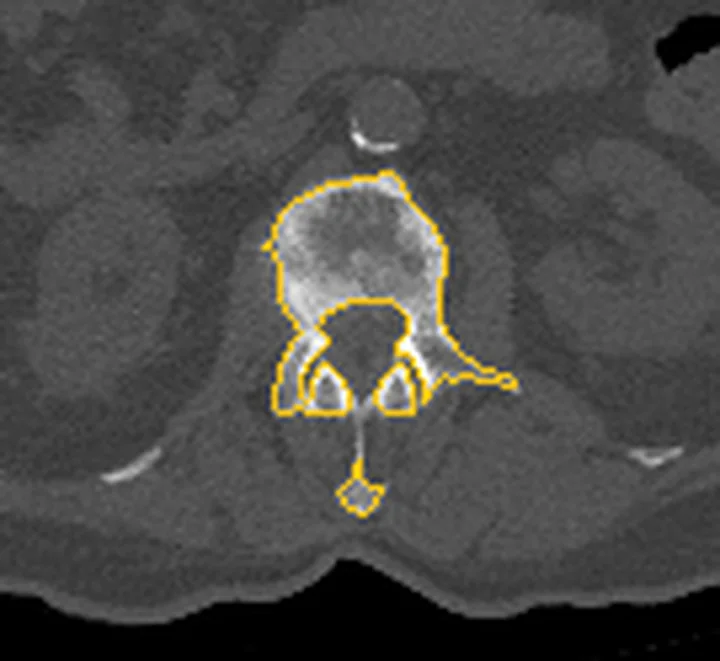
Normal vertebrada posterior elemanlar boyunca süreklilik izlenir; Chance kırığında bu bütünlüğü bozan yatay kırık hattı incelikli seyredebileceğinden multiplanar reformatlarda dikkatlice aranır. Şüpheli seviyeyi komşu vertebrayla karşılaştırırken yatay kortikal yarık, posterior kemik halkadaki devamı ve spinöz-faset hizasındaki açılmayı ara.
Normal BT ile kıyasla
Aynı bölgenin, kaynak veri setinde patoloji içermediği belirtilen bir BT incelemesini kesit kesit kaydırın; organ sınırlarını açarak anatomiyi hasta görüntüsüyle karşılaştırın. Küçük rastlantısal bulgular tümüyle dışlanmamıştır.
Kaynak: TotalSegmentator v2.01 veri seti (Wasserthal ve ark., Radiology: Artificial Intelligence 2023), CC BY 4.0, vaka s1338; organ sınırları veri setinin otomatik segmentasyonundan, birleştirilerek sadeleştirildi. Görüntüler 2,5 mm kesit aralığına yeniden örneklendi.
Ayırıcı tanı
- Ligamentöz veya osteoligamentöz fleksiyon-distraksiyon yaralanmaları, AO Spine sınıflamasında B-tipinin osseo-ligamentous alt grubunu oluşturur.
- Burst kırığı
- korpus arka duvarı parçalanır ve fragman kanala taşabilir; yatay yarığın posterior kemik gergi bandı boyunca devamı tanımlayıcı değildir.
- Osseo-ligamentous fleksiyon-distraksiyon yaralanmaları
- kemik yerine bağ dokulardan kopma gösterir, aynı yatay kırık hattını korpus ve pediküllerde oluşturmaz.
- Kronik pars interartikülaris defekti
- pars içinde sınırlı, çoğu kez kenarları kortike yarık görünür; vertebra korpusunu yatay kesmez.
Tuzaklar
- Yalnız korpus içindeki çizgiyi görüp incelemeyi bitirme; pediküllerin iki tarafını ve posterior arkı multiplanar reformatlarda izlemeden transosseöz Chance sınıflaması tamamlanmış olmaz.
- Spinöz çıkıntı aralığındaki genişlemeyi tek başına kemik Chance kanıtı sayma; bu bulgu ligamentöz yaralanmada da olabilir ve kemik hattının yokluğu ayrımı değiştirir.
- Korpus arka duvarındaki retropulsiyonu yatay kırığın olağan parçası gibi geçme; eşlik eden burst morfolojisini ayrı tarif et.
- Omurga penceresine odaklanırken aynı travma incelemesinin batın kesitlerini atlama; mezenter ve bağırsak bulguları kemik paterninden ayrı gözden geçirilmelidir.
Kendini dene
AO Spine torakolomber sınıflamasına göre B tipi yaralanmalar nasıl ayrılır?
Cevabı göster
Tamamen kemik içinden kopma ile kemik-bağ dokudan kopma. Kaynak, B-tipi yaralanmaların posterior gergi bandının tamamen kemik içinden (purely osseous) ya da kemik-bağ dokudan (osseo-ligamentous) kopması şeklinde ikiye ayrıldığını belirtir.
Kucak kemeri travması sonrası torakolomber transosseöz yatay kırık saptanıyor. Aynı mekanizma nedeniyle özellikle hangi BT bölgesi yeniden taranmalıdır?
Cevabı göster
Mezenter ve barsak. Lap kemeriyle ilişkili fleksiyon-distraksiyon kuvveti abdominal visseral ve mezenterik yaralanmayla birliktelik gösterebilir; bu nedenle batın kesitlerinde bağırsak, mezenter ve serbest sıvı bulguları aranır. Diğer seçenekler bu kırık mekanizmasının özellikle ilişkili abdominal eşlikçileri değildir.
İlgili konular
Kaynaklar
Bu sayfadaki 36 cümle ve 2 quiz sorusu aşağıdaki kaynaklardan alıntılarla tek tek karşılaştırıldı; 11 cümle bu karşılaştırmada düzeltildi (2026-10-08).
- Unstable Bony Chance Fracture Successfully Treated With Teriparatide in Patient With Ankylosed Spine: A Case Report and Review of the Literaturepmc.ncbi.nlm.nih.gov
- Posterior thoracic discectomy and interbody fusion for the correction of severe hyperkyphotic deformity: technical note and case reportpmc.ncbi.nlm.nih.gov
- Orbital Defect Size Reflects Structural Displacement but Not Ocular Motor Dysfunction: A Cohort Study of 1084 Patientspmc.ncbi.nlm.nih.gov
- CT for Cervical Spine Clearance in the Obtunded Adult Blunt Trauma Patient is Appropriate in a Resource‐Constrained Environmentpmc.ncbi.nlm.nih.gov
- Instability After Reverse Shoulder Arthroplasty: Evaluation, Diagnosis, Managementpmc.ncbi.nlm.nih.gov
- [Minimally invasive surgery for Chance fractures: Three case studies].pubmed.ncbi.nlm.nih.gov
- Unstable Bony Chance Fracture Successfully Treated With Teriparatide in Patient With Ankylosed Spine: A Case Report and Review of the Literature.pubmed.ncbi.nlm.nih.gov
- Evaluation of Clinical Outcomes of Management of Paediatric Bone Forearm Fractures using Titanium Elastic Nailing System: A Prospective Study of 50 Cases.pubmed.ncbi.nlm.nih.gov
- Osteochondral autograft transplantation in the treatment of AO/OTA type C3 tibial plafond fractures with irreducibly comminuted area and/or cartilage delamination in the distal tibial facet.pubmed.ncbi.nlm.nih.gov
- Nonoperative management of C-2 dens fractures: Single center experience and review of the literature.pubmed.ncbi.nlm.nih.gov
- Double-level noncontiguous thoracic Chance fractures treated with percutaneous stabilization: illustrative case.pubmed.ncbi.nlm.nih.gov
- Comparative analysis of cancellous graft and cortico-cancellous graft in osteosynthesis of scaphoid pseudoarthrosis with plate.pubmed.ncbi.nlm.nih.gov
- Frontal sinus fractures with suspected outflow tract obstruction: a new approach for sinus preservation.pubmed.ncbi.nlm.nih.gov
- Radiological features of traumatic vertebral endplate fracture: an analysis of 194 cases with 263 vertebral fractures.pubmed.ncbi.nlm.nih.gov
- Occult bladder wall injury with pelvic binder.pubmed.ncbi.nlm.nih.gov
- Isolated tympanic plate fracture detected by cone-beam computed tomography: report of four cases with review of literature.pubmed.ncbi.nlm.nih.gov
- Efficacy and Safety of Percutaneous Pedicle Screw Fixation for Neurologically Intact Thoracolumbar Burst Fractures: A Prospective Interventional Study.pubmed.ncbi.nlm.nih.gov
- Skeletal growth and development dictate the processes of vertebral fracture in the pediatric spine; a review emphasizing fracture biomechanics of the vertebral body during the period of skeletal immaturity.pubmed.ncbi.nlm.nih.gov
- Chance fracture: A case report and review of the literature.pubmed.ncbi.nlm.nih.gov
- Sacral dysmorphism and gender-specific variations: A CT-Based approach to safe percutaneous sacral screw placement - An ambispective study.pubmed.ncbi.nlm.nih.gov
- Evaluation of radiologists' accuracy and interrater reliability when interpreting CT scans after ventral hernia repair.pubmed.ncbi.nlm.nih.gov
- Interobserver reliability of computed tomography angiography in the assessment of ruptured intracranial aneurysm and impact on patient management.pubmed.ncbi.nlm.nih.gov
- Pseudomyogenic hemangioendothelioma of the thoracolumbar spine: A case-based review of a rare cause of vertebral collapse and neurological deficit.pubmed.ncbi.nlm.nih.gov
- Lipomatosis From Prolonged Use of Corticosteroids in Ethiopia: A Case Report.pubmed.ncbi.nlm.nih.gov
- Biomechanical investigation of elbow dislocation: comparative analysis using <i>Papio anubis</i> baboon and human cadaver models.pubmed.ncbi.nlm.nih.gov
- Hollow viscus injury due to blunt abdominal trauma: a tertiary trauma center experience.pubmed.ncbi.nlm.nih.gov
- Surgical management of high-grade pancreatic injuries: Insights from a high-volume pancreaticobiliary specialty unit.pubmed.ncbi.nlm.nih.gov
- An analysis of 77 cases of pancreatic injuries at a level one trauma center: Outcomes of conservative and surgical treatments.pubmed.ncbi.nlm.nih.gov
- Posterior thoracic discectomy and interbody fusion for the correction of severe hyperkyphotic deformity: technical note and case report.pubmed.ncbi.nlm.nih.gov
- A 3D-CT Study of the Cortical Bone Trajectory Screw Placement Parameters Based on Lumbar CT.pubmed.ncbi.nlm.nih.gov
- Partial vertebrectomy with spine shortening for old spondyloptosis at the thoracolumbar spine: a case series study and literature review.pubmed.ncbi.nlm.nih.gov
- Uni-portal non-coaxial spinal endoscopic surgery on percutaneous hollow screw fixation for atypical hangman's fracture: a novel minimally invasive technique case report.pubmed.ncbi.nlm.nih.gov
- Preoperative 3D-Planned S1 Corridors Transferred into 2D Fluoroscopy Allow for Safe Intraoperative Large-Diameter Implant Placement: Description of a Novel Sacroiliac Fixation Technique and Proof of Concept in 137 Implantations.pubmed.ncbi.nlm.nih.gov
- C-Arm Oblique View-Assisted Screw Placement Method for Extremely Small Lumbar Pedicles in Thoracolumbar Vertebral Body Fractures.pubmed.ncbi.nlm.nih.gov
- Chronic type 2 odontoid fracture with atlantoaxial spondyloptosis in an adult: a case report and literature review.pubmed.ncbi.nlm.nih.gov
- Simultaneous Cervical and Lumbar Vertebral Fracture-Dislocation in an Ankylosing Spondylitis Patient: A Case Report.pubmed.ncbi.nlm.nih.gov
- Atlantoaxial Reconstruction: The Artful Evolution of Craniovertebral Junctional Spine Surgery.pubmed.ncbi.nlm.nih.gov
- Dural tears from traumatic spinal fractures: an illustrative case and systematic review of its incidence, diagnosis, risk factors, and management.pubmed.ncbi.nlm.nih.gov
- Comparison of Two Posterior Minimally Invasive Approaches for Odontoid Fractures: Midline Nuchal Ligament Approach vs. Paramedian Muscle-Splitting Approach.pubmed.ncbi.nlm.nih.gov
- CT evaluation of pediatric craniocervical distraction injuries: a comprehensive review of morphometric parameters and practical applications.pubmed.ncbi.nlm.nih.gov
- Machine Learning Algorithm to Predict Change in the Decision-Making for Thoracolumbar Fractures Without Neurological Deficit After MRI: A Multicenter Study.pubmed.ncbi.nlm.nih.gov
- Intact Posterior Tension Band in Spinal Fractures in Patients With Spinal Ankylosing Disorders - Is it a Myth or a Reality? A Systematic Review.pubmed.ncbi.nlm.nih.gov
- Exploring the biomechanical mechanisms of cervical rotation manipulation in different lateral bending positions: a finite element analysis.pubmed.ncbi.nlm.nih.gov
- A Primer on Anatomy, Biophysics, Pathology, Imaging and Treatment of the Intervertebral Disc and the Anterior Spinal Column: The Discogenic, Intervertebral, Spinal Column (DISC) ASPN Workgroup.pubmed.ncbi.nlm.nih.gov
- Lateral lumbar and thoracic interbody fusion (LLIF) for thoracolumbar spine trauma (Trauma LLIF): A single-center, retrospective observational cohort study.pubmed.ncbi.nlm.nih.gov
- Imaging evaluation of traumatic thoracolumbar spine injuries: Radiological review.pubmed.ncbi.nlm.nih.gov
- AO spine injury classification system: a revision proposal for the thoracic and lumbar spine.pubmed.ncbi.nlm.nih.gov
- A literature review and case report: Traumatic appendicitis in an elderly patient with spinal cord injury and medical comorbidities.pubmed.ncbi.nlm.nih.gov
- High-Velocity Drag Racing Collision Leading to Rare Superior Mesenteric Branch Injury: A Case Report.pubmed.ncbi.nlm.nih.gov
- An atypical presentation of mesenteric bucket-handle injury following direct trauma during football: a case report.pubmed.ncbi.nlm.nih.gov
- Paper template-based intraoperative rod bending for percutaneous stabilization of thoracic extension-distraction fracture: illustrative case.pubmed.ncbi.nlm.nih.gov
- Surgical Outcome of a Giant Dorsal Spinal Neurofibroma: A Case Report.pubmed.ncbi.nlm.nih.gov
- Case Report: Long-term outcomes after surgery for spinal infiltrative lipoma in two dogs.pubmed.ncbi.nlm.nih.gov
- Anatomical and biological reconstruction of traumatic complete burst fractures of the thoracolumbar vertebrae using pedicle fixation combined with stent-armed kyphoplasty and intracorporeal bone grafting: technique rationale, 7-year experience and clinical, imaging, and histological outcomes.pubmed.ncbi.nlm.nih.gov
- Complications of vertebral augmentation in metastatic spinal fractures: a systematic review of multiple study designs.pubmed.ncbi.nlm.nih.gov
- Quantification in bone SPECT/CT.pubmed.ncbi.nlm.nih.gov
- Agreement and discordance between the modified thoracolumbar injury classification and severity score and the thoracolumbar AOSpine injury score in guiding surgical decision-making for thoracolumbar fractures: a comparative study.pubmed.ncbi.nlm.nih.gov
- Tension-band high-strength suture combined with absorbable screws with cortical penetration for treating Mayo type IIA olecranon fractures: finite element analysis, biomechanical testing, and clinical study.pubmed.ncbi.nlm.nih.gov
- Thoracolumbar Fractures: Historical Systems and Advancements With the AO Spine Classification.pubmed.ncbi.nlm.nih.gov
- The evolution of cervical spine trauma classification: a paradigm shift from morphological description to clinical decision-making.pubmed.ncbi.nlm.nih.gov
- Conservative Treatment of Pediatric Fractures-Narrative Review of Acceptable Deformity and Remodeling Potential.pubmed.ncbi.nlm.nih.gov
- Spine Trauma Classifications: Historical, Current, and Emerging Perspectives for Radiologists.pubmed.ncbi.nlm.nih.gov
- Surface Engineering for PMMA-Based Removable Prostheses: A Narrative Review.pubmed.ncbi.nlm.nih.gov
- Fracture Patterns in Fatal Free Falls: A Systematic Review of Intrinsic and Extrinsic Risk Factors and the Role of Postmortem CT.pubmed.ncbi.nlm.nih.gov
- Rugby Injury Imaging.pubmed.ncbi.nlm.nih.gov
- Clinical Utility of Physical Examination Findings in Pediatric and Adolescent Acute Spondylolysis.pubmed.ncbi.nlm.nih.gov
- The Spine is the Tree of Life: A Systematic Review and Meta-Analysis of the Radiographic Findings Related to Spinal Injuries in Athletes.pubmed.ncbi.nlm.nih.gov
- Predictive Factors for the Outcome of Surgical Treatment of Lumbar Spondylolysis in Young Sporting Individuals.pubmed.ncbi.nlm.nih.gov
- Radiological investigation of acute mandibular injury.pubmed.ncbi.nlm.nih.gov
- Magnetic resonance imaging of the shoulder.pubmed.ncbi.nlm.nih.gov
- Long-term safety and effectiveness of the "OptEase" vena cava filter.pubmed.ncbi.nlm.nih.gov
- Advances in the Clinical Diagnostics to Equine Back Pain: A Review of Imaging and Functional Modalities.pubmed.ncbi.nlm.nih.gov
- Why you should wear your seatbelt on an airplane: Burst fracture of the atlas (jefferson fracture) due to in-flight turbulence.pubmed.ncbi.nlm.nih.gov
- The development and evaluation of the subaxial injury classification scoring system for cervical spine trauma.pubmed.ncbi.nlm.nih.gov
- Magnetic Resonance Imaging for Spine Emergencies.pubmed.ncbi.nlm.nih.gov
- Emergency management of severe polytrauma with traumatic diaphragmatic hernia via EMSS: case report and literature review.pubmed.ncbi.nlm.nih.gov
- Imaging in polytrauma - Principles and current concepts.pubmed.ncbi.nlm.nih.gov
- Isolated Atypical Pedicle Stress Fractures in Patients on Prolonged Bisphosphonate Therapy: Report of Two Cases and a Literature-Based Proposal for Diagnostic Criteria.pubmed.ncbi.nlm.nih.gov
- 3D printed patient-specific drill guide for percutaneous pedicle screw fixation in lumbosacral vertebrae in dogs: A cadaveric study and clinical case report.pubmed.ncbi.nlm.nih.gov
- Microanatomy and spatial analysis of the muscular triangle involving the vertebral artery's third segment.pubmed.ncbi.nlm.nih.gov
- Surgery of the tumors of the spine.pubmed.ncbi.nlm.nih.gov
- Magnetic resonance imaging of the spine.pubmed.ncbi.nlm.nih.gov
- Biportal endoscopic laminectomy vs. open-door laminoplasty for 2-3 levels of cervical myelopathy: a prospective observational cohort study.pubmed.ncbi.nlm.nih.gov
- Interspinous process fixation versus posterior lumbar interbody fusion following decompression for single-level grade I degenerative spondylolisthesis: a retrospective propensity score-matched study.pubmed.ncbi.nlm.nih.gov
- Sagittal Alignment and Segmental Mobility After Cervical Intradural Extramedullary Tumor Surgery: A Comparative Analysis of Unilateral Hemilaminectomy and Laminotomy with Laminoplasty.pubmed.ncbi.nlm.nih.gov
- Chance-type fractures of the thoracolumbar spine: imaging analysis in 53 patients.pubmed.ncbi.nlm.nih.gov
- Comparing 3 Different Techniques of Patella Fracture Fixation and Their Complications.pubmed.ncbi.nlm.nih.gov
- Interventions for treating proximal humeral fractures in adults.pubmed.ncbi.nlm.nih.gov
- Postoperative X-ray and CT measurement of mounting parameter accuracy for hexapod external fixator in treating tibial fractures: a retrospective study.pubmed.ncbi.nlm.nih.gov
- Use of artificial intelligence for classification of fractures around the elbow in adults according to the 2018 AO/OTA classification system.pubmed.ncbi.nlm.nih.gov
- Biphasic small bowel perforation after blunt abdominal trauma: a case report of delayed ischaemic progression and re-perforation.pubmed.ncbi.nlm.nih.gov
- Evaluation of Pediatric Patients with Blunt Abdominal Trauma: A Systematic Review, Meta-Analysis, and Practice Management Recommendations.pubmed.ncbi.nlm.nih.gov
- Traumatic abdominal wall injuries in postmortem CT.pubmed.ncbi.nlm.nih.gov
- Fetal parietal bone fracture in late 3rd trimester secondary to traffic accident with improper seatbelt use: a case report.pubmed.ncbi.nlm.nih.gov
- Posterior Fixation Combined with Anterior Transoral Plate Osteosynthesis for Chronic Gehweiler IIIb Atlas Fracture-Dislocation: Case Report and Literature Review.pubmed.ncbi.nlm.nih.gov
- Clinical effects and risk factors of transoral Jefferson's fracture reduction and plating in Jefferson's fracture.pubmed.ncbi.nlm.nih.gov
- Safety and Stability of a Combined C2 Screw Placement Strategy With Vertebral Artery Mobilization.pubmed.ncbi.nlm.nih.gov
- Orbital Defect Size Reflects Structural Displacement but Not Ocular Motor Dysfunction: A Cohort Study of 1084 Patients.pubmed.ncbi.nlm.nih.gov
- Indications and Limitations of Standalone Percutaneous Vertebroplasty for Reverse Chance Fractures Associated With Ankylosing Spinal Disorders.pubmed.ncbi.nlm.nih.gov
- Complete abdominal aortic occlusion following seat-belt trauma: a proposal for early recognition.pubmed.ncbi.nlm.nih.gov
- Massive traumatic abdominal wall hernia in pediatric multitrauma in Australia: a case report.pubmed.ncbi.nlm.nih.gov
- Pediatric chance fracture with seatbelt syndrome: A case report.pubmed.ncbi.nlm.nih.gov
- Comparative Clinical Efficacy and Safety of Multi-Segment Thoracolumbar Tuberculosis Treated Through the Posterior "Detour Method" Versus the Combined Anterior-Posterior Approach: A Technique Note and Preliminary Retrospective Study.pubmed.ncbi.nlm.nih.gov
- Koala Kyphoscoliosis: Radiographic and CT Features of Abnormal Vertebral Column Curvature in Koalas (<i>Phascolarctos cinereus</i>) of the Mount Lofty Ranges, South Australia.pubmed.ncbi.nlm.nih.gov
- Anatomy and pathology of facet joint.pubmed.ncbi.nlm.nih.gov
- Imaging features of primary tumors of the spine: A pictorial essay.pubmed.ncbi.nlm.nih.gov
- Arthroscopic-Assisted Uni-Portal Spinal Surgery Combined With Kirschner Wire Anchoring for Cervical Spondylotic Radiculopathy: A Technical Note and Preliminary Clinical Results.pubmed.ncbi.nlm.nih.gov
- Spinal lesions: a comprehensive radiologic overview.pubmed.ncbi.nlm.nih.gov
- Pediatric spinal injuries- current concepts.pubmed.ncbi.nlm.nih.gov
- First Clinical Experience with a Novel 3D C-Arm-Based System for Navigated Percutaneous Thoracolumbar Pedicle Screw Placement.pubmed.ncbi.nlm.nih.gov
- Multidisciplinary management of spinal metastases: what the radiologist needs to know.pubmed.ncbi.nlm.nih.gov
Eğitim amaçlıdır; hasta başında tanı ve tedavi kararının yerine geçmez. İçerik yapay zekâ destekli bir süreçle güncel literatüre göre cümle cümle kaynaklarla karşılaştırıldı, ancak uzman radyolog incelemesinden geçmedi. Klinik kararlarda güncel kılavuzları, kurum protokollerini ve radyoloji raporunu esas alın.