Özet
Kama kompresyon kırığı, travma sonrası veya düşük enerjili yüklenmede vertebra korpusunun özellikle ön bölümünün çökmesiyle görülür. BT, son plak impaksiyonunu, kortikal kırık hattını ve posterior duvarın korunup korunmadığını hızla ortaya koyar; posterior duvar tutulumu varsa yaralanma basit kama kırığı olarak adlandırılmamalıdır. Akut ve eski deformiteyi ayırmada kırık hattı, kortikal kontur ve eşlik eden yumuşak doku bulguları yardımcıdır, ancak kırık yaşını kesinleştirmede MR kemik iliği ödemini gösterir. Posterior duvar uzanımı veya eşlik eden instabilite atlanırsa kanal riski ve yaralanma sınıflaması eksik kalabilir.
Okuma sırası
- Torakolomber korpuslar. Sagittal kemik rekonstrüksiyonunda T12–L2 bileşkesini bul ve komşu korpusların ön duvar hizasını takip ederek yükseklik kaybının merkezini belirle.
- Kırık son plağı. Çöken son plak boyunca trabeküler sıkışma ve kortikal basamaklanma ara; kırık çizgisinin hangi son plakla ilişkili olduğunu göster.
- Korpus ön ve arka duvarı. Ön korpus yüksekliğini üst ve alt komşu seviyelerle kıyasla, sonra posterior korteksi aksiyel kesitlerde de kesintisiz izleyerek burst bileşenini dışla.
- Kırık düzeyi ve korpus konturu. Fokal kifotik açılanmayı tarif et ve keskin kortikal kırık hattı ile kortike yeniden şekillenmeyi ayır; BT tek başına ödemin yaşını belirlemez.
- Posterior elemanlar ve spinal kanal. Son olarak pedikülleri, posterior elemanları, kanal çapını ve komşu seviyeleri tarayarak eşlik eden kırık veya retropulsiyon olup olmadığını göster.
Faz ve pencere
- Kontrastsız tanısal
- İnce kesit kontrastsız BT'nin kemik algoritmalı sagittal ve koronal rekonstrüksiyonlarında ön korpus yüksekliği kaybı, son plakta çökme ve kortikal kesinti izlenir; kırık morfolojisi için intravenöz kontrast gerekmez.
Önerilen pencereler: Kemik (G 1800 / M 400), Yumuşak doku (G 400 / M 40).
BT bulguları
- Ön korpus kama biçimli alçalır; komşu sağlam vertebraların konturlarıyla karşılaştırıldığında ön yükseklik kaybı belirgindir.
- Üst veya alt son plakta fokal çökme ve trabeküler impaksiyon görülür; karşı son plağın ve posterior duvarın devamlılığı ayrıca izlenir.
- Akut kırık lehine keskin radyolüsent hat korteksi keser veya son plak altında uzanır; tek başına kemik iliği yoğunluğu BT'de yaş tayini sağlamaz.
- Posterior korpus duvarının düzgün ve kesintisiz kalması izole A1 kama morfolojisini destekler; duvar fragmanı kanala taşmışsa burst morfolojisi düşünülür.
- Fokal kifotik açılanma yaralanan seviyede ölçülür ve komşu disk aralıkları ile vertebral hizalanma üzerinden tarif edilir.
- Paravertebral yumuşak doku şişliği veya hematom akut travmayı destekleyebilir; yokluğu kırığı dışlamaz.
- Kronik deformitede kortikal kenarlar yeniden şekillenmiş ve kortike görünür; keskin akut kırık çizgisi genellikle yoktur.
Ölçütler ve sınıflamalar
- AO Spine A1
- Bir veya iki son plak tutulabilir; kırık hatları birbirine bağlanmaz ve posterior korpus duvarı tutulmamıştır. Posterior duvar kırığı varsa A1 kullanılmaz.
Normalde
Normal torakolomber korpusta ön ve arka duvarlar paralel, son plaklar düzgün konkav veya hafif düz konturlu, korpus yüksekliği komşu seviyelerle uyumludur. Aynı sagittal düzlemde ön korpus yüksekliğini, son plak çizgisinin kesintisizliğini ve posterior duvarın kanal sınırına göre konumunu kıyasla.
Normal BT ile kıyasla
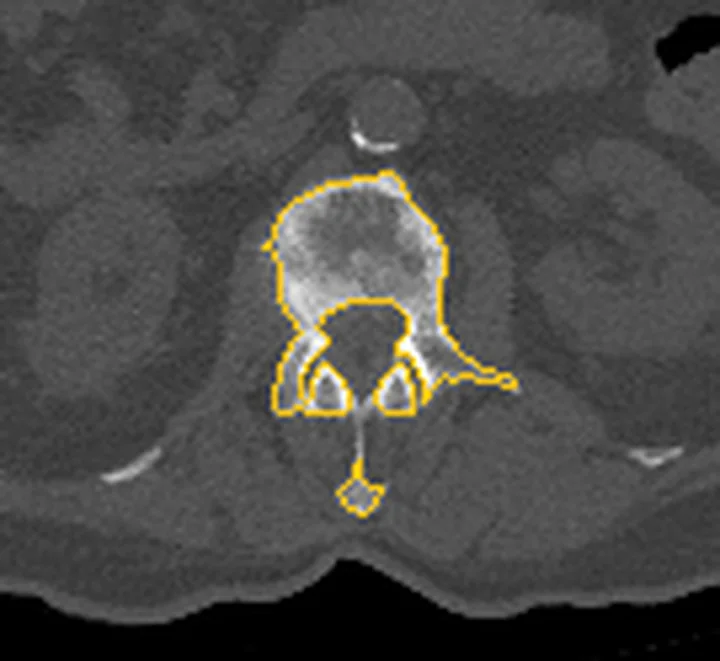
Aynı bölgenin, kaynak veri setinde patoloji içermediği belirtilen bir BT incelemesini kesit kesit kaydırın; organ sınırlarını açarak anatomiyi hasta görüntüsüyle karşılaştırın. Küçük rastlantısal bulgular tümüyle dışlanmamıştır.
Kaynak: TotalSegmentator v2.01 veri seti (Wasserthal ve ark., Radiology: Artificial Intelligence 2023), CC BY 4.0, vaka s1338; organ sınırları veri setinin otomatik segmentasyonundan, birleştirilerek sadeleştirildi. Görüntüler 2,5 mm kesit aralığına yeniden örneklendi.
Ayırıcı tanı
- Burst kırığı
- posterior korpus duvarında kırık ve kanala doğru retropulsiyon izlenir.
- Eski kompresyon deformitesi
- kortikal kenarlar yeniden şekillenmiş ve kortike görünür; akut keskin kırık çizgisi olmayabilir.
- Schmorl nodu, intervertebral diskin son plak üzerinden vertebra korpusu içine fokal herniasyonudur.
- Patolojik kırık
- litik veya sklerotik kemik lezyonu, pedikül tutulumu ya da yumuşak doku kitlesi eşlik edebilir.
- Gelişimsel kama vertebra
- düzgün kortike kontur ve kronik şekil değişikliği vardır; akut kortikal kesinti beklenmez.
Tuzaklar
- Ön duvar çökmesini tek başına A1 diye sınıflama; sagittal ve aksiyel kesitlerde posterior duvarın her iki kenarını izle.
- Kronik osteoporotik çökmeyi yeni travma olarak yorumlama; kortikal kenarların kortikasyonu ve eski görüntülerle karşılaştırma yardımcıdır.
- BT'de kırık hattının görünmemesi akut kırığı dışlamaz; ağrı düzeyiyle uyum sürüyorsa MR'da kemik iliği ödemi değerlendirilir.
- Bir vertebra kırığı bulunduğunda travma BT'sinin diğer seviyelerinde ek kırık aramayı bırakma; çok seviyeli ve atlanan yaralanmalar mümkündür.
Kendini dene
T12'de tek son plak çökmesi ve ön yükseklik kaybı var; posterior duvar kesintisiz. En uygun AO morfolojisi hangisidir?
Cevabı göster
A1 kama kırığı. Tek son plak impaksiyonu ve posterior duvarın korunması A1 ile uyumludur. AOSpine sınıflamaya göre A tipi yaralanmalar kama impaksiyonu, bölünme, pençe, eksik burst ve tam burst alt tiplerini kapsar; B tipi yaralanmalar posterior gergi bantının kemikli veya osteo-ligamentöz kopmasını ifade eder.
Ön korpus çökmesine ek olarak posterior duvar kırığı ve kanala doğru yer değiştirmiş kemik fragmanı görülüyor. Hangi kırık morfolojisi en uygundur?
Cevabı göster
Burst kırığı. Posterior duvar tutulumu burst kırığı morfolojisiyle uyumludur; komplet burst kırığında her iki son plak ve posterior vertebral duvar tutulur.
İlgili konular
- Torakolomber burst kırığı
- Ligamentöz fleksiyon-distraksiyon yaralanması
- Anterior distraksiyon/hiperekstansiyon yaralanması
Kaynaklar
Bu sayfadaki 39 cümle ve 2 quiz sorusu aşağıdaki kaynaklardan alıntılarla otomatik olarak karşılaştırıldı; 3 cümle bu karşılaştırmada düzeltildi (2026-10-09).
- Diagnostic decision-making, vertebral augmentation, and osteoporosis therapy in vertebral compression fractures: a narrative reviewpmc.ncbi.nlm.nih.gov
- Pseudomyogenic hemangioendothelioma of the thoracolumbar spine: A case-based review of a rare cause of vertebral collapse and neurological deficitpmc.ncbi.nlm.nih.gov
- Deep Learning-Assisted Radiomics for Predicting Thoracolumbar Osteoporotic Vertebral Fracturespmc.ncbi.nlm.nih.gov
- An exploratory multimodal imaging and clinicopathological strategy for suspected Kümmell’s disease in the absence of MRIpmc.ncbi.nlm.nih.gov
- Anatomical and biological reconstruction of traumatic complete burst fractures of the thoracolumbar vertebrae using pedicle fixation combined with stent-armed kyphoplasty and intracorporeal bone grafting: technique rationale, 7-year experience and clinical, imaging, and histological outcomespmc.ncbi.nlm.nih.gov
- Malunion of post-traumatic thoracolumbar fractures.pubmed.ncbi.nlm.nih.gov
- Classifying thoracolumbar fractures: role of quantitative imaging.pubmed.ncbi.nlm.nih.gov
- Minimally invasive surgical treatment options for osteoporotic vertebral fractures OF4.pubmed.ncbi.nlm.nih.gov
- Evaluation of wedging of lower thoracic and upper lumbar vertebral bodies in the pediatric population.pubmed.ncbi.nlm.nih.gov
- Distal Junctional Failures in Degenerative Thoracolumbar Hyperkyphosis.pubmed.ncbi.nlm.nih.gov
- Surgical treatment of low lumbar osteoporotic vertebral collapse: a single-institution experience.pubmed.ncbi.nlm.nih.gov
- Height restoration and sustainability using bilateral vertebral augmentation systems for vertebral compression fractures: a cadaveric study.pubmed.ncbi.nlm.nih.gov
- 3D Computed Tomography Mapping of Thoracolumbar Vertebrae Fractures.pubmed.ncbi.nlm.nih.gov
- Percutaneous pedicle screw fixation combined with selective transforaminal endoscopic decompression for the treatment of thoracolumbar burst fracture.pubmed.ncbi.nlm.nih.gov
- Efficacy and Safety Evaluation of Bilateral Pedicle Approach Combined with Positional Reduction for the Treatment of Osteoporotic Thoracolumbar Burst Fractures.pubmed.ncbi.nlm.nih.gov
- Sagittal correction after short percutaneous fixation for thoracolumbar compression fractures: comparison of the combination of SpineJack® kyphoplasty and fractured vertebra screw fixation.pubmed.ncbi.nlm.nih.gov
- Single vs Double Index Screws in Thoracolumbar Burst Fractures: A Retrospective Analysis.pubmed.ncbi.nlm.nih.gov
- Cone-beam computed tomography guided unipedicular central stentoplasty of the thoracolumbar spine: Early technical experience and results.pubmed.ncbi.nlm.nih.gov
- A nonlinear finite element model validation study based on a novel experimental technique for inducing anterior wedge-shape fractures in human vertebral bodies in vitro.pubmed.ncbi.nlm.nih.gov
- Diagnostic decision-making, vertebral augmentation, and osteoporosis therapy in vertebral compression fractures: a narrative review.pubmed.ncbi.nlm.nih.gov
- An Investigation of the Etiology and Pattern of Spinal Injuries Among Patients Presenting to the Emergency Department in a Tertiary Care Hospital.pubmed.ncbi.nlm.nih.gov
- Modified bone-disc-bone osteotomy (MBDBO) for the treatment of spinal kyphotic deformity secondary to old thoracolumbar vertebral fracture: a retrospective study with 2-year follow-up.pubmed.ncbi.nlm.nih.gov
- Anatomical and biological reconstruction of traumatic complete burst fractures of the thoracolumbar vertebrae using pedicle fixation combined with stent-armed kyphoplasty and intracorporeal bone grafting: technique rationale, 7-year experience and clinical, imaging, and histological outcomes.pubmed.ncbi.nlm.nih.gov
- The evolution of cervical spine trauma classification: a paradigm shift from morphological description to clinical decision-making.pubmed.ncbi.nlm.nih.gov
- Agreement and discordance between the modified thoracolumbar injury classification and severity score and the thoracolumbar AOSpine injury score in guiding surgical decision-making for thoracolumbar fractures: a comparative study.pubmed.ncbi.nlm.nih.gov
- Inter-observer reliability of osteoporotic fracture classification across imaging modalities for thoracolumbar osteoporotic fractures.pubmed.ncbi.nlm.nih.gov
- Clinical Outcomes of Balloon Kyphoplasty for Osteoporotic Vertebral Fractures With Posterior Element Injury: A Retrospective Study.pubmed.ncbi.nlm.nih.gov
- Combined vertebroplasty and pregabalin versus vertebroplasty alone for osteoporotic thoracolumbar fractures with referred pain: a retrospective cohort study.pubmed.ncbi.nlm.nih.gov
- Microvascular anatomy and mapping of intraosseous arterioles in the human L1 vertebral body: a histological study, literature comparison, and relevance for fracture healing.pubmed.ncbi.nlm.nih.gov
- AO spine injury classification system: a revision proposal for the thoracic and lumbar spine.pubmed.ncbi.nlm.nih.gov
- Opportunistic Screening at Abdominal CT: Use of Automated Body Composition Biomarkers for Added Cardiometabolic Value.pubmed.ncbi.nlm.nih.gov
- Intraoperative three-dimensional imaging-guided vertebral body stenting for cleft-associated very severe osteoporotic vertebral compression fractures: a surgical technique case series.pubmed.ncbi.nlm.nih.gov
- Age-related changes in dorsal and ventral vertebral body height of the T12 vertebra in females: A magnetic resonance imaging study.pubmed.ncbi.nlm.nih.gov
- A study on the factors influencing the improvement of spinal kyphosis after percutaneous vertebroplasty for thoracolumbar compression fractures in the elderly.pubmed.ncbi.nlm.nih.gov
- Anatomy of the intraosseous arterial microvasculature of the adult lumbar vertebral body and its role in fracture healing: a literature review and historical perspective.pubmed.ncbi.nlm.nih.gov
- Shaping the future of spinal implants: advancing bioactive composites with 3D printing for next-generation surgical care.pubmed.ncbi.nlm.nih.gov
- Biomaterials for vertebral body repair: interior augmentation and total replacement-a literature review of bone fusion outcomes in clinical studies.pubmed.ncbi.nlm.nih.gov
- Atypical Femoral Fracture Secondary to Long-Term Bisphosphonate Use: A Case Report.pubmed.ncbi.nlm.nih.gov
- Radiological Diagnosis and Advances in Imaging of Vertebral Compression Fractures.pubmed.ncbi.nlm.nih.gov
- Validation of the TLICS and AOSpine injury score for surgical management of paediatric traumatic spinal injuries.pubmed.ncbi.nlm.nih.gov
- Application of the pivot forward combined leveraging technique in the treatment of thoracolumbar fractures: a finite element analysis and clinical study.pubmed.ncbi.nlm.nih.gov
- Microscopic far lateral transforaminal lumbar/thoracolumbar interbody fusion for patients with kyphotic Kummell's disease - a retrospective comparison study with bone cement enhanced screws plus vertebroplasty.pubmed.ncbi.nlm.nih.gov
- The bisegmental Cobb angle in osteoporotic spine fractures: Does it influence treatment decision or functional outcome?pubmed.ncbi.nlm.nih.gov
- Concomitant osteoporotic vertebral compression fracture and infectious spondylitis in a patient with herpes zoster: A case report.pubmed.ncbi.nlm.nih.gov
- Interventional Pain Procedures: A Narrative Review Focusing on Safety and Complications. Part 3 - Sympathetic and Ganglion-Targeted Techniques.pubmed.ncbi.nlm.nih.gov
- Paravertebral soft tissue swelling on magnetic resonance images helps in differentiation between osteoporotic and malignant vertebral fractures.pubmed.ncbi.nlm.nih.gov
- Efficacy of polymethyl methacrylate combined with calcium phosphate cement in percutaneous vertebroplasty for postmenopausal women with osteoporotic thoracolumbar compression fractures.pubmed.ncbi.nlm.nih.gov
- Radiomics in spinal research: a narrative review.pubmed.ncbi.nlm.nih.gov
- 4 pedicle screw mono-segment versus 6 pedicle screw short-segment fixation in the treatment of thoracolumbar endplate fractures: finite element analysis and clinical follow-up.pubmed.ncbi.nlm.nih.gov
- The effectiveness of posterior Schanz screw system in the anatomical restoration of thoracolumbar vertebral burst fractures: A 10-year single-institution experience.pubmed.ncbi.nlm.nih.gov
- Axial Skeleton Bone Marrow Changes in Inflammatory Rheumatologic Disorders.pubmed.ncbi.nlm.nih.gov
- Single-Position Minimally Invasive Retropleural Asymmetric Vertebral Column Resection and Percutaneous Pedicle Screw Fixation in the Lateral Position for Congenital Kyphoscoliosis.pubmed.ncbi.nlm.nih.gov
- Compression fracture of the T12 vertebra combined with diaphragmatic hernia after low-energy trauma: a case report and literature review.pubmed.ncbi.nlm.nih.gov
- Surgery of the tumors of the spine.pubmed.ncbi.nlm.nih.gov
- Flexion teardrop fracture of the cervical spine: a narrative review.pubmed.ncbi.nlm.nih.gov
- Determining the need for stabilising therapy of cervical spine injuries on CT: towards standardising decision-making in the emergency department.pubmed.ncbi.nlm.nih.gov
- Long-term safety and effectiveness of the "OptEase" vena cava filter.pubmed.ncbi.nlm.nih.gov
- Intact Posterior Tension Band in Spinal Fractures in Patients With Spinal Ankylosing Disorders - Is it a Myth or a Reality? A Systematic Review.pubmed.ncbi.nlm.nih.gov
- The value of magnetic resonance imaging and computed tomography in the study of spinal disorders.pubmed.ncbi.nlm.nih.gov
- Modified percutaneous Kyphoplasty technique in the treatment of osteoporotic thoracolumbar burst fractures: could it reduce the odds of cement leakage?pubmed.ncbi.nlm.nih.gov
- Emergency radiology of severe acute injury in extreme alpine summer sports: a pictorial essay.pubmed.ncbi.nlm.nih.gov
- Atlantoaxial rotatory subluxation in a pediatric patient with osteopetrosis following minor trauma: illustrative case.pubmed.ncbi.nlm.nih.gov
- An exploratory multimodal imaging and clinicopathological strategy for suspected Kümmell's disease in the absence of MRI.pubmed.ncbi.nlm.nih.gov
- Axial Spondyloarthritis: Mimics and Pitfalls of Imaging Assessment.pubmed.ncbi.nlm.nih.gov
- Pseudomyogenic hemangioendothelioma of the thoracolumbar spine: A case-based review of a rare cause of vertebral collapse and neurological deficit.pubmed.ncbi.nlm.nih.gov
- Imaging Evaluation of Bone Tumors in the Cervical Spine: A Comprehensive Review.pubmed.ncbi.nlm.nih.gov
- Multiple Myeloma Presenting as Cauda Equina Syndrome: A Rare and Early Spinal Manifestation.pubmed.ncbi.nlm.nih.gov
- Congenital and Breed-Associated Vertebral Anomalies in Dogs and Cats: Developmental Anatomy, Genetic Determinants, and Biological Significance.pubmed.ncbi.nlm.nih.gov
- Surgical Correction of Thoracolumbar Kyphosis in Achondroplasia: Complications, Pitfalls, and Reflections on the Pursuit of Maximal Realignment in View of Correction Leading to Functional Disability.pubmed.ncbi.nlm.nih.gov
- Congenital Scoliosis: A Comprehensive Review of Diagnosis, Management, and Surgical Decision-Making in Pediatric Spinal Deformity-An Expanded Narrative Review.pubmed.ncbi.nlm.nih.gov
- Internal-locking intramedullary nails (talons, claws, wings, wedge-locks, endopins): a mechanics-guided scoping review of designs, failure signatures, and technique imperatives.pubmed.ncbi.nlm.nih.gov
- Deep learning model for differentiating acute and chronic osteoporotic vertebral compressive fractures on multidetector CT: a retrospective study with external validation.pubmed.ncbi.nlm.nih.gov
- The role of musculoskeletal radiologists in emergency and trauma settings: current and emerging imaging modalities.pubmed.ncbi.nlm.nih.gov
- Precision stratified treatment of primary hyperparathyroidism based on multilevel emerging biomarkers.pubmed.ncbi.nlm.nih.gov
- Case Report: Diagnostic and therapeutic challenges of secondary spinal tuberculosis following percutaneous vertebroplasty: a case of staged surgery with bone cement retention report.pubmed.ncbi.nlm.nih.gov
- Fatal Injuries Caused by Falling Trees: Correlation Between Postmortem Computed Tomography and Forensic Autopsy Findings in Eight Cases.pubmed.ncbi.nlm.nih.gov
- An Emergency Medicine Disposition Challenge: A Scoping Review of Isolated Transverse Process Fractures of the Cervical Spine.pubmed.ncbi.nlm.nih.gov
- Acute management of spinal fractures: What you need to know.pubmed.ncbi.nlm.nih.gov
- Which vertebral levels provide practical HU-based assessment for osteoporosis screening? A comparative analysis from T1 to S2.pubmed.ncbi.nlm.nih.gov
- Teaching common cognitive biases and associated errors in veterinary neurologic diagnosis using clinical vignettes: a narrative review.pubmed.ncbi.nlm.nih.gov
- Traumatic spinal fractures: epidemiological and clinical evaluation in a forensic medicine clinic sample.pubmed.ncbi.nlm.nih.gov
- Higher screw-to-cage length ratios in standalone lateral interbody fusion using integrated, expandable implants provide more predictable outcomes with less variability: A 2-year follow-up study.pubmed.ncbi.nlm.nih.gov
- Anterior column reconstruction with mono-segmental fusion and lag screw fixation of sagittal split for burst-split fracture of the thoracolumbar spine.pubmed.ncbi.nlm.nih.gov
- DGOU classification guided cement diffusion strategy in unilateral kyphoplasty for osteoporotic vertebral compression fractures.pubmed.ncbi.nlm.nih.gov
- Analysis of radiologic and clinical outcome in acute osteoporotic vertebral compression fracture: Single-agent teriparatide vs. teriparatide with subsequent vertebroplasty.pubmed.ncbi.nlm.nih.gov
- Mid- to long-term outcome of instrumented anterior cervical fusion for subaxial injuries.pubmed.ncbi.nlm.nih.gov
- Occipital plate-assisted posterior reduction for tumor-related severe atlantoaxial dislocation: a single-case surgical technique.pubmed.ncbi.nlm.nih.gov
- Crosslink augmentation in posterior fixation of unstable thoracic and thoracolumbar fractures: A comparative cohort study of mechanical failure and sagittal alignment.pubmed.ncbi.nlm.nih.gov
- The Integrated Nerve, Discoligamentous Complex, and Vertebra Scoring System for Thoracolumbar Junction (TLJ) Injury.pubmed.ncbi.nlm.nih.gov
- Applications of the SpineJack device in the surgical management of type A4 lumbar burst fractures without neurological deficit: illustrative cases.pubmed.ncbi.nlm.nih.gov
- International Harmonization of Nomenclature and Diagnostic Criteria (INHAND): Non-proliferative and Proliferative Lesions of the Non-human Primate ( M. fascicularis ).pubmed.ncbi.nlm.nih.gov
- Lumbar interbody fusion via anterior lumbar interbody fusion versus oblique lumbar interbody fusion versus lateral lumbar interbody fusion: a narrative review for surgeons.pubmed.ncbi.nlm.nih.gov
- A4 Thoracolumbar Fracture Class Is Associated With a Greater Degree of Vertebral Height Loss in Conservatively Managed Patients.pubmed.ncbi.nlm.nih.gov
- Indications and Limitations of Standalone Percutaneous Vertebroplasty for Reverse Chance Fractures Associated With Ankylosing Spinal Disorders.pubmed.ncbi.nlm.nih.gov
- Trans-intervertebral space osteotomy for post-traumatic thoracolumbar kyphosis: a minimum 2-year follow-up study.pubmed.ncbi.nlm.nih.gov
- Vertebral osteomyelitis caused by Chaetomium Globosum in a young adult: A case report and literature review.pubmed.ncbi.nlm.nih.gov
- Insights into the Pathophysiology of Scheuermann's Kyphosis: From Structural Deformities to Genetic Predisposition and Underlying Signalling Pathways.pubmed.ncbi.nlm.nih.gov
- Spinal disorders mimicking infection.pubmed.ncbi.nlm.nih.gov
- [Radicular pain caused by Schmörl's node: a case report].pubmed.ncbi.nlm.nih.gov
Eğitim amaçlıdır; hasta başında tanı ve tedavi kararının yerine geçmez, tıbbi tavsiye değildir. Metinler yapay zekâ desteğiyle yazıldı ve otomatik bir adımda kaynak alıntılarıyla karşılaştırıldı; bu bir tıbbi doğrulama değildir ve içerik uzman radyolog incelemesinden geçmedi. Klinik kararlarda güncel kılavuzları, kurum protokollerini ve radyoloji raporunu esas alın.