Özet
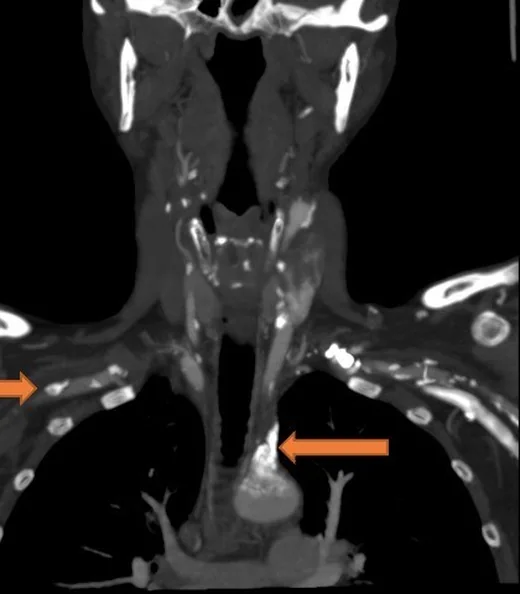
Subklavyen arterin vertebral arter çıkışından önceki aterosklerotik darlığı, kol perfüzyonunu azaltırken ipsilateral vertebral akımın tersine dönmesine yol açabilir; bu akım değişikliği nörolojik yakınmalarla birlikteyse subklavyen çalma sendromu adını alır. BT anjiyografi arkus dalı ostiumunu, darlığın vertebral çıkışa göre konumunu, distal yeniden doluşu ve eşlik eden arkus damar hastalığını haritalar. Statik BT lümen anatomisini gösterir; akımın yönünü ve çalmanın hemodinamik derecesini Doppler veya akım duyarlı MR ile doğrulamak gerekir. Darlık ve eşlik eden kollateral yol gözden kaçarsa kol iskemisinin ya da vertebrobaziler belirtilerin nedeni yanlış yorumlanabilir.
Faz ve pencere
- BTA tanısal
- BT anjiyografi lezyonun yerini, yaygınlığını ve kollateral dolaşımı anatomik olarak değerlendirir; vertebral akım yönü duplex ultrasonografiyle gösterilebilir.
Önerilen pencereler: Anjiyo (G 600 / M 150), Mediasten (G 350 / M 50), Yumuşak doku (G 400 / M 40).
BT bulguları
- Darlık veya tıkanıklık vertebral arter ostiumunun proksimalindedir; bu anatomik ilişki çalma mekanizmasının ön koşuludur.
- Subklavyen ostiumda eksantrik kalsifiye plak ve lümen daralması aterosklerotik etiyolojiyi destekler.
- Oklüzyonun distalindeki subklavyen arter kollateral dolaşım üzerinden yeniden dolabilir.
- İpsilateral vertebral arter küçük ya da geniş görünebilir; çap tek başına retrograd akımı veya çalma şiddetini göstermez.
- Brakiyosefalik trunkus, karşı subklavyen arter ve karotis ostiumlarındaki eşlik eden plaklar çok seviyeli arkus aterosklerozunu ortaya koyar.
- Genişlemiş internal torasik, tiroservikal veya kostoservikal kollateral damarlar kronik akım kısıtlanmasına eşlik edebilir.
- Kontrast bolusunun zamanlamasına bağlı asimetrik opasifikasyon gerçek oklüzyon sanılabilir; ince kesit kaynak görüntülerde lümen devamlılığını takip et.
Normalde
Normalde subklavyen arter aort arkusundan veya brakiyosefalik trunkustan kesintisiz lümenle çıkar; vertebral arter ostiumu proksimal subklavyen arterden ayrılır ve iki taraflı damar çapları değişken olsa da keskin bir ostial daralma ya da distal yeniden doluş paterni yoktur. Aksiyel kesitlerde ostiumu, koronal oblik rekonstrüksiyonda vertebral çıkış ile lezyon arasındaki mesafeyi ve karşı subklavyen arteri kıyasla; akım yönü için normal BT görünümünden sonuç çıkarma.
Normal BT ile kıyasla
Aynı bölgenin, kaynak veri setinde patoloji içermediği belirtilen bir BT incelemesini kesit kesit kaydırın; organ sınırlarını açarak anatomiyi hasta görüntüsüyle karşılaştırın. Küçük rastlantısal bulgular tümüyle dışlanmamıştır.
Kaynak: TotalSegmentator v2.01 veri seti (Wasserthal ve ark., Radiology: Artificial Intelligence 2023), CC BY 4.0, vaka s0975; organ sınırları veri setinin otomatik segmentasyonundan, birleştirilerek sadeleştirildi. Görüntüler 2,5 mm kesit aralığına yeniden örneklendi.
Ayırıcı tanı
- Vertebral arter ostial stenozu
- daralma vertebral arterin kendi çıkışındadır; subklavyen darlık vertebral ostiumun proksimalinde bulunmaz.
- Brakiyosefalik trunkus stenozu
- sağ karotis ve sağ subklavyen akımı birlikte etkilenir; sol subklavyen ostiumu normal kalabilir.
- Takayasu arteriti
- arkus dallarında uzun, düzgün ve konsantrik darlıklar ile duvar kalınlaşması aterosklerotik kısa ostial plaklardan ayrılır.
- Arteriyel torasik çıkış sendromu
- subklavyen arter kostoklaviküler aralıkta basılır; ostial lezyon yerine pozisyonla ilişkili distal subklavyen değişiklik beklenir.
- Konjenital vertebral arter hipoplazisi
- vertebral damar seyri boyunca ince kalır; proksimal subklavyen darlık ve distal subklavyen yeniden doluş eşlik etmez.
Tuzaklar
- Bir fazlı BTA'da vertebral arterin opaklaşmasını antegrad akım kanıtı sayma; statik opasifikasyon kan yönünü belirlemez ve Doppler ile doğrulama gerekir.
- Subklavyen ostiumu aortik arkus kalsifikasyonu ve omuz kaynaklı çizgi artefaktı altında kalabilir; ince aksiyel kesitleri ve oblik MPR'yi birlikte değerlendir.
- Vertebral arterde tamamen ters akım örüntüsü bulunan olgularda, arter çapı Doppler dalga biçimiyle birlikte subklavyen oklüzyonunu ağır stenozdan ayırt etmeye yardımcı olabilir.
- BTA'daki zayıf distal opasifikasyonu oklüzyon saymadan önce enjeksiyon tarafını, bolus zamanlamasını ve kol pozisyonunu kontrol et.
Kendini dene
Anjiyografide sol subklavyen arterin proksimalinde tam oklüzyon ve ipsilateral vertebral arterde retrograd akım saptanıyor. Çalma mekanizmasını anatomik olarak en çok hangi bulgu destekler?
Cevabı göster
Vertebral çıkış öncesi darlık. Vertebral arter çıkışının proksimalindeki subklavyen darlık çalma mekanizmasının anatomik temelidir; statik BTA akım yönünü kanıtlamaz. Diğer seçenekler bu basınç ilişkisini kurmaz.
Subklavyen çalma sendromunda retrograd vertebral arter akımına yol açan temel anatomik lezyonun yeri neresidir?
Cevabı göster
Vertebral arter ostiumunun proksimalindeki subklavyen arter darlığı/oklüzyonu. Çalma fenomeninin oluşabilmesi için darlık veya tıkanıklık mutlaka vertebral arter çıkışının proksimalinde yer almalıdır; distaldeki darlık antegrad akımı engellemez ve çalma oluşturmaz.
İlgili konular
Kaynaklar
Bu sayfadaki 34 cümle ve 2 quiz sorusu aşağıdaki kaynaklardan alıntılarla otomatik olarak karşılaştırıldı; 4 cümle bu karşılaştırmada düzeltildi (2026-10-09).
- A Forgotten Cause of Chronic Dizziness in the Elderly: Exercise‐Induced Vertebrobasilar Insufficiency due to Grade III Subclavian Steal Syndromepmc.ncbi.nlm.nih.gov
- Intravascular Ultrasound (IVUS)-Guided Endovascular Treatment of Severe Left Subclavian Artery Stenosis in a Patient With High-Risk Post-Coronary Artery Bypass Grafting Surgerypmc.ncbi.nlm.nih.gov
- Coronary-Driven Cerebral Revascularization in Type 2a Takayasu Arteritis: A Rare Multisystem Collateral Phenotypepmc.ncbi.nlm.nih.gov
- Dialysis arteriovenous fistula causing subclavian steal syndrome in the absence of subclavian artery stenosispmc.ncbi.nlm.nih.gov
- Total Left Subclavian Artery Occlusion Causing Coronary Subclavian Steal Syndrome and Reversible Left Ventricular Systolic Dysfunctionpmc.ncbi.nlm.nih.gov
- A review of subclavian steal syndrome with clinical correlation.pubmed.ncbi.nlm.nih.gov
- Acute blue finger: a diagnostic challenge.pubmed.ncbi.nlm.nih.gov
- Symptomatic subclavian steal syndrome: Report of four Moroccan cases and literature review.pubmed.ncbi.nlm.nih.gov
- Right aortic arch analysis - Anatomical variant or serious vascular defect?pubmed.ncbi.nlm.nih.gov
- [Acute finger ischemia: A retrospective study of 13 patients].pubmed.ncbi.nlm.nih.gov
- Relevance of basilar artery study in patients with subclavian steal phenomenon.pubmed.ncbi.nlm.nih.gov
- Right-sided aortic arch with complex anomalies presented with transient ischemic attack.pubmed.ncbi.nlm.nih.gov
- An aberrant subclavian artery exhibiting the partial steal phenomenon in a patient with VACTERL association.pubmed.ncbi.nlm.nih.gov
- High incidence of progressive stenosis in aberrant left subclavian artery with right aortic arch.pubmed.ncbi.nlm.nih.gov
- 18 F-Fluorodeoxyglucose Positron Emission Tomography-Magnetic Resonance Monitoring of Brain Metabolic Changes in a Case of Arteriovenous Malformation-Related Steal Phenomenon Symptoms.pubmed.ncbi.nlm.nih.gov
- Subarachnoid Hemorrhage as Result of Retrocorporeal Artery Aneurysm Rupture: Rare Sequel of Subclavian Steal Syndrome.pubmed.ncbi.nlm.nih.gov
- Acute coronary syndrome following arteriovenous fistula creation in a post CABG patient: A steal phenomenon from coronary artery to subclavian artery.pubmed.ncbi.nlm.nih.gov
- Cerebral protection during retrograde brachiocephalic artery stenting using a single filter and increased subclavian steal phenomenon: illustrative case.pubmed.ncbi.nlm.nih.gov
- Asymptomatic Complete Spiral Stent Fracture in Subclavian Artery with Progressive Restenosis in the Early Postoperative Period: A Case Report.pubmed.ncbi.nlm.nih.gov
- A Forgotten Cause of Chronic Dizziness in the Elderly: Exercise-Induced Vertebrobasilar Insufficiency due to Grade III Subclavian Steal Syndrome.pubmed.ncbi.nlm.nih.gov
- Resolution of Refractory Vertigo Following Endovascular Treatment of Right Subclavian Steal Syndrome.pubmed.ncbi.nlm.nih.gov
- Intravascular Ultrasound (IVUS)-Guided Endovascular Treatment of Severe Left Subclavian Artery Stenosis in a Patient With High-Risk Post-Coronary Artery Bypass Grafting Surgery.pubmed.ncbi.nlm.nih.gov
- A Rare Coexistence of Arteria Lusoria, Truncus Bicaroticus, and Klippel-Feil Syndrome: A Five-Year Follow-Up and Procedural Considerations.pubmed.ncbi.nlm.nih.gov
- Congenital Anomalies and Variations of the Carotid and Vertebral Arteries: A Case-Based Imaging Review.pubmed.ncbi.nlm.nih.gov
- Syncope as the Initial Presentation of Takayasu Arteritis in a 57-Year-Old Female: A Case Report and Literature Review.pubmed.ncbi.nlm.nih.gov
- Operative Procedures for Ultrasound Assessment of Extracranial Artery Disease: A Narrative Review by the Italian Society for Vascular Investigation (SIDV).pubmed.ncbi.nlm.nih.gov
- Role of multimodality imaging pre-access for planning of surgical creation of arteriovenous fistulas and arteriovenous grafts in the chronic kidney disease and end-stage renal disease population.pubmed.ncbi.nlm.nih.gov
- Neurological Complications in Pediatric Takayasu Arteritis: Insights from a Single-Center Experience.pubmed.ncbi.nlm.nih.gov
- Association of Subclavian Steal Phenomenon with Prevalence of Contralateral Vertebral Artery Atherosclerotic Stenosis: A Hospital-Based Cohort Study.pubmed.ncbi.nlm.nih.gov
- Ischemic posterior circulation stroke: a review of anatomy, clinical presentations, diagnosis, and current management.pubmed.ncbi.nlm.nih.gov
- Self-expanding open-cell carotid stent for symptomatic moderate-to-severe vertebral artery origin atherosclerotic stenosis: a single-center retrospective study.pubmed.ncbi.nlm.nih.gov
- Double Distal Filter Protection with a Single Guiding Catheter for Internal Carotid Artery Stenosis with a Persistent Primitive Hypoglossal Artery: A Case Report and Literature Review.pubmed.ncbi.nlm.nih.gov
- Tandem occlusions after emergent stenting in acute ischemic stroke: A retrospective cohort study from a comprehensive stroke center's experience (TOESIS study).pubmed.ncbi.nlm.nih.gov
- Subclavian Artery Diseasepubmed.ncbi.nlm.nih.gov
- Siltation and tidal effects: a comprehensive, clinical, and didactic approach to reasoning about vertebrobasilar hypoflow conditions.pubmed.ncbi.nlm.nih.gov
- Stent insertion for chronic total occlusion of the common carotid artery in a patient with Takayasu arteritis using an adjunctive retrograde approach via superficial temporal artery puncture: illustrative case.pubmed.ncbi.nlm.nih.gov
- Multiple Posterior Circulation Infarctions in a Patient With Complex Aortic Atheroma and Left Vertebral Artery Stenosis: A Case Report.pubmed.ncbi.nlm.nih.gov
- Coronary Artery Vasculitis: A Nightmare Complicating Percutaneous Coronary Intervention.pubmed.ncbi.nlm.nih.gov
- Idiopathic Ascending Aortic Thrombus With Limb Ischemia and Myocardial Infarction in a Young Woman.pubmed.ncbi.nlm.nih.gov
- Segmental vertebral artery agenesis with deep cervical reconstitution in a cervicothoracic variant cluster.pubmed.ncbi.nlm.nih.gov
- Double vertebral artery-connected persisting proatlantal artery coexisting with a persisting carotid duct in an adult case: first evidence.pubmed.ncbi.nlm.nih.gov
- Endovascular management of craniospinal arteriovenous fistula causing steal syndrome in neurofibromatosis type 1: a case report.pubmed.ncbi.nlm.nih.gov
- One-dimensional computational circulatory models: a scoping review.pubmed.ncbi.nlm.nih.gov
- Incidental Vascular Findings in Computed Tomography Performed in the Qualification for the TAVI Procedure.pubmed.ncbi.nlm.nih.gov
- A Non-Coronary, Peripheral Arterial Atherosclerotic Disease (Carotid, Renal, Lower Limb) in Elderly Patients-A Review: Part I-Epidemiology, Risk Factors, and Atherosclerosis-Related Diversities in Elderly Patients.pubmed.ncbi.nlm.nih.gov
- The Interscalene Triangle: A Cadaveric Dissection of a Critical Neurovascular Corridor at the Root of the Neck.pubmed.ncbi.nlm.nih.gov
- Imaging Spectrum of Thoracic Outlet Syndrome: A Case Series Highlighting Arterial, Venous, and Neurogenic Subtypes.pubmed.ncbi.nlm.nih.gov
- Endovascular Treatment of Hemoptysis: Does Bronchial Artery Embolization Fit All?pubmed.ncbi.nlm.nih.gov
- Imaging in chronic thromboembolic pulmonary hypertension: review of the current literature.pubmed.ncbi.nlm.nih.gov
- CIRSE Standards of Practice for the Interventional Radiology Management of Acute and Chronic Arterial Mesenteric Ischaemia.pubmed.ncbi.nlm.nih.gov
- A Case of High-Risk Acute Stanford Type B Aortic Dissection in a Right-Sided Aortic Arch Presenting With Transient Hemiparesis.pubmed.ncbi.nlm.nih.gov
- Early Outcomes of a Curvature-Guided Strategy for Dual-Branch Revascularization in Zone 1 TEVAR.pubmed.ncbi.nlm.nih.gov
- Imaging considerations in tetralogy of Fallot: A comprehensive review.pubmed.ncbi.nlm.nih.gov
- Precision alignment in minimalist fenestrated thoracic endovascular aortic repair: a novel physician-modified technique involving self-aligning Relay nonbare stent grafts for thoracic aortic endovascular repair.pubmed.ncbi.nlm.nih.gov
- Left Subclavian Artery Thrombosis Causing Myocardial Ischemia in Patients With Prior Coronary Artery Bypass Grafting.pubmed.ncbi.nlm.nih.gov
- Late radiation-induced cardiovascular disease after childhood rhabdomyosarcoma: a case report.pubmed.ncbi.nlm.nih.gov
- Building an Endovascular Skeleton: Prophylactic Stenting in a Hybrid Approach to a Thymic Carcinoma with Supra-aortic Trunk Encasement.pubmed.ncbi.nlm.nih.gov
- The Floating Threat: A Rare Case Report of Carotid Saddle Thrombus in a Healthy Adult.pubmed.ncbi.nlm.nih.gov
- Takayasu Arteritis in a 15-Year-Old Male Presenting with Constitutional Symptoms and Upper Limb Pulse Deficit: A Case Report a Resource-Limited Settings.pubmed.ncbi.nlm.nih.gov
- Aortitis as a High-Risk Vascular Syndrome: Integrating Phenotype-Driven Diagnosis, Multidisciplinary Assessment, and Personalised Management.pubmed.ncbi.nlm.nih.gov
- Type IV Takayasu Arteritis Presenting as a Late-Onset Hypertensive Emergency and Transient Ischemia: A Case Report Highlighting Diagnostic Challenges.pubmed.ncbi.nlm.nih.gov
- Multimodality Imaging of Thoracic Outlet Syndrome: Etiological and Anatomical Correlates.pubmed.ncbi.nlm.nih.gov
- LACHT syndrome with branchial cyst in a female infant; case report and review of literature.pubmed.ncbi.nlm.nih.gov
- The persistent proatlantal artery: types and subtypes.pubmed.ncbi.nlm.nih.gov
- Ischemic stroke as an initial manifestation of Loeys-Dietz syndrome type 3 caused by the recurrent p.Arg287Trp variant in <i>SMAD3</i>: a case report with familial context.pubmed.ncbi.nlm.nih.gov
- Neurosonology in acute stroke revealing bilateral internal carotid artery occlusion maintained by persistent embryologic collaterals: A case report.pubmed.ncbi.nlm.nih.gov
- Endovascular management of iliac vessel injury complicating lumbar disc surgery: a case report and review of literature.pubmed.ncbi.nlm.nih.gov
- Role of Clinical and Multimodality Neuroimaging in the Evaluation of Brain Death/Death by Neurologic Criteria and Recent Highlights from 2023 Updated Guidelines.pubmed.ncbi.nlm.nih.gov
- The spectrum of computed tomography findings in blunt trauma of the subclavian/axillary artery: a pictorial essay.pubmed.ncbi.nlm.nih.gov
- Rescue Endovascular Treatment to Prevent Neurological Deterioration in Acute Symptomatic Bilateral Vertebral Artery Occlusion.pubmed.ncbi.nlm.nih.gov
- Traumatic vertebral artery injury: a review of the screening criteria, imaging spectrum, mimics, and pitfalls.pubmed.ncbi.nlm.nih.gov
- Tricuspid regurgitation: standardized stepwise work-up from referral to expert heart valve centre.pubmed.ncbi.nlm.nih.gov
- CT imaging post-TAVI: Murphy's first law in action-preparing to recognize the unexpected.pubmed.ncbi.nlm.nih.gov
- Contrast opacification on thoracic CT angiography: challenges and solutions.pubmed.ncbi.nlm.nih.gov
- Stanford Type B aortic dissection following transradial coronary angiography in a patient with an aberrant right subclavian artery: a case report.pubmed.ncbi.nlm.nih.gov
- Stent angioplasty in patients with vertebral artery ostial stenosis: clinical and angiographic outcomes in 525 patients.pubmed.ncbi.nlm.nih.gov
- Drug-coated balloon angioplasty for symptomatic vertebral artery origin stenosis: a real-world analysis of efficacy and predictors for bailout stenting.pubmed.ncbi.nlm.nih.gov
- Parent Artery Disease-Related Stroke: What Is the Impact on Endovascular Treatment? A Narrative Review.pubmed.ncbi.nlm.nih.gov
- Bilateral Persistent Sciatic Artery With Unilateral Thrombosis: A Rare Case of Acute Limb Ischemia Successfully Managed With Endovascular Intervention.pubmed.ncbi.nlm.nih.gov
- Open surgical revascularization after IL-6 blockade for Takayasu arteritis: A case report.pubmed.ncbi.nlm.nih.gov
- Hypoplastic aorto-iliac syndrome and hypoplasia of the vena cava and iliac veins presenting as simultaneous left leg claudication and iliofemoral deep venous thrombosis.pubmed.ncbi.nlm.nih.gov
- Autonomic Dysregulation Attributed to Vertebral Artery Insufficiency Secondary to Subclavian Steal Syndrome: A Case Report.pubmed.ncbi.nlm.nih.gov
- Role of Interventional Radiology in the Management of Non-aortic Thoracic Trauma.pubmed.ncbi.nlm.nih.gov
- Mechanisms of aortic dissection: From pathological changes to experimental and <i>in silico</i> models.pubmed.ncbi.nlm.nih.gov
- Advancements in Transcatheter Aortic Valve Implantation: A Focused Update.pubmed.ncbi.nlm.nih.gov
- Non-invasive Vascular Laboratory Evaluation of the Upper Extremity.pubmed.ncbi.nlm.nih.gov
- Carotid steal syndrome with recurrent syncope: A novel manifestation of Takayasu arteritis.pubmed.ncbi.nlm.nih.gov
- Cervical carotid to vertebral artery high-flow interposition graft bypass serves as an extracranial communicating pathway between anterior and posterior circulation for vertebrobasilar lesions.pubmed.ncbi.nlm.nih.gov
- Subtypes of the Completely Reversed Flow Waveform in Vertebral Artery Can Help to Differentiate Subclavian Artery Occlusion from Severe Stenosis.pubmed.ncbi.nlm.nih.gov
- Color Doppler Ultrasonography for the Evaluation of Subclavian Artery Stenosis.pubmed.ncbi.nlm.nih.gov
- Drug-Coated Balloon Angioplasty for de Novo Subclavian Artery Stenosis: Mid-Term Outcomes and Independent Risk Factors for Restenosis.pubmed.ncbi.nlm.nih.gov
- Giant-cell arteritis related strokes: scoping review of mechanisms and rethinking treatment strategy?pubmed.ncbi.nlm.nih.gov
- Coronary-Driven Cerebral Revascularization in Type 2a Takayasu Arteritis: A Rare Multisystem Collateral Phenotype.pubmed.ncbi.nlm.nih.gov
- Bilateral persistence of the proatlantal intersegmental arteries in moyamoya syndrome: illustrative case.pubmed.ncbi.nlm.nih.gov
- Nonatherosclerotic Subclavian Steal Syndrome Due to Brachiocephalic Trunk Kinking in an Elderly Woman: A Case Report.pubmed.ncbi.nlm.nih.gov
Eğitim amaçlıdır; hasta başında tanı ve tedavi kararının yerine geçmez, tıbbi tavsiye değildir. Metinler yapay zekâ desteğiyle yazıldı ve otomatik bir adımda kaynak alıntılarıyla karşılaştırıldı; bu bir tıbbi doğrulama değildir ve içerik uzman radyolog incelemesinden geçmedi. Klinik kararlarda güncel kılavuzları, kurum protokollerini ve radyoloji raporunu esas alın.