Özet
Künt göğüs travmasında kaburga ve sternum kırıkları ile sternoklaviküler çıkıklar, plevra, akciğer ve damar yaralanmalarıyla birlikte bulunabilir; BT'de eşlik eden toraks yaralanmaları da değerlendirilmelidir. BT, grafide görülmeyen kaburga kırıklarını ve diğer toraks yaralanmalarını saptayabilir; kanama şüphesinde psödoanevrizma veya aktif kontrast kaçağını gösterebilir. Göğüs duvarı yaralanması ağrının yanı sıra torasik kafes stabilitesinin kaybı ve bölgesel mekaniğin bozulmasıyla ventilasyonu bozabilir; pnömotoraks ve hemotoraks eşlik eden plevral yaralanmalar arasındadır.
Faz ve pencere
- Kontrastsız tanısal
- BT göğüs travması tanısında grafiden üstündür ve yüksek kaliteli çok düzlemli görüntüler yaralanmaların saptanmasını belirgin biçimde artırır. Yüksek kaliteli çok düzlemli BT rekonstrüksiyonları, göğüs travması yaralanmalarının saptanmasını ve tanısal doğruluğu artırır.
- BTA tanısal
- Kanama şüphesinde kontrastlı BT incelemede psödoanevrizma veya aktif kontrast ekstravazasyonu aranır. İntravenöz kontrastlı BT, damar yaralanması ve aktif kanama şüphesinde tanısal öneme sahiptir.
Önerilen pencereler G genişlik, M merkez; değerler Hounsfield birimi (HU)
- KemikG 1800 / M +400
- MediastenG 350 / M +50
- AnjiyoG 600 / M +150
- Yumuşak dokuG 400 / M +40
BT bulguları
- BT grafiye kıyasla daha fazla kırık ve diğer toraks yaralanmasını saptayabilir; negatif grafi sonrası her hastada rutin BT verimsiz olabilir ve ek radyasyon, maliyet ve kaynak kullanımıyla ilişkilidir.
- Flail chest, üç veya daha fazla komşu kaburgada ikişer yerde kırıkla çevre göğüs duvarından ayrılmış bir segmentin oluştuğu yaralanmadır.
- CPR sonrası sternum kırıkları ağırlıklı olarak sternum gövdesinin orta ve alt üçte birlik kesimlerinde görülmüştür.
- Kostokondral yaralanma — kıkırdak-kemik bileşkesinde kırık görülebilir.
- Sternoklaviküler eklem çıkığı — medial klavikula başı sternuma göre yer değiştirir; posterior deplasman mediastinal damar ve hava yolu komşuluğu nedeniyle özellikle önemlidir.
- Radyolojik flail segment, üç veya daha fazla komşu kaburgada ikişer kırıkla tanımlanan morfolojidir ve bu tanım klinik paradoksal solunumun varlığını göstermez.
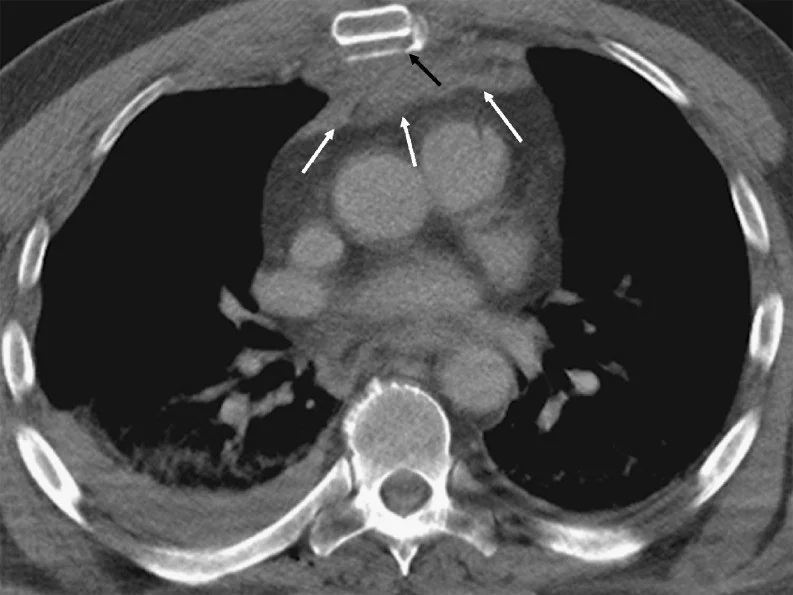
- Göğüs duvarı hematomu pektoralis kası üzerindeki cilt altı dokularda görülebilir ve küçük bir aktif ekstravazasyon odağı eşlik edebilir.
- Kontrastlı BT aktif ekstravazasyonu gösterebilir; akciğer kontüzyonları ile hemotoraks ve pnömotoraksla birlikte kaburga kırıkları en sık tanılar arasındadır.
- Sternal kırık değerlendirmesinde eşlik eden göğüs duvarı hematomu da göz önünde bulundurulmalıdır.
Ölçütler ve sınıflamalar
- Radyolojik flail segment
- ≥3 komşu kaburganın her birinde ≥2 kırık noktası
Normalde
İnce kesitli çok düzlemli BT rekonstrüksiyonları, kaburga korteksleri ve sternoklaviküler eklemlerin değerlendirilmesinde tanısal doğruluğu belirgin biçimde artırır. Yüksek kaliteli çok düzlemli BT görüntüleri göğüs travması yaralanmalarının saptanmasını belirgin biçimde artırır.
Normal BT ile kıyasla
Aynı bölgenin, kaynak veri setinde patoloji içermediği belirtilen bir BT incelemesini kesit kesit kaydırın; organ sınırlarını açarak anatomiyi hasta görüntüsüyle karşılaştırın. Küçük rastlantısal bulgular tümüyle dışlanmamıştır.
Kaynak: TotalSegmentator v2.01 veri seti (Wasserthal ve ark., Radiology: Artificial Intelligence 2023), CC BY 4.0, vaka s1278; organ sınırları veri setinin otomatik segmentasyonundan, birleştirilerek sadeleştirildi. Görüntüler 2,5 mm kesit aralığına yeniden örneklendi.
Ayırıcı tanı
- Grafide gözden kaçabilen göğüs yaralanmalarında doğru çok düzlemli ve üç boyutlu rekonstrüksiyonlar tanıyı belirgin biçimde daha doğru kılar.
- Kostokondral kalsifikasyon artışı yapısal sertlikte belirgin artışla ilişkilidir.
- Göğüs duvarı travmasında kontrastlı BT aktif kontrast kaçağını ve eşlik eden hematomu gösterebilir.
Tuzaklar
- Sternum değerlendirmesinde aksiyel kesitlere ek olarak çok düzlemli rekonstrüksiyonları inceleyin; doğru çok düzlemli ve üç boyutlu rekonstrüksiyonlar tanıyı belirgin biçimde daha doğru kılar.
- Çok dedektörlü BT vücudun geniş bölümünü minimal hareket artefaktıyla görüntüler ve doğru çok düzlemli rekonstrüksiyonlar tanıyı belirgin biçimde daha doğru kılar.
- Posterior sternoklaviküler eklem çıkığı mediastinal yapıların komşuluğundan dolayı hayati tehdit oluşturabilir ve erken tanı gerektirir.
- Kaburga kırıklarının değerlendirilmesinde otomatik çok düzlemli rekonstrüksiyonlar okuma süresini kısaltabilir; mevcut haliyle orijinal BT kesitlerinin tamamlayıcısı olarak kullanılmalıdır.
Kendini dene
BT'de birbirini izleyen üç kaburganın her birinde iki ayrı kırık hattı var. Bu kemik örüntüsünün adı nedir?
Cevabı göster
Radyolojik flail segment. Üç komşu kaburganın her birinde iki veya daha fazla kırık hattı radyolojik flail segment tanımına uyar. Diğer seçenekler farklı eklem, sternum veya kıkırdak bulgularıdır.
BT'de kostokondral yaralanmayı doğrudan destekleyen bulgu hangisidir?
Cevabı göster
Kostokondral bileşkede kırık. Kostokondral bileşkede kırık, bu bölgedeki yaralanmayı doğrudan destekler; bir olgu bildiriminde BT'de kostokondral eklem kırıkları gösterilmiştir.
İlgili konular
Kaynaklar
Bu sayfadaki 37 cümle ve 2 quiz sorusu aşağıdaki kaynaklardan alıntılarla otomatik olarak karşılaştırıldı; 23 cümle bu karşılaştırmada düzeltildi (2026-10-12).
- Factors associated with occult acute rib fractures on chest CT after negative radiography in older fall patientspmc.ncbi.nlm.nih.gov
- Regional analgesia for chest wall injuries related to cardiopulmonary resuscitation: retrospective service evaluation and injury pattern mapping*pmc.ncbi.nlm.nih.gov
- Rigid anterior plating for open transverse sternal fracture traversing previous sternotomy: a case reportpmc.ncbi.nlm.nih.gov
- Surgical stabilization of rib fractures in patients with open flail chest results in improved clinical outcomes: a report of three casespmc.ncbi.nlm.nih.gov
- Biomechanics of chest wall injury: implications for surgical stabilization and failure preventionpmc.ncbi.nlm.nih.gov
- CT imaging of blunt chest trauma.pubmed.ncbi.nlm.nih.gov
- Surgical Stabilization of Rib Fractures: Indications, Techniques, and Pitfalls.pubmed.ncbi.nlm.nih.gov
- Surgical reconstruction of traumatic flail chest with titanium plaques.pubmed.ncbi.nlm.nih.gov
- Blunt rupture of the thoracic duct after severe thoracic trauma.pubmed.ncbi.nlm.nih.gov
- A pictorial essay of thoracic wall diseases: multiple pathologies in the same anatomical site.pubmed.ncbi.nlm.nih.gov
- NEXUS chest: validation of a decision instrument for selective chest imaging in blunt trauma.pubmed.ncbi.nlm.nih.gov
- Internal Mammary Artery Injury without Chest Wall Fractures after Cardiopulmonary Resuscitation: A Case Report.pubmed.ncbi.nlm.nih.gov
- Spontaneous reduction of type I traumatic manubriosternal joint dislocation: A case report.pubmed.ncbi.nlm.nih.gov
- Blunt trauma as a cause of rib chondro-osteitis: a case study.pubmed.ncbi.nlm.nih.gov
- Multidetector computed tomography-spectrum of blunt chest wall and lung injuries in polytraumatized patients.pubmed.ncbi.nlm.nih.gov
- [Herniation of the middle lobe of the right lung due to a coarsely dislocated sternum fracture].pubmed.ncbi.nlm.nih.gov
- Favourable outcome in survivors of CPR-related chest wall injuries.pubmed.ncbi.nlm.nih.gov
- Use of Analgesics and Sedatives in Nontraumatic Patients after Sudden Cardiac Arrest during the Peri-Resuscitation Period in the Emergency Department.pubmed.ncbi.nlm.nih.gov
- Multidetector CT findings of skeletal chest injuries secondary to cardiopulmonary resuscitation.pubmed.ncbi.nlm.nih.gov
- Biomechanics of chest wall injury: implications for surgical stabilization and failure prevention.pubmed.ncbi.nlm.nih.gov
- Rigid anterior plating for open transverse sternal fracture traversing previous sternotomy: a case report.pubmed.ncbi.nlm.nih.gov
- Fatal Injuries Caused by Falling Trees: Correlation Between Postmortem Computed Tomography and Forensic Autopsy Findings in Eight Cases.pubmed.ncbi.nlm.nih.gov
- Pneumothorax and Hemothorax: Practical Approaches for Radiologists.pubmed.ncbi.nlm.nih.gov
- Thoracic trauma WSES-AAST guidelines.pubmed.ncbi.nlm.nih.gov
- Non-pulmonary postoperative complications of cardiothoracic surgery.pubmed.ncbi.nlm.nih.gov
- Rib Plating Versus Nonsurgical Treatment of Flail Chest: Comparison of Adverse Events in More than 12,500 Patients.pubmed.ncbi.nlm.nih.gov
- Surgical stabilization of rib fractures in adults without flail chest: a scoping review of pain, quality of life, and clinical outcomes.pubmed.ncbi.nlm.nih.gov
- Effects of early surgery (within 48 hours) <i>vs.</i> delayed surgery on the incidence of pulmonary complications in elderly patients with multiple rib fractures.pubmed.ncbi.nlm.nih.gov
- International Society of Paediatric Surgical Oncology (IPSO) Surgical Practice Guidelines.pubmed.ncbi.nlm.nih.gov
- Patterns of injury and violence in Yaoundé Cameroon: an analysis of hospital data.pubmed.ncbi.nlm.nih.gov
- Deep-Inspiration Breath-Hold Strategy Improves Image Quality of Transthoracic Lateral Shoulder Radiography.pubmed.ncbi.nlm.nih.gov
- Acute Traumatic Aortic Injury: What the Radiologist Needs to Know.pubmed.ncbi.nlm.nih.gov
- Surgical stabilization of rib fractures (SSRF): the WSES and CWIS position paper.pubmed.ncbi.nlm.nih.gov
- Blunt Chest Trauma-Induced Left Internal Mammary Artery Injury Requiring Interventional Radiology Embolization: A Case Report.pubmed.ncbi.nlm.nih.gov
- Pictorial essay of radiological features of benign intrathoracic masses.pubmed.ncbi.nlm.nih.gov
- Multidetector computed tomography of chest trauma: indications, technique and interpretation.pubmed.ncbi.nlm.nih.gov
- Chest Wall and Diaphragmatic Injuries: Imaging Evaluation and Clinical Considerations.pubmed.ncbi.nlm.nih.gov
- Factors associated with occult acute rib fractures on chest CT after negative radiography in older fall patients: A retrospective observational study.pubmed.ncbi.nlm.nih.gov
- Posterior Sternoclavicular Joint Dislocation Presenting as Acute Torticollis in a Kabaddi Player: A Case Report.pubmed.ncbi.nlm.nih.gov
- Posterior Sternoclavicular Joint Dislocation in a Pediatric Wrestler: Delayed Diagnosis After Initially Benign Radiographs.pubmed.ncbi.nlm.nih.gov
- Medial Clavicle Physeal Fracture in a 15-Year-Old Male: A Case Report.pubmed.ncbi.nlm.nih.gov
- Computer tomography-based three-dimensional reconstruction of an extended AB-thymoma: a case report.pubmed.ncbi.nlm.nih.gov
- Narrative review of chest wall ultrasound: a practical approach.pubmed.ncbi.nlm.nih.gov
- Understanding a mass in the paraspinal region: an anatomical approach.pubmed.ncbi.nlm.nih.gov
- The state of trial registrations in the field of Orthopaedics in years 2015-2020. A meta-epidemiological study.pubmed.ncbi.nlm.nih.gov
- Musculoskeletal Infection: The Great Mimickers on Imaging.pubmed.ncbi.nlm.nih.gov
- Glossary of terms for musculoskeletal radiology.pubmed.ncbi.nlm.nih.gov
- Natural Biomaterials for Osteochondral Repair: From Source to Strategy.pubmed.ncbi.nlm.nih.gov
- Preclinical modeling of Loeys-Dietz syndrome: insights into mechanisms and therapy.pubmed.ncbi.nlm.nih.gov
- Dinosaur senescence: a hadrosauroid with age-related diseases brings a new perspective of "old" dinosaurs.pubmed.ncbi.nlm.nih.gov
- Defining the imaging diagnostic criteria for adult chronic non-bacterial osteitis.pubmed.ncbi.nlm.nih.gov
- Subaxial Cervical Spine Injuries: WFNS Spine Committee Recommendations.pubmed.ncbi.nlm.nih.gov
- Imaging and Management of Blunt Cerebrovascular Injury.pubmed.ncbi.nlm.nih.gov
- 2.5-mm articulated endoluminal forceps using a compliant mechanism.pubmed.ncbi.nlm.nih.gov
- Imaging of pediatric musculoskeletal trauma: Age-specific considerations and challenges.pubmed.ncbi.nlm.nih.gov
- 3D CT Anatomy and Morphology of the Appendicular Skeleton of European Pond Turtle (Emys orbicularis).pubmed.ncbi.nlm.nih.gov
- Unconventional auricular reconstruction using controlled scaffold buckling and chondrogenic cocktail containing muscle-derived cells.pubmed.ncbi.nlm.nih.gov
- Musculoskeletal Ultrasound and Protein-Based Hydrogels: Novel Approaches for the Diagnosis and Treatment of Sports Injuries.pubmed.ncbi.nlm.nih.gov
- Efficacy of intramedullary bridge fixation for midshaft clavicle fractures: a retrospective analysis of a novel technique.pubmed.ncbi.nlm.nih.gov
- Ultrasound and bone: a pictorial review.pubmed.ncbi.nlm.nih.gov
- Emergency radiology of severe acute injury in extreme alpine summer sports: a pictorial essay.pubmed.ncbi.nlm.nih.gov
- Magnetic resonance imaging evaluation of oblique injuries: Introduction of the deadrise sign.pubmed.ncbi.nlm.nih.gov
- Screening performance of sternal CT attenuation for opportunistic osteoporosis.pubmed.ncbi.nlm.nih.gov
- The oldest ceratosaurian (Dinosauria: Theropoda), from the Lower Jurassic of Italy, sheds light on the evolution of the three-fingered hand of birds.pubmed.ncbi.nlm.nih.gov
- Commentary: an eye on PET quantification.pubmed.ncbi.nlm.nih.gov
- Integration of detection and tracking networks for automated rib multiplanar reconstruction: a feasibility study for fracture diagnosis.pubmed.ncbi.nlm.nih.gov
- Beyond the surface: A review of current and potential micro-CT applications in paleopathology.pubmed.ncbi.nlm.nih.gov
- Surgical stabilization of rib fractures in patients with open flail chest results in improved clinical outcomes: a report of three cases.pubmed.ncbi.nlm.nih.gov
- Video-assisted thoracoscopic surgery surgical stabilization of rib fractures: surgical technique and case report.pubmed.ncbi.nlm.nih.gov
- Application of virtual overlapping technology for the selection of appropriate metal plate dimensions in rib fracture surgery.pubmed.ncbi.nlm.nih.gov
- Computer-aided diagnosis system for thoracic computed tomography of rib fractures in older emergency patients: A preliminary study.pubmed.ncbi.nlm.nih.gov
- Multifocal costal osseous pneumatosis and osteomyelitis secondary to <i>Clostridium botulinum</i> in a dog.pubmed.ncbi.nlm.nih.gov
- Thoracic wall trauma-misdiagnosed lesions on radiographs and usefulness of ultrasound, multidetector computed tomography and magnetic resonance imaging.pubmed.ncbi.nlm.nih.gov
- Osteoarticular Mycoses.pubmed.ncbi.nlm.nih.gov
- ARDS management in trauma patients.pubmed.ncbi.nlm.nih.gov
- Lung parenchymal trauma biomechanics, mechanisms, and classification: a narrative review of the current knowledge.pubmed.ncbi.nlm.nih.gov
- Blunt trauma related chest wall and pulmonary injuries: An overview.pubmed.ncbi.nlm.nih.gov
- MRI Advancements in Musculoskeletal Clinical and Research Practice.pubmed.ncbi.nlm.nih.gov
- Point-of-care ultrasound (POCUS) diagnosis of rib fractures.pubmed.ncbi.nlm.nih.gov
- Long-term safety and effectiveness of the "OptEase" vena cava filter.pubmed.ncbi.nlm.nih.gov
- Aortic arch impingement with Salter Harris II epiphyseal fracture of the medial clavicle: A novel use of video assisted thoracoscopy.pubmed.ncbi.nlm.nih.gov
- Sternal Resections: An Attempt to Find the Ideal Reconstruction Method.pubmed.ncbi.nlm.nih.gov
- Traumatic retropharyngeal hematoma: A systematic review of reported cases.pubmed.ncbi.nlm.nih.gov
- Accessory Articulation of Elongated Anterior Tubercles of the Transverse Processes at C5-C6 in a Young Adult Female Patient: A Case Report.pubmed.ncbi.nlm.nih.gov
- A Diagnostic Algorithm for Reconstructing the Direction of Gunshots Using OsiriX and Maya in Living Patients: A Forensic Radiology Approach.pubmed.ncbi.nlm.nih.gov
- A Guide to Improving the Care of Patients with Fragility Fractures, Edition 2.pubmed.ncbi.nlm.nih.gov
- Total laparoscopic radical hysterectomy for cervical cancer in prolapsed uterus.pubmed.ncbi.nlm.nih.gov
- Imaging of traumatic shoulder injuries - Understanding the surgeon's perspective.pubmed.ncbi.nlm.nih.gov
- Posterior Sternoclavicular Dislocation: A Case Report.pubmed.ncbi.nlm.nih.gov
- Costal cartilage fractures in blunt polytrauma patients - a prospective clinical and radiological follow-up study.pubmed.ncbi.nlm.nih.gov
- Surgical Stabilization of Rib Fractures: Current Evidence and Considerations for Posterior Rib Fractures.pubmed.ncbi.nlm.nih.gov
- A statistical shape model of the human sternum including cortical bone thickness.pubmed.ncbi.nlm.nih.gov
- Life-threatening hemothorax after radiofrequency ablation for subcapsular hepatocellular carcinoma in a patient with previous rib injury.pubmed.ncbi.nlm.nih.gov
- Spontaneous Massive Intrathoracic Hematoma in a Patient with Marfan Syndrome.pubmed.ncbi.nlm.nih.gov
- Aortic Injury and Hemopericardium: Key Findings and Evaluation.pubmed.ncbi.nlm.nih.gov
- Traumatic fractures of the sternum - typical distribution and need for subgroups within AO and OTA classification system?pubmed.ncbi.nlm.nih.gov
- Surgical stabilization of rib fractures in older adults: a retrospective cohort study.pubmed.ncbi.nlm.nih.gov
- Surgical management of complex non-union in chest wall instability: focus on posterior rib fractures, parasternal cartilage rupture, and costal margin injury.pubmed.ncbi.nlm.nih.gov
- Lung Parenchymal and Airway Injuries: Differential Diagnosis and Severity Grading.pubmed.ncbi.nlm.nih.gov
- Management of a Complex Medial-End Clavicle Fracture With Hook Plate Fixation After Failed Prior Surgeries: A Case Report and Narrative Review of Surgical Options.pubmed.ncbi.nlm.nih.gov
- [Traumatic Posterior Sternoclavicular Joint Dislocation in Adolescents].pubmed.ncbi.nlm.nih.gov
- Penetrating Chest Trauma With Lung Evisceration, Pneumomediastinum, Pneumocranium, and Brachial Plexus Injury: A Case Report From a Resource-Limited Setting.pubmed.ncbi.nlm.nih.gov
- Balance-shaped sternal elevation-assisted uniportal subxiphoid video-assisted thoracoscopic surgery for thymoma with persistent left superior vena cava.pubmed.ncbi.nlm.nih.gov
- Video-assisted thoracoscopic-guided reduction and external stabilisation of traumatic rib fractures in a cat.pubmed.ncbi.nlm.nih.gov
- Case report: A rare secondary systemic candidiasis as a bite wound complication in a dog.pubmed.ncbi.nlm.nih.gov
- Current Position of Nuclear Medicine Imaging in Primary Bone Tumors.pubmed.ncbi.nlm.nih.gov
- Three-year emergency department analysis of clavicle fractures: Age- and sex-dependent patterns and associated injuries.pubmed.ncbi.nlm.nih.gov
- Conservative Treatment of Pediatric Fractures-Narrative Review of Acceptable Deformity and Remodeling Potential.pubmed.ncbi.nlm.nih.gov
- Comparative Outcomes of Surgical Stabilization and Nonoperative Management for Rib Fractures: A Quasi-experimental Study.pubmed.ncbi.nlm.nih.gov
- Fracture Mapping in High-Energy Chest Trauma.pubmed.ncbi.nlm.nih.gov
- Cardiopulmonary Resuscitation-Induced Hardware Failure After Surgical Stabilization of Flail Chest.pubmed.ncbi.nlm.nih.gov
- Intercostal artery embolization and the risk of spinal cord ischemia: Importance of identifying the Adamkiewicz artery-A report of two cases.pubmed.ncbi.nlm.nih.gov
- An Overview of Meta-Analyses on the Surgical Stabilization of Rib Fractures in Adults: A Narrative Umbrella Review (2020-2025).pubmed.ncbi.nlm.nih.gov
- Does patient sex affect the anatomic relationships between the sternoclavicular joint and posterior vascular structures?pubmed.ncbi.nlm.nih.gov
- Emergency repair of complete right main bronchial transection after blunt chest trauma: a case report.pubmed.ncbi.nlm.nih.gov
Eğitim amaçlıdır; hasta başında tanı ve tedavi kararının yerine geçmez, tıbbi tavsiye değildir. Metinler yapay zekâ desteğiyle yazıldı ve otomatik bir adımda kaynak alıntılarıyla karşılaştırıldı; bu bir tıbbi doğrulama değildir ve içerik uzman radyolog incelemesinden geçmedi. Klinik kararlarda güncel kılavuzları, kurum protokollerini ve radyoloji raporunu esas alın.