Özet
Künt veya penetran göğüs travması, visseral plevrayı yırtarak plevra boşluğuna hava kaçmasına ve akciğerin göğüs duvarından ayrılmasına yol açabilir. Toraks BT, özellikle sırtüstü çekilmiş grafide görünmeyen küçük anterior pnömotoraksı ve eşlik eden akciğer ya da kaburga yaralanmasını gösterir. Basınç etkisi gelişen pnömotoraks mediasteni itip venöz dönüşü bozabilir; küçük bir bulgunun gözden kaçması da pozitif basınçlı ventilasyon sırasında kötüleşmeye zemin hazırlayabilir.
Faz ve pencere
- Kontrastsız tanısal
- Plevra boşluğundaki hava çok düşük atenüasyonlu, akciğer dokusu ile göğüs duvarı arasında ince şerit biçiminde görülür; toraks BT, göğüs grafisinde tespit edilemeyen pnömotoraksın altın standart tanı aracıdır. Sırtüstü hastada hava önce anteromedial ve subpulmonik rezeslerde birikebildiğinden yalnızca apikal kesitlere bakmak yeterli değildir.
Önerilen pencereler: Akciğer (G 1500 / M -600), Mediasten (G 350 / M 50).
BT bulguları
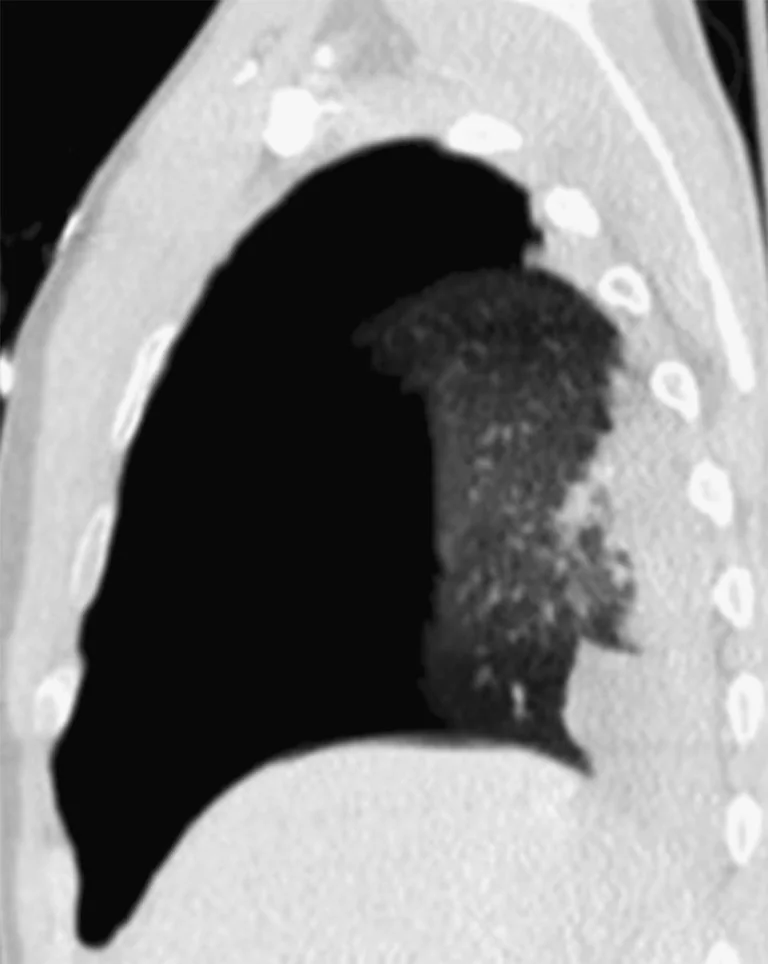
- Visseral plevra çizgisi — ince, keskin plevral sınırın dışında akciğer damar izleri sonlanır; göğüs duvarı ile çizgi arasındaki alan havadır.
- Anterior plevral hava — sırtüstü hastada anteromedial ve subpulmonik rezeslerde visseral plevradan ayrılan hava birikimi görülür.
- Medial pnömotoraks — kalp kenarı veya mediastinal plevra boyunca hava, öne yerleşimli küçük pnömotoraksı ele verebilir.
- Derin sulkus işareti — supin grafide kostofrenik reses beklenmedik ölçüde derin ve hiperlüsent görünür; BT'de subpulmonik hava doğrulanır.
- Akciğer retraksiyonu — visseral plevra çizgisinin hilus yönüne çekilmesi ve komşu akciğer hacminin azalması daha geniş hava koleksiyonunu gösterir.
- Tansiyon fizyolojisini düşündüren kitle etkisi — aynı tarafta hemitoraks genişlemesi, diyafram basısı ve karşı tarafa mediastinal itilme eşlik edebilir; kaymanın yokluğu tansiyonu dışlamaz.
- Eşlik eden travma bulguları — kaburga kırığı, akciğer kontüzyonu, laserasyon, cilt altı amfizemi veya hemotoraks pnömotoraksın kaynağını ve kapsamını açıklar.
Normalde
Normal toraksta visseral plevra ile göğüs duvarı arasında hava birikimi yoktur; pnömotoraksta ise bu iki yapı arasında düşük atenüasyonlu hava birikir ve visseral plevra hattının dış tarafında pulmoner damar izleri sonlanır. Toraksta normalde visseral plevra ile kostal plevra arasında hava şeridi bulunmaz; pnömotoraksta ise bu iki yapı arasında ince bir hava birikimi belirir ve visseral plevra hattının dış tarafında damar izleri kaybolur.
Normal BT ile kıyasla
Aynı bölgenin, kaynak veri setinde patoloji içermediği belirtilen bir BT incelemesini kesit kesit kaydırın; organ sınırlarını açarak anatomiyi hasta görüntüsüyle karşılaştırın. Küçük rastlantısal bulgular tümüyle dışlanmamıştır.
Kaynak: TotalSegmentator v2.01 veri seti (Wasserthal ve ark., Radiology: Artificial Intelligence 2023), CC BY 4.0, vaka s1278; organ sınırları veri setinin otomatik segmentasyonundan, birleştirilerek sadeleştirildi. Görüntüler 2,5 mm kesit aralığına yeniden örneklendi.
Ayırıcı tanı
- Büller
- pnömotoraksı taklit edebilen ve ayırıcı tanıda dikkate alınması gereken önemli bulgulardandır.
- Cilt kıvrımı
- göğüs duvarındaki çizgi plevra konturunu izlemez ve çizginin dışındaki akciğer alanında damar izleri devam eder.
- Plevral yapışıklıklar plevral havanın dağılımını değiştirebilir; yapışıklıkla obliterasyona uğramış alanlara hava giremez.
- Pnömomediastinumda hava mediastende birikir; BT, havanın mediastende mi yoksa plevral boşlukta mı olduğunu göstermeye yardımcı olur.
Tuzaklar
- Supin hastada havanın öne dağılması apikal plevra çizgisini görünmez kılabilir; aksiyel seriyi sternum arkasındaki ilk hava ceplerinden posterior resese kadar tarayın.
- Küçük pnömotoraksı değerlendirirken BT kesitlerini dikkatle inceleyin; BT küçük pnömotoraksları göğüs grafisinden daha duyarlı saptar.
- Mediastinal kaymayı tansiyonun zorunlu işareti saymayın; iki taraflı pnömotoraks veya erken basınç artışında kayma görülmeyebilir.
- Plevral dren bulunan hastada tüp malpozisyonu veya tıkanması pnömotoraksla birlikte görülebilir; dren işlevini değerlendirirken bu olasılığı göz önünde bulundurun.
Kendini dene
Sırtüstü travma BT'sinde anteromedial plevral aralıkta hava ve akciğer kenarında ince bir çizgi görülüyor; çizginin periferinde akciğer işaretleri yok. Bu bulgular en çok hangi tanıyı düşündürür?
Cevabı göster
Travmatik pnömotoraks. Visseral plevra çizgisinin periferinde akciğer işaretlerinin kaybolması pnömotoraksı destekler. Pnömotoraks, parietal ve visseral plevra arasındaki hava olarak tanımlanır; visseral plevra çizgisinin periferinde akciğer işaretleri görülmez.
Göğüs duvarı ile kol arasında uzanan ve visseral plevra çizgisinden daha kalın görünen bir çizgi var. Bu çizginin en olası açıklaması nedir?
Cevabı göster
Cilt kıvrımı. Göğüs duvarı ile kol arasında hapsolmuş hava, visseral plevra çizgisinden daha kalın görünen bir cilt kıvrımı oluşturabilir. Gerçek pnömotoraksta visseral plevra çizgisinin periferinde akciğer işaretleri bulunmaz.
Bu konunun yer aldığı turlar
İlgili konular
Kaynaklar
Bu sayfadaki 35 cümle ve 2 quiz sorusu aşağıdaki kaynaklardan alıntılarla tek tek karşılaştırıldı; 23 cümle bu karşılaştırmada düzeltildi (2026-10-08).
- Occult pneumothorax, revisitedpmc.ncbi.nlm.nih.gov
- Principles of diagnosis and management of traumatic pneumothoraxpmc.ncbi.nlm.nih.gov
- Traumatic pneumothorax and hemothorax: What you need to know.pubmed.ncbi.nlm.nih.gov
- Traumatic Pneumothorax: A Review of Current Diagnostic Practices And Evolving Management.pubmed.ncbi.nlm.nih.gov
- Chest ultrasonography versus supine chest radiography for diagnosis of pneumothorax in trauma patients in the emergency department.pubmed.ncbi.nlm.nih.gov
- A Narrative Review of Traumatic Pneumothorax Diagnoses and Management.pubmed.ncbi.nlm.nih.gov
- Diagnostic accuracy of prehospital ultrasound in detecting lung injury in patients with trauma: a systematic review and meta-analysis.pubmed.ncbi.nlm.nih.gov
- Evaluation and management of traumatic pneumothorax: A Western Trauma Association critical decisions algorithm.pubmed.ncbi.nlm.nih.gov
- Contralateral Traumatic Hemopneumothorax.pubmed.ncbi.nlm.nih.gov
- Giant bullous emphysema mistaken for traumatic pneumothorax.pubmed.ncbi.nlm.nih.gov
- Data on the epidemiology, diagnosis, and treatment of patients with pneumothorax.pubmed.ncbi.nlm.nih.gov
- Occult traumatic pneumothorax: Is routine follow up chest X-ray necessary?pubmed.ncbi.nlm.nih.gov
- Bedside Ultrasonography: AUseful Tool for Traumatic Pneumothorax.pubmed.ncbi.nlm.nih.gov
- Point-of-Care Diagnostic Device for Traumatic Pneumothorax: Low Sensitivity of the Unblinded PneumoScan™.pubmed.ncbi.nlm.nih.gov
- Double-lung point sign in traumatic pneumothorax.pubmed.ncbi.nlm.nih.gov
- Not so FAST-Chest ultrasound underdiagnoses traumatic pneumothorax.pubmed.ncbi.nlm.nih.gov
- Lung parenchymal trauma biomechanics, mechanisms, and classification: a narrative review of the current knowledge.pubmed.ncbi.nlm.nih.gov
- Acute Traumatic Aortic Injury: What the Radiologist Needs to Know.pubmed.ncbi.nlm.nih.gov
- Traumatic Diaphragmatic Rupture With Pericardial Tear and Transdiaphragmatic Herniation of the Stomach.pubmed.ncbi.nlm.nih.gov
- Performance of an artificial intelligence-based software in detecting pneumothorax on supine chest radiographs: a retrospective study.pubmed.ncbi.nlm.nih.gov
- Sex-, Age-, and Projection-Related Variability in Pneumothorax and Pulmonary Mass Detection Frequencies on Chest Radiographs: A Retrospective Cross-Sectional Study.pubmed.ncbi.nlm.nih.gov
- Impact of Artificial Intelligence Assistance on Diagnosing Traumatic Pneumothorax: A Comparison of Specialist and Non-Specialist Emergency Physicians.pubmed.ncbi.nlm.nih.gov
- Physiological Persistence of Tension Pneumothorax After Minor Diaphragmatic Injury During Laparoscopic Adrenalectomy: A Case Report.pubmed.ncbi.nlm.nih.gov
- Inability to Ventilate Due to a Sudden Intraoperative Tension Hydrothorax.pubmed.ncbi.nlm.nih.gov
- When Foreign Body Aspiration Is Not the Whole Story: An Undiagnosed Congenital Pulmonary Airway Malformation Mimicking Tension Pneumothorax in an Infant.pubmed.ncbi.nlm.nih.gov
- Case Report: Retrosternal parathyroid lipoadenoma in an obese male patient-diagnostic pitfalls and postoperative biphasic parathyroid hormone dynamics.pubmed.ncbi.nlm.nih.gov
- Advanced imaging techniques and artificial intelligence in pleural diseases: a narrative review.pubmed.ncbi.nlm.nih.gov
- Cosmic Signs in Radiology: A Pictorial Review.pubmed.ncbi.nlm.nih.gov
- Can lung ultrasound replace chest computed tomography in pediatric patients with complicated community-acquired pneumonia?pubmed.ncbi.nlm.nih.gov
- Advantages of electromagnetic navigation bronchoscopy in localizing pulmonary nodules challenging to traditional hook-wire localization: a comparative study on precision localization dilemmas.pubmed.ncbi.nlm.nih.gov
- Lung imaging methods: indications, strengths and limitations.pubmed.ncbi.nlm.nih.gov
- Interventional Pain Procedures: A Narrative Review Focusing on Safety and Complications. Part 3 - Sympathetic and Ganglion-Targeted Techniques.pubmed.ncbi.nlm.nih.gov
- Guidance for clinical practice using emergency and point-of-care ultrasonography.pubmed.ncbi.nlm.nih.gov
- ABCDE of prehospital ultrasonography: a narrative review.pubmed.ncbi.nlm.nih.gov
- Uniportal subxiphoid thoracoscopic thymectomy using percutaneous suspension technique for giant anterior mediastinal mass resection: a case report.pubmed.ncbi.nlm.nih.gov
- Retrospective Review Is the Best View: A Primer for Residents and Radiologists on Missed Findings in Chest Radiography.pubmed.ncbi.nlm.nih.gov
- Comparison of surgical approaches for pectus excavatum in children and adolescents: a single-center retrospective study.pubmed.ncbi.nlm.nih.gov
- Ultrasonographic Assessment of the Lungs in Asiatic Elephants (Elephas maximus).pubmed.ncbi.nlm.nih.gov
- Rare Bilateral Massive Pneumothorax, Pneumomediastinum, Pneumoperitoneum, and Diffuse Subcutaneous Emphysema During Colonoscopy: Multidisciplinary Collaboration: Case Report.pubmed.ncbi.nlm.nih.gov
- Fleischner Society: Glossary of Terms for Thoracic Imaging.pubmed.ncbi.nlm.nih.gov
- International Society of Paediatric Surgical Oncology (IPSO) Minimally Invasive Surgery (MIS) Guidelines.pubmed.ncbi.nlm.nih.gov
- Tips and Tricks in Thoracic Radiology for Beginners: A Findings-Based Approach.pubmed.ncbi.nlm.nih.gov
- Pneumothorax and Hemothorax: Practical Approaches for Radiologists.pubmed.ncbi.nlm.nih.gov
- Common and Rare Radiological Findings of Pulmonary and Thoracic Hydatid Cysts.pubmed.ncbi.nlm.nih.gov
- Blunt trauma related chest wall and pulmonary injuries: An overview.pubmed.ncbi.nlm.nih.gov
- Chest Wall and Diaphragmatic Injuries: Imaging Evaluation and Clinical Considerations.pubmed.ncbi.nlm.nih.gov
- Lung Parenchymal and Airway Injuries: Differential Diagnosis and Severity Grading.pubmed.ncbi.nlm.nih.gov
- Optimising Autologous Breast Reconstruction: Pneumothorax and Pneumomediastinum-A Literature Review and First Reported Case of Pneumomediastinum Following Bilateral DIEP Flap Reconstruction.pubmed.ncbi.nlm.nih.gov
- The role of thoracoplasty in modern thoracic surgery: a narrative review with three illustrative cases.pubmed.ncbi.nlm.nih.gov
- Infectious Pneumonia and Lung Ultrasound: A Review.pubmed.ncbi.nlm.nih.gov
- The Role of Thoracic Ultrasound for Diagnosis of Diseases of the Chest Wall, the Mediastinum, and the Diaphragm-Narrative Review and Pictorial Essay.pubmed.ncbi.nlm.nih.gov
- Deep learning applications in pulmonary medical imaging: recent updates and insights on COVID-19.pubmed.ncbi.nlm.nih.gov
- 2022 ACC/AHA guideline for the diagnosis and management of aortic disease: A report of the American Heart Association/American College of Cardiology Joint Committee on Clinical Practice Guidelines.pubmed.ncbi.nlm.nih.gov
- 2022 ACC/AHA Guideline for the Diagnosis and Management of Aortic Disease: A Report of the American Heart Association/American College of Cardiology Joint Committee on Clinical Practice Guidelines.pubmed.ncbi.nlm.nih.gov
- Patterns of injury and violence in Yaoundé Cameroon: an analysis of hospital data.pubmed.ncbi.nlm.nih.gov
- Total laparoscopic radical hysterectomy for cervical cancer in prolapsed uterus.pubmed.ncbi.nlm.nih.gov
- Case report: Subcutaneous emphysema following postoperative nausea.pubmed.ncbi.nlm.nih.gov
- Recognizing Descending Necrotizing Mediastinitis in Adults: A Narrative Review of Diagnostic Dilemmas and Barriers.pubmed.ncbi.nlm.nih.gov
- Spontaneous Pneumomediastinum, Subcutaneous Emphysema, and Pneumoperitoneum in RT-PCR-Confirmed Measles: A Pediatric Case Report.pubmed.ncbi.nlm.nih.gov
- Low Diagnostic Accuracy of Transthoracic Ultrasound for the Assessment of Spontaneous Pneumothorax in the Emergency Setting: A Multicentric Study.pubmed.ncbi.nlm.nih.gov
- Safety and efficacy of endobronchial ultrasound-guided transbronchial biopsy of intrathoracic lymphadenopathy.pubmed.ncbi.nlm.nih.gov
- Cerebral air embolism in interventional pulmonology.pubmed.ncbi.nlm.nih.gov
- Clinical and radiological characteristics of Mpox pneumonia in immunosuppressed HIV-infected patients: a multicenter study from China.pubmed.ncbi.nlm.nih.gov
- Tension Gastrothorax in a Child With Undiagnosed Congenital Diaphragmatic Hernia: A Case Report and Proposed Emergency Management Algorithm.pubmed.ncbi.nlm.nih.gov
- Congenital bronchopleural fistula in a newborn: a rare cause of persistent neonatal air leak - a case report.pubmed.ncbi.nlm.nih.gov
- Car Accident and Respiratory Distress: A Trauma-Based Pneumothorax Simulation Case for Medical Students.pubmed.ncbi.nlm.nih.gov
- Transforming pulmonary care with applications of endobronchial valves beyond emphysema: a narrative review.pubmed.ncbi.nlm.nih.gov
- Point-of-care ultrasound during trauma and critical care transport: a practical, safety-gated review.pubmed.ncbi.nlm.nih.gov
- Thoracic ultrasound in the modern management of pleural disease.pubmed.ncbi.nlm.nih.gov
- Diagnostic accuracy of transthoracic ultrasound for detection of pneumothorax, hemothorax, and lung contusion in trauma patients: comparison with chest radiography.pubmed.ncbi.nlm.nih.gov
- SPOT THE BOT: A comparative quality assessment of AI-generated written instructions for lung ultrasound training.pubmed.ncbi.nlm.nih.gov
- Analysis of pleural reaction following CT-guided hookwire localization for pulmonary nodules.pubmed.ncbi.nlm.nih.gov
- Imaging diagnostics of pulmonary ground-glass nodules: a narrative review with current status and future directions.pubmed.ncbi.nlm.nih.gov
- High-affinity alphavbeta3 integrin targeted optical probe as a new imaging biomarker for early atherosclerosis: initial studies in Watanabe rabbits.pubmed.ncbi.nlm.nih.gov
- Point-of-Care Ultrasound in Blunt Chest Trauma: Diagnostic Performance and Clinical Relevance.pubmed.ncbi.nlm.nih.gov
- Breathe easy, baby, breathe. Lung ultrasound in neonatal critical care.pubmed.ncbi.nlm.nih.gov
- Long-term safety and effectiveness of the "OptEase" vena cava filter.pubmed.ncbi.nlm.nih.gov
- Systemic Injury Burden, Not Pneumothorax Size, Predicts Prolonged Chest Tube Duration in Traumatic Pneumothorax: A Retrospective Analysis at a Level 1 Trauma Center.pubmed.ncbi.nlm.nih.gov
- Imaging of pleural disease.pubmed.ncbi.nlm.nih.gov
- Thoracic abnormal air collections in patients in the intensive care unit: radiograph findings correlated with CT.pubmed.ncbi.nlm.nih.gov
- Spinnaker-sail sign in full-term neonates with spontaneous pneumomediastinum: a case study and scoping literature review.pubmed.ncbi.nlm.nih.gov
- The Mediastinal Visceral Space: The Central Pathway for the Spread of Mediastinal Disease.pubmed.ncbi.nlm.nih.gov
- Expert consensus on imaging diagnosis of human infection with avian influenza.pubmed.ncbi.nlm.nih.gov
- Hybrid Congenital Pulmonary Malformation Revealed by Chronic Hemoptysis in a Six-Year-Old Girl: A Case Report.pubmed.ncbi.nlm.nih.gov
- Secondary Pneumomediastinum Following Bronchoscopic Interventions in Patients With Prolonged Tracheostomy Intubation: A Case Series.pubmed.ncbi.nlm.nih.gov
- Inferior phrenic artery-to-pulmonary artery fistula after surgery for catamenial pneumothorax: a case report.pubmed.ncbi.nlm.nih.gov
- Is It Time to Abandon the Absolute Contraindication to FNAC in Pulmonary Hydatid Cysts? A Case Report and Literature Review.pubmed.ncbi.nlm.nih.gov
- Secondary Complications in COVID-19 Patients: A Case Series.pubmed.ncbi.nlm.nih.gov
- Ten Years of Pediatric Lung Ultrasound: A Narrative Review.pubmed.ncbi.nlm.nih.gov
- The anatomical compartments and their connections as demonstrated by ectopic air.pubmed.ncbi.nlm.nih.gov
- Bronchoscopy and the Pulmonologist in Contemporary Lung Cancer Care.pubmed.ncbi.nlm.nih.gov
- ARDS management in trauma patients.pubmed.ncbi.nlm.nih.gov
- State-of-the-Art Mediastinal Staging in Non-Small-Cell Lung Cancer: Integration of Combined Endosonographic Techniques with Updated IASLC TNM 9th Classification.pubmed.ncbi.nlm.nih.gov
- A Hidden Airway Injury: Delayed Diagnosis of Tracheal Disruption After Penetrating Neck Trauma.pubmed.ncbi.nlm.nih.gov
- Pigtail catheter found in the Lingula of a pediatric patient on VV-ECMO while performing flexible bronchoscopy: a case report on an unexpected finding.pubmed.ncbi.nlm.nih.gov
- Subcutaneous and mediastinal emphysema after lobectomy: Two case reports with different courses.pubmed.ncbi.nlm.nih.gov
- Expanding the role of ultrasonography in cardiopulmonary assessment in dromedary camels.pubmed.ncbi.nlm.nih.gov
- Extensive Pneumomediastinum, Pneumopericardium, and Subcutaneous Emphysema Complicating Anti-melanoma Differentiation-Associated Gene 5 (Anti-MDA5)-Positive Dermatomyositis-Associated Fibrosing Interstitial Lung Disease: A CT-Based Case Report.pubmed.ncbi.nlm.nih.gov
- Case Report: Invasive mucinous adenocarcinoma mimicking interstitial pneumonia with autoimmune features: diagnostic pitfalls and reflections.pubmed.ncbi.nlm.nih.gov
- Intrathoracic Gastric Volvulus Mimicking a Cardiopulmonary Emergency: An Unusual but Fatal Diagnostic Pitfall in Critical Care.pubmed.ncbi.nlm.nih.gov
- COVID-19 Vaccination and Pulmonary Nodules: A Narrative Review of Causality, Detection Bias and Thoracic Imaging Pitfalls.pubmed.ncbi.nlm.nih.gov
- Extended Focused Assessment with Sonography for Trauma in the Emergency Department: A Comprehensive Review.pubmed.ncbi.nlm.nih.gov
- Impacting factors of diagnostic accuracy of ultrasound-guided percutaneous core needle biopsy in mediastinal lesions: an analysis with 622 cases.pubmed.ncbi.nlm.nih.gov
- Laparoscopic repair for neonatal spontaneous gastric perforation: a case report.pubmed.ncbi.nlm.nih.gov
- Chest CT scan for the screening of air anomalies at risk of pulmonary barotrauma for the initial medical assessment of fitness to dive in a military population.pubmed.ncbi.nlm.nih.gov
- Cystic Lung Diseases: Algorithmic Approach.pubmed.ncbi.nlm.nih.gov
- The use of Diagnostic Imaging for Identifying Abnormal Gas Accumulations in Cetaceans and Pinnipeds.pubmed.ncbi.nlm.nih.gov
- Spontaneous Pneumothorax: A Review of Underlying Etiologies and Diagnostic Imaging Modalities.pubmed.ncbi.nlm.nih.gov
- Bilateral Lung Points without Pneumothorax: Exploring "Lung Point" Mimics.pubmed.ncbi.nlm.nih.gov
- Predicting non-surgical treatment failure in patients with spontaneous pneumothorax-the Base-C score: a retrospective study.pubmed.ncbi.nlm.nih.gov
- Use of Lung Ultrasound in Cystic Fibrosis: Is It a Valuable Tool?pubmed.ncbi.nlm.nih.gov
- Thoracic Endometriosis Syndrome: A Comprehensive Review and Multidisciplinary Approach to Management.pubmed.ncbi.nlm.nih.gov
Eğitim amaçlıdır; hasta başında tanı ve tedavi kararının yerine geçmez. İçerik yapay zekâ destekli bir süreçle güncel literatüre göre cümle cümle kaynaklarla karşılaştırıldı, ancak uzman radyolog incelemesinden geçmedi. Klinik kararlarda güncel kılavuzları, kurum protokollerini ve radyoloji raporunu esas alın.