Özet
Karın travmasından sonra peritoneal boşlukta bağırsak dışı gaz, özellikle künt travmada içi boş organın tam kat yaralanmasını akla getirir. İntravenöz kontrastlı BT'de serbest gaz, ans kalınlaşması, mezenter stranding ve interloop sıvı gibi bulgular bir arada değerlendirilerek cerrahi gerektiren yaralanma olasılığı artar. Penetran yaralarda yara traktının peritoneuma uzanımı peritoneal penetrasyon için patognomoniktir; tek başına bağırsak duvarı defektini kanıtlamaz. Gözden kaçan bağırsak yaralanmasında gecikmiş tanı sepsise bağlı morbidite ve mortaliteyi artırır; pnömotorakstan gelen havayı perforasyon sanmak yanlış yorumlamaya yol açar.
Faz ve pencere
- Portal tanısal
- İntravenöz kontrastlı BT'de portal venöz fazda lümen dışı gaz peritoneal boşlukta, mezenterik yapraklar arasında veya retroperitoneal alanda izlenebilir; aynı incelemede bağırsak duvarı, mezenter damarları ve serbest sıvı değerlendirilir.
Önerilen pencereler G genişlik, M merkez; değerler Hounsfield birimi (HU)
- AkciğerG 1500 / M −600
- BatınG 400 / M +50
- Yumuşak dokuG 400 / M +40
BT bulguları
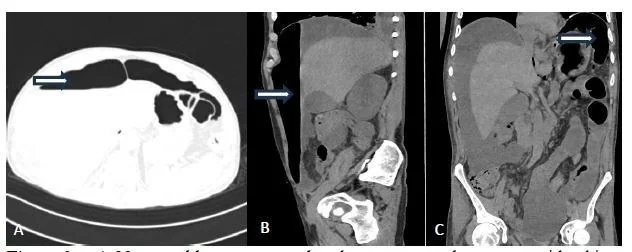
- Ön peritoneal gaz — sırtüstü incelemede peritoneal boşlukta küçük, lümen dışı hava cepleri görülebilir.
- Havanın bağırsak lümeni dışında kalması durumunda peritoneal boşlukta (pnömoperitoneum), mezenterik yapraklarda veya retroperitoneal alanda bulunabilir.
- Mezenterik gaz — mezenter yağında kümelenen küçük kabarcıklar, yaralanma yerinin belirlenmesine yardımcı olabilir.
- Pnömoretroperitoneum — bağırsak lümeni dışındaki gaz retroperitoneal alanda yerleşebilir ve peritoneal boşluktaki gazdan anatomik olarak ayrılır.
- Bağırsak duvarı defekti, bağırsak duvarının tüm kalınlığında kopukluk olarak tanımlanır ve içeriklerin mezenterik yapraklara ya da peritoneal/retroperitoneal alanlara sızmasına neden olur.
- Künt travmada ekstraluminal hava tam kat barsak yırtığı için yüksek özgüllüklü, ancak duyarlılığı düşük (%18–32) bir bulgudur; lümen dışına enterik kontrast veya barsak içeriği sızıntısı da tam kat yırtığı destekler.
- Mezenterik yağdaki çizgilenme veya hematom bağırsak ve mezenter yaralanmasını destekleyen bulgulardır; anslar arasındaki ya da mezenterik yapraklardaki sıvı, diğer peritoneal boşluklardaki sıvıya göre bu yaralanmalar için daha özgüldür.
Normalde
Normalde gastrointestinal gaz lümen içinde izlenir; travma sonrası lümen dışı gaz peritoneal boşlukta, mezenterik yapraklar arasında veya retroperitoneal alanda yerleşebilir. Şüpheli lümen dışı gaz odağını lümenle devamlılık ve peritoneal boşluk, mezenterik yapraklar ya da retroperitoneal alandaki yerleşimi açısından değerlendirin.
Normal BT ile kıyasla
Aynı bölgenin, kaynak veri setinde patoloji içermediği belirtilen bir BT incelemesini kesit kesit kaydırın; organ sınırlarını açarak anatomiyi hasta görüntüsüyle karşılaştırın. Küçük rastlantısal bulgular tümüyle dışlanmamıştır.
Kaynak: TotalSegmentator v2.01 veri seti (Wasserthal ve ark., Radiology: Artificial Intelligence 2023), CC BY 4.0, vaka s0119; organ sınırları veri setinin otomatik segmentasyonundan, birleştirilerek sadeleştirildi. Görüntüler 2,5 mm kesit aralığına yeniden örneklendi.
Ayırıcı tanı
- Ciltten peritoneuma uzanan yara traktı peritoneal penetrasyonun patognomonik bulgusudur; bağırsak duvarı defekti ayrıca değerlendirilmelidir, çünkü trakt tek başına defekti kanıtlamaz.
- Pnömotorakstan kaynaklanan hava diyafram krusları boyunca karın içine ilerleyerek serbest intraperitoneal havayı taklit edebilir.
- Yakın dönem girişim veya enstrümantasyon sonrası gaz, ciddi patolojilere ait gaz görünümünü taklit edebilir; BT'de gaz dağılımının haritalanması yüksek riskli özelliklerin dışlanmasına yardımcı olur.
- Gazın bağırsak duvarıyla çevrili lümen içinde kalması, travmaya bağlı olarak lümen dışına taşmış havadan (pnömoperitoneum, mezenterik hava veya pnömoretroperitoneum) anatomik olarak ayrılır.
- BT'de travmatik gaz retroperitoneum, abdominopelvik fasya planları ve cilt altı dokular dahil karın duvarı çevresinde izlenebilir; gazın dağılımı yerleşimini haritalamaya yardımcı olur.
Tuzaklar
- Penetran yaralanmalarda yara traktının peritoneuma uzanması peritoneal penetrasyonu gösterir; bağırsakta tam kat yırtık ayrıca araştırılmalıdır.
- Mezenter yağı içinde sıkışan küçük hava kabarcıkları yaralanma yerinin belirlenmesine yardımcı olabilir, bu nedenle mezenter dikkatle değerlendirilmelidir.
- Diyafram altı gazı abdominal kaynaklı kabul etmeden toraks tabanındaki pnömotoraksı ve pnömomediastinumu kontrol edin.
- Pnömoperitoneum yokluğu bağırsak-mezenter yaralanmasını dışlamaz; duvar defekti, anormal duvar kontrastlanması, mezenter değişikliği ve açıklanamayan sıvı ayrıca değerlendirilmelidir.
- Solid organ yaralanması olmadan görülen serbest sıvı, özellikle mezenterik veya interloop yerleşimliyse barsak-mezenter yaralanması açısından araştırılmalıdır; tek başına özgül değildir.
Kendini dene
Künt travmada sigmoid mezokolonda gaz, aynı yerde duvar kesintisi ve interloop sıvı görülüyor. En olası tanı hangisidir?
Cevabı göster
Sigmoid perforasyonu. Mezokolondaki gazın aynı segmentte duvar defekti ve komşu sıvıyla eşleşmesi sigmoid tam kat yaralanmasını destekler. Pnömotorakstan diyafram krusları boyunca hava geçişi serbest abdominal havayı taklit edebilir; pnömotoraks yokluğunda serbest intraperitoneal hava bağırsak yaralanması için yüksek özgüllüklü bir bulgudur.
Penetran yarada BT'de giriş yarasından peritoneuma uzanan trakt izleniyor, ek duvar defekti yok. Bu bulgu tek başına neyi gösterir?
Cevabı göster
Peritoneal penetrasyon. Peritoneuma uzanan trakt peritoneal penetrasyon için patognomoniktir; bağırsak yaralanması için duvar defekti gibi doğrudan bulgular ayrıca aranmalıdır.
İlgili konular
- Künt barsak yaralanması
- Mezenter yaralanması
- Duodenal ve retroperitoneal yaralanma
- Delici/kesici yaralanma ve yara yolu
Kaynaklar
Bu sayfadaki 37 cümle ve 2 quiz sorusu aşağıdaki kaynaklardan alıntılarla otomatik olarak karşılaştırıldı; 14 cümle bu karşılaştırmada düzeltildi (2026-10-12).
- WSES guidelines on blunt and penetrating bowel injury: diagnosis, investigations, and treatmentpmc.ncbi.nlm.nih.gov
- Radiologic Imaging of Traumatic Bowel and Mesenteric Injuries: A Comprehensive Up-to-Date Reviewpmc.ncbi.nlm.nih.gov
- Nonsurgical management of traumatic pneumoperitoneum in a cat.pubmed.ncbi.nlm.nih.gov
- Dual-Energy CT: A Paradigm Shift in Acute Traumatic Abdomen.pubmed.ncbi.nlm.nih.gov
- Floating appendix: post-traumatic amputation of the appendix as sequela or complication?: a case report.pubmed.ncbi.nlm.nih.gov
- Idiopathic pneumoperitoneum diagnosed following high-energy motor vehicular trauma:a case report.pubmed.ncbi.nlm.nih.gov
- Traumatic abdominal wall hernia after impact from handlebar: A case report.pubmed.ncbi.nlm.nih.gov
- Co-incidence of acute appendicitis and appendiceal transection after blunt abdominal trauma: a case report.pubmed.ncbi.nlm.nih.gov
- Gastrointestinal tract perforation following blunt abdominal trauma: an institution's experience.pubmed.ncbi.nlm.nih.gov
- Localized air foci in the lower thorax in the patients with pneumothorax: skip pneumothoraces.pubmed.ncbi.nlm.nih.gov
- Specific Radiological Findings of Traumatic Gastrointestinal Tract Injuries in Patients With Blunt Chest and Abdominal Trauma.pubmed.ncbi.nlm.nih.gov
- Early computed tomography in victims of non-traumatic out-of-hospital cardiac arrest.pubmed.ncbi.nlm.nih.gov
- Multi detector computed tomography in the diagnosis of bowel injury.pubmed.ncbi.nlm.nih.gov
- Pediatric Pyloric Transection: An Unusual Injury Following Blunt Abdominal Trauma.pubmed.ncbi.nlm.nih.gov
- Massive intraperitoneal free air induced by pneumothorax and pneumomediastinum.pubmed.ncbi.nlm.nih.gov
- Jejunal Perforation Associated With a Horseshoe-Shaped Abdominal Contusion After a Horse Kick: A Case Report.pubmed.ncbi.nlm.nih.gov
- Delayed Recognition of Multiple Small Bowel Perforations and Mesenteric Lacerations Following Combined Blunt and Penetrating Lumbar Trauma: A Case Report.pubmed.ncbi.nlm.nih.gov
- Polytrauma with pelvic fracture associated traumatic hernia and multiple hollow viscera injuries: a rare case report.pubmed.ncbi.nlm.nih.gov
- Occult Small Bowel Injury With Delayed Retroperitoneal Abscess Formation After Blunt Trauma: A Case Report.pubmed.ncbi.nlm.nih.gov
- Complication imaging after laparoscopic Roux-en-Y gastric bypass: clues to the diagnosis and pitfalls.pubmed.ncbi.nlm.nih.gov
- Advances in Imaging and Diagnosis of Emphysematous Cholecystitis.pubmed.ncbi.nlm.nih.gov
- Early Sodium Dynamics in Severely Injured Patients with Intestinal Perforations: A Multicenter Analysis.pubmed.ncbi.nlm.nih.gov
- Trans-anal small bowel evisceration through a perforation of the rectum: a case report.pubmed.ncbi.nlm.nih.gov
- Diagnostic performance of an artificial intelligence algorithm for detecting pneumoperitoneum on abdominal CT scans.pubmed.ncbi.nlm.nih.gov
- Imaging of pediatric gastrostomy tube malposition: Pearls and pitfalls.pubmed.ncbi.nlm.nih.gov
- Caught in the Whirl: Computed Tomography Diagnosis of Transverse Colon Volvulus With Proximal Jejunal Involvement and Cecocolic Pneumatosis.pubmed.ncbi.nlm.nih.gov
- The Importance of Predicting Bowel Necrosis in Acute Mesenteric Ischemia: Narrative Review.pubmed.ncbi.nlm.nih.gov
- Radiological insights into diverticulitis: Clinical manifestations, complications, and differential diagnosis.pubmed.ncbi.nlm.nih.gov
- A-Lines below the Diaphragm - A Case Report of Occult Pneumoperitoneum.pubmed.ncbi.nlm.nih.gov
- Tension pneumoperitoneum combined with CO<sub>2</sub> gas embolism during peroral endoscopic myotomy: a case report and review of literature.pubmed.ncbi.nlm.nih.gov
- Beyond embryological remnants: imaging of ligamentum teres hepatis and falciform ligament pathologies.pubmed.ncbi.nlm.nih.gov
- Atypical fundal perforation: a case report.pubmed.ncbi.nlm.nih.gov
- Case Report: Bezoar-mimicking intraluminal gossypiboma causing small-bowel obstruction and chronic malabsorption 15 years after hysterectomy.pubmed.ncbi.nlm.nih.gov
- Computed tomography findings and surgical outcomes in acute mesenteric ischemia: a retrospective single-center cohort study.pubmed.ncbi.nlm.nih.gov
- Long-term safety and effectiveness of the "OptEase" vena cava filter.pubmed.ncbi.nlm.nih.gov
- Rare Adult Ileo-Ileo-Colic Intussusception Caused by an Ileal Lipoma with Spontaneous Ileal Rupture and Rectal Hemorrhage: A Case Report with a Hypothesis-Generating Discussion of Mesenteric Anatomical Variability.pubmed.ncbi.nlm.nih.gov
- Acute and chronic complications of cesarean delivery: An update for the general radiologist.pubmed.ncbi.nlm.nih.gov
- Crohn's disease: research progress in decoding pathogenic multi-network and precision management of artificial intelligence radiomics.pubmed.ncbi.nlm.nih.gov
- Diagnostic challenges in boerhaave syndrome with bilateral pleural contamination: complementary roles of computed tomography, endoscopy, and video-assisted thoracoscopic surgery.pubmed.ncbi.nlm.nih.gov
- Case report on complex jewelry foreign body ingestion in pediatric population: When watchful waiting prevails over intervention.pubmed.ncbi.nlm.nih.gov
- Recurrent Cervical Esophageal Fistula and Retroesophageal Abscess Following Surgical Management of Zenker's Diverticulum.pubmed.ncbi.nlm.nih.gov
- Predictive Value of Preoperative CT Findings for Bowel Ischemia in Patients with Blunt Mesenteric Injury: A Retrospective Cohort Study.pubmed.ncbi.nlm.nih.gov
- Abdomen (A Pandora's Box): A Delayed Presentation of Blunt Abdominal Injury With a Mesenteric Tear Leading to Gangrenous Bowel.pubmed.ncbi.nlm.nih.gov
- Radiologic Imaging of Traumatic Bowel and Mesenteric Injuries: A Comprehensive Up-to-Date Review.pubmed.ncbi.nlm.nih.gov
- Benign Pneumoperitoneum: A Case Report and Literature Review.pubmed.ncbi.nlm.nih.gov
- Recurrent Non-surgical Pneumoperitoneum Associated With Jejunal Diverticulosis: A Case Report and Diagnostic Challenge.pubmed.ncbi.nlm.nih.gov
- Gastric Necrosis and Perforation Secondary to Severe Diabetic Gastroparesis in a Young Woman With Type 1 Diabetes Mellitus: A Case Report.pubmed.ncbi.nlm.nih.gov
- Computed tomography of pediatric abdominal trauma: optimizing utilization and enhancing diagnostic interpretation.pubmed.ncbi.nlm.nih.gov
- International Society of Paediatric Surgical Oncology (IPSO) Minimally Invasive Surgery (MIS) Guidelines.pubmed.ncbi.nlm.nih.gov
- An Overview of Gastroduodenal Perforation.pubmed.ncbi.nlm.nih.gov
- Pneumoperitoneum Following Perineal Air Insufflation can be Managed Conservatively.pubmed.ncbi.nlm.nih.gov
- An Unusual Case of Penetrating Abdominal Trauma With Important Clinical Lessons.pubmed.ncbi.nlm.nih.gov
- Thoracic abnormal air collections in patients in the intensive care unit: radiograph findings correlated with CT.pubmed.ncbi.nlm.nih.gov
- Patterns of injury and violence in Yaoundé Cameroon: an analysis of hospital data.pubmed.ncbi.nlm.nih.gov
- Dual single-port laparoscopic surgery for metastatic low-grade serous ovarian carcinoma: a case report of an innovative minimally invasive approach adhering to no-touch isolation technique.pubmed.ncbi.nlm.nih.gov
- Patient-engaged preoperative optimization for a complex incisional hernia: a case report.pubmed.ncbi.nlm.nih.gov
- Iatrogenic Large Bowel Perforation Following Image-Guided Pericardiocentesis: A Case Report.pubmed.ncbi.nlm.nih.gov
- Imaging and clinical features of intra-abdominal injuries in children with suspected physical abuse.pubmed.ncbi.nlm.nih.gov
- Hepatic portal venous gas after ingesting glyphosate: A case report and literature review.pubmed.ncbi.nlm.nih.gov
- Extensive Multicompartmental Air Dissection With Pneumoscrotum and Pneumorrhachis After Perineal Compressed-Air Injury Without Demonstrable Persistent Full-Thickness Rectal Perforation: A Case Report.pubmed.ncbi.nlm.nih.gov
- Pneumopericardium and multicompartmental air dissemination after colorectal endoscopic resection managed conservatively: a case report.pubmed.ncbi.nlm.nih.gov
- Pneumothorax, Pneumomediastinum, Pneumoperitoneum, Pneumoretroperitoneum, and Cervical Emphysema After Colonoscopy: A Case Report.pubmed.ncbi.nlm.nih.gov
- Ultrasonography in the Diagnosis of Surgical Acute Abdomen in Zaria, Nigeria.pubmed.ncbi.nlm.nih.gov
- Aortoenteric fistula: clinical features, diagnostic challenges, and surgical outcomes - a retrospective analysis of 10 cases.pubmed.ncbi.nlm.nih.gov
- Visceral Arterial Pseudoaneurysms-A Clinical Review.pubmed.ncbi.nlm.nih.gov
- Pneumatosis intestinalis revisited: associated imaging findings, clinical correlation, management, risk stratification and future perspectives.pubmed.ncbi.nlm.nih.gov
- Acute abdomen with intraperitoneal free gas: a diagnostic pitfall of pneumatosis cystoides intestinalis-a case report.pubmed.ncbi.nlm.nih.gov
- Common and Rare Radiological Findings of Pulmonary and Thoracic Hydatid Cysts.pubmed.ncbi.nlm.nih.gov
- An international multidisciplinary consensus statement on laparoscopic liver biopsy.pubmed.ncbi.nlm.nih.gov
- Point-of-Care Ultrasonography Helped to Rapidly Detect Pneumomediastinum in a Vomiting Female.pubmed.ncbi.nlm.nih.gov
- Diverticulitis-Associated Mesenteric Venous Thrombophlebitis: A Case Report and Systematic Review of Diagnosis, Management, and Outcomes.pubmed.ncbi.nlm.nih.gov
- Laparoscopic Evaluation of Traumatic Pneumoperitoneum Without Hollow Viscus Injury: A Case Series.pubmed.ncbi.nlm.nih.gov
- Challenges in Diagnosis and Management of Pneumoperitoneum Associated with Pneumatosis Cystoides Intestinalis in Children: A Systematic Review.pubmed.ncbi.nlm.nih.gov
- Does laparoscopic surgery decrease the risk of atrial fibrillation after foregut surgery?pubmed.ncbi.nlm.nih.gov
- Laparoscopic Exploration for Penetrating Abdominal Trauma Caused by Deer Antlers: A Case Report.pubmed.ncbi.nlm.nih.gov
- Case Report: Laparoscopic management of penetrating liver injury from pneumatic nail gun.pubmed.ncbi.nlm.nih.gov
- Complete traumatic transection of the fourth portion of the duodenum after blunt abdominal trauma: a case report.pubmed.ncbi.nlm.nih.gov
- Traumatic Ruptured Hepatic Cyst Managed by Laparoscopic Fenestration Assisted With Indocyanine Green (ICG) Fluorescence: A Case Report.pubmed.ncbi.nlm.nih.gov
- Penetrating trauma leading to a transfixing common bile duct injury: case report and surgical management.pubmed.ncbi.nlm.nih.gov
- Delayed Diagnosis of Pyogenic Spondylitis After Impalement by Steel Rods: Case Report.pubmed.ncbi.nlm.nih.gov
- Surgical decision-making in paediatric penetrating trauma: case report from two paediatric tertiary centres.pubmed.ncbi.nlm.nih.gov
- Tissue-Resident Macrophage in Inflammation and Cancer.pubmed.ncbi.nlm.nih.gov
- Contrast-enhanced computed tomography abdomen versus diagnostic laparoscopy-based management in patients with penetrating abdominal trauma: a randomised controlled trial.pubmed.ncbi.nlm.nih.gov
- Diagnostic Approaches to Vascular Injury in Polytrauma-A Literature Review.pubmed.ncbi.nlm.nih.gov
- Endoscopic management of perforations, leaks and fistulas.pubmed.ncbi.nlm.nih.gov
- Endoscopic trans-esophageal submucosal tunneling surgery: A new therapeutic approach for diseases located around the aorta ventralis.pubmed.ncbi.nlm.nih.gov
- Recurrent ascending cholangitis with acute pancreatitis and pancreatic atrophy caused by a juxtapapillary duodenal diverticulum: A case report and literature review.pubmed.ncbi.nlm.nih.gov
- A literature review and case report: Traumatic appendicitis in an elderly patient with spinal cord injury and medical comorbidities.pubmed.ncbi.nlm.nih.gov
- Post-traumatic superior mesenteric artery syndrome following lumbar spine stabilization: A case report and literature review.pubmed.ncbi.nlm.nih.gov
- Emphysematous conditions of the abdomen and pelvis: pearls and pitfalls.pubmed.ncbi.nlm.nih.gov
- The anatomical compartments and their connections as demonstrated by ectopic air.pubmed.ncbi.nlm.nih.gov
- WSES guidelines on blunt and penetrating bowel injury: diagnosis, investigations, and treatment.pubmed.ncbi.nlm.nih.gov
- CT of Penetrating Abdominopelvic Trauma.pubmed.ncbi.nlm.nih.gov
- Abdominal computed tomography scoring systems and experienced radiologists in the radiological diagnosis of small bowel and mesenteric injury.pubmed.ncbi.nlm.nih.gov
- Significant blunt bowel and mesenteric injury - Comparison of two CT scoring systems in a trauma registry cohort.pubmed.ncbi.nlm.nih.gov
- Delayed Colonic Perforation Following Blunt Abdominal Trauma: A Diagnostic Dilemma.pubmed.ncbi.nlm.nih.gov
- Emergency surgical approach for abdominal trauma in a patient with Crohn's disease: case report and literature review.pubmed.ncbi.nlm.nih.gov
- Laparoscopy in Emergency: Why Not? Advantages of Laparoscopy in Major Emergency: A Review.pubmed.ncbi.nlm.nih.gov
- The Use of Laparoscopy in the Management of Trauma Patients: Brief review.pubmed.ncbi.nlm.nih.gov
- When It Is Not NEC: Recognizing Mimics of Necrotizing Enterocolitis in Preterm Infants.pubmed.ncbi.nlm.nih.gov
- Severe post-traumatic Pancreatoduodenal injury with septic shock and enteric fistula: A multidisciplinary challenge - Case report.pubmed.ncbi.nlm.nih.gov
- Know your way around acute unenhanced CT during global iodinated contrast crisis: a refresher to ED radiologists.pubmed.ncbi.nlm.nih.gov
- Rare and Unusual Consequences of Blunt Abdominal Trauma-The Significance of Anatomical Anomalies.pubmed.ncbi.nlm.nih.gov
- Contrast-enhanced ultrasound (CEUS) in urgent and emergent pediatric conditions: a comprehensive review.pubmed.ncbi.nlm.nih.gov
- Pediatric blunt duodenal injury: a 9-year retrospective single-center series from Vietnam.pubmed.ncbi.nlm.nih.gov
- Gastrointestinal perforation: clinical and MDCT clues for identification of aetiology.pubmed.ncbi.nlm.nih.gov
- Traumatic complete pyloric transection following blunt abdominal trauma: A case report and literature review.pubmed.ncbi.nlm.nih.gov
- Changes in the coelomic microclimate during carbon dioxide laparoscopy: morphological and functional implications.pubmed.ncbi.nlm.nih.gov
- Primary ventral and incisional hernias: comprehensive review.pubmed.ncbi.nlm.nih.gov
- Perforated sigmoid colon diverticulitis initially presenting with pneumoperitoneum, pneumoretroperitoneum, and pneumomediastinum: A case report.pubmed.ncbi.nlm.nih.gov
- Endoscope-Assisted Thoracic Duct Ligation and Cisterna Chyli Ablation Using Double O-Ring Wound Retractors in a Dog with Presumed Idiopathic Chylothorax.pubmed.ncbi.nlm.nih.gov
- Pneumatosis cystoides intestinalis misdiagnosed as pneumoperitoneum due to colon perforation in a patient with blunt trauma injuries: a case report.pubmed.ncbi.nlm.nih.gov
Eğitim amaçlıdır; hasta başında tanı ve tedavi kararının yerine geçmez, tıbbi tavsiye değildir. Metinler yapay zekâ desteğiyle yazıldı ve otomatik bir adımda kaynak alıntılarıyla karşılaştırıldı; bu bir tıbbi doğrulama değildir ve içerik uzman radyolog incelemesinden geçmedi. Klinik kararlarda güncel kılavuzları, kurum protokollerini ve radyoloji raporunu esas alın.