Özet
Çoklu travmada sistematik okuma, yaşamı tehdit eden bulguların ve kolay atlanan anatomik bölgelerin tutarlı biçimde taranmasına yardım eder. Beyin ve kafa tabanı değerlendirmesi tüm vücut incelemesinin ilk bölümüdür; kafa kontrastsız serisi, boyun damar görüntülemesi ve gövde fazları aynı bilgi türünü sağlamaz. Aksiyel seri, multiplanar rekonstrüksiyon ve uygun yumuşak doku-kemik pencerelerini birlikte kullanmak lezyonun uzanımını netleştirir. Sistematik kontrol listesi ve tutarlı tarama paterni izlenmediğinde, eşlik eden önemli yaralanmaların radyolojik olarak kaçırılma riski artar.
Okuma sırası
- Hemisferler, falx ve sisternalar. Orta-ağır travmatik beyin hasarında ilk nörogörüntüleme incelemesi olarak kontrastsız kafa BT'sini değerlendirin.
- Falx cerebri. Subdural hematomun tentorium ve falx cerebelli boyunca yeniden dağılım gösterip göstermediğini değerlendirin.
- Orta hat ve lateral ventriküller. Travmaya bağlı herniasyon olgularında BT değerlendirmesinde hematom, ventriküller, orta beyin ve perimezensefalik sisternalar birlikte incelenebilir.
- Bazal sisternalar ve kafa tabanı. Kafa ve boyun travması kuşkusunda, modified ve expanded Denver ölçütlerini karşılayan seçilmiş olgularda BTA eklenebilir.
Faz ve pencere
- Kontrastsız tanısal
- Kafa ve spinal kemik travmasında akut kan, parankim hasarı ve kırık kontrastsız seride aranır; kontrast fazı bunların başlangıç taramasının yerini almaz.
- BTA
- Kafa tabanı kırığı karotis kanalına uzanıyorsa veya künt serebrovasküler yaralanma kuşkusu varsa boyun ve intrakraniyal damarlar BT anjiyografide değerlendirilir; tüm travma hastalarına rutin değildir.
- Portal
- Gövde organ ve yumuşak doku yaralanmaları IV kontrastlı gövde ediniminde incelenir; bu fazın varlığı kontrastsız kafa incelemesini gereksiz kılmaz.
Önerilen pencereler G genişlik, M merkez; değerler Hounsfield birimi (HU)
- BeyinG 80 / M +40
- SubduralG 200 / M +75
- KemikG 1800 / M +400
- AnjiyoG 600 / M +150
- Yumuşak dokuG 400 / M +40
- AkciğerG 1500 / M −600
- MediastenG 350 / M +50
- BatınG 400 / M +50
BT bulguları
- Akut subdural hematom, tentoryum ve falx cerebelliye yeniden dağılabilir.
- Parankim ve ventriküller — kortikal kontüzyon, derin kanama, intraventriküler kan ve gri-beyaz cevher sınırını değerlendir.
- Kitle etkisi değerlendirilirken orta hat kayması ve bazal sisternaların basısı gibi bulgular birlikte incelenir.
- Damar kuşkusu — kanal geçişi, düzensiz damar konturu veya dolum kusurunu BTA varsa damar lümeninde ara.
- Görüntülenen diğer alanlar — toraks, abdomen-pelvis, damarlar, kemikler ve yumuşak dokuyu tarama kapsamı ve kontrast fazına göre sırala.
Normalde
Normal çoklu travma BT'si, baştan pelvise görüntülenen alanlarda akut travmatik yaralanma saptanmaması olarak tanımlanır. Görüntüleme kapsamındaki bölgeleri sistematik ve kontrol listesine dayalı biçimde sırayla değerlendirin.
Normal BT ile kıyasla
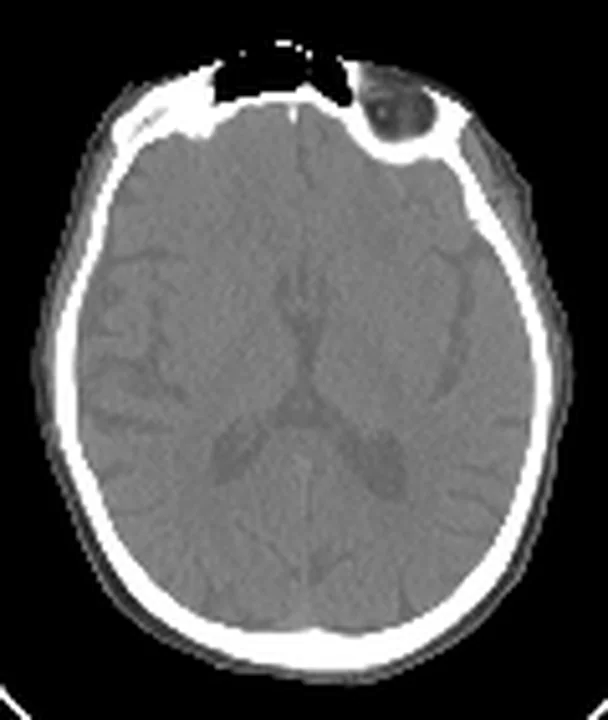
Aynı bölgenin, kaynak veri setinde patoloji içermediği belirtilen bir BT incelemesini kesit kesit kaydırın; organ sınırlarını açarak anatomiyi hasta görüntüsüyle karşılaştırın. Küçük rastlantısal bulgular tümüyle dışlanmamıştır.
Kaynak: TotalSegmentator v2.01 veri seti (Wasserthal ve ark., Radiology: Artificial Intelligence 2023), CC BY 4.0, vaka s0103; organ sınırları veri setinin otomatik segmentasyonundan, birleştirilerek sadeleştirildi. Görüntüler 2,5 mm kesit aralığına yeniden örneklendi.
Ayırıcı tanı
- Subdural hematom, kafa travması sonrası görülebilen akut intrakraniyal kanamalardan biridir.
- Epidural hematom, travmatik beyin hasarında görülebilen ekstraaksiyel kanamalardandır.
- Travmatik subaraknoid kanama
- hiperdansite kortikal sulkus veya bazal sisterna içinde kalır.
- Beyin kontüzyonu
- özellikle gri-beyaz cevher sınırında kortikal-subkortikal parankimde yamalı kanama yapar.
Tuzaklar
- Akut subdural hematomun tentoryum ve falx cerebelliye yeniden dağılabileceğini göz önünde bulundurun.
- Kafa tabanı kemik çizgilerini değerlendirirken koronal ve sagittal reformasyonları da inceleyin.
- Damar yaralanması için BTA endikasyonu varsa bunu sıradan kontrastlı gövde serisinin kapsadığını varsayma; boyun damarlarının uygun zamanlama ve kapsamını doğrula.
- Tüm vücut BT değerlendirmesinde görüntüleme kapsamının baştan pelvise kadar uzandığını doğrulayın.
Kendini dene
Subdural hematom hangi dural yansımalar boyunca yeniden dağılım gösterebilir?
Cevabı göster
Tentorium ve falx cerebelli boyunca. Subdural hematom tentorium ve falx cerebelli boyunca yeniden dağılım gösterebilir.
Travma sonrası kafa içinde hava görülüyor. Kafa içindeki gazın radyolojik adı nedir?
Cevabı göster
Pnömosefali. Pnömosefali, kafa boşluğu içinde hava bulunmasıdır; olguların çoğu kafa travması veya cerrahi işlem sonrasında ortaya çıkar.
Bu konunun yer aldığı turlar
İlgili konular
- Tüm vücut travma BT protokolü ve tarama sınırları
- Subdural hematom
- Beyin kontüzyonu ve intraparenkimal kanama
- Kalvaryum ve kafa tabanı kırığı
Kaynaklar
Bu sayfadaki 32 cümle ve 2 quiz sorusu aşağıdaki kaynaklardan alıntılarla otomatik olarak karşılaştırıldı; 14 cümle bu karşılaştırmada düzeltildi (2026-10-09).
- Importance of the Mechanism of Injury in Trauma Radiology Decision-Makingpmc.ncbi.nlm.nih.gov
- Artificial Intelligence in Fracture Detection: A Systematic Review and Meta-Analysis.pubmed.ncbi.nlm.nih.gov
- The diagnostic values of UCH-L1 in traumatic brain injury: A meta-analysis.pubmed.ncbi.nlm.nih.gov
- Facial fractures: The "bottom-up" approach.pubmed.ncbi.nlm.nih.gov
- An increasing number of convolutional neural networks for fracture recognition and classification in orthopaedics : are these externally validated and ready for clinical application?pubmed.ncbi.nlm.nih.gov
- Evaluating fracture risk in acute ankle sprains: Any news since the Ottawa Ankle Rules? A systematic review.pubmed.ncbi.nlm.nih.gov
- The effectiveness of ultrasound in the detection of fractures in adults with suspected upper or lower limb injury: a systematic review and subgroup meta-analysis.pubmed.ncbi.nlm.nih.gov
- Acromiohumeral distance measurement in rotator cuff tendinopathy: is there a reliable, clinically applicable method? A systematic review.pubmed.ncbi.nlm.nih.gov
- Imaging to improve agreement for proximal humeral fracture classification in adult patient: A systematic review of quantitative studies.pubmed.ncbi.nlm.nih.gov
- Computed tomography versus magnetic resonance imaging versus bone scintigraphy for clinically suspected scaphoid fractures in patients with negative plain radiographs.pubmed.ncbi.nlm.nih.gov
- High-Energy Pelvic Ring Injuries: A Comprehensive Imaging Review.pubmed.ncbi.nlm.nih.gov
- How reliable is the distinction between thoracolumbar AO type A3 and A4 fractures? A systematic literature review.pubmed.ncbi.nlm.nih.gov
- Performance of artificial intelligence in automated measurement of patellofemoral joint parameters: a systematic review.pubmed.ncbi.nlm.nih.gov
- Artificial intelligence fracture recognition on computed tomography: review of literature and recommendations.pubmed.ncbi.nlm.nih.gov
- Which is the Superior Thoracolumbar Injury Classification Tool? TLICS Versus AOSpine 2013: A Systematic Review.pubmed.ncbi.nlm.nih.gov
- Prognostic Value of Initial CT Imaging for Surgical Planning and Outcomes in Panfacial Fractures: A Systematic Review and Meta-Analysis.pubmed.ncbi.nlm.nih.gov
- Strengthening trauma care in low- and middle-income countries through guideline adaptation and scalable system reforms.pubmed.ncbi.nlm.nih.gov
- Evaluation of Pediatric Patients with Blunt Abdominal Trauma: A Systematic Review, Meta-Analysis, and Practice Management Recommendations.pubmed.ncbi.nlm.nih.gov
- Explosive Weapons Trauma Care Collective (EXTRACCT) Blast Injury Clinical Practice Guideline: Traumatic Brain Injury From Blast and Penetrating Mechanisms in Settings With Variable Resource Availability.pubmed.ncbi.nlm.nih.gov
- Delayed Traumatic Subarachnoid Hemorrhage Following Initially Negative Computed Tomography (CT) Imaging in a Patient With a Mechanical Mitral Valve and Markedly Elevated International Normalized Ratio (INR).pubmed.ncbi.nlm.nih.gov
- Bilateral anterior tibial artery pseudoaneurysms triggered by minor blunt trauma as the initial presentation of vascular Ehlers-Danlos syndrome with a whole-exon deletion.pubmed.ncbi.nlm.nih.gov
- Non-thrombotic pulmonary emboli: imaging findings and differential diagnoses.pubmed.ncbi.nlm.nih.gov
- First Experiences with Fusion of PET-CT and MRI Datasets for Navigation-Assisted Percutaneous Biopsies for Primary and Metastatic Bone Tumors.pubmed.ncbi.nlm.nih.gov
- Role of Multidetector Computed Tomography in the Evaluation of Maxillofacial Trauma.pubmed.ncbi.nlm.nih.gov
- Fracture Detection on Bone Radiographs: The Impact of an AI Tool on Orthopaedic Night Shifts.pubmed.ncbi.nlm.nih.gov
- Impact of discrepancies in radiological interpretation on forensic report outcomes: A retrospective study.pubmed.ncbi.nlm.nih.gov
- Diagnostic Accuracy and Time Efficiency of Artificial Intelligence for Intracranial Hemorrhage Detection on Emergency Brain CT.pubmed.ncbi.nlm.nih.gov
- AI-Based Approaches for the Identification and Quantification of Traumatic Brain Injury in Computed Tomography Imaging: Systematic Review.pubmed.ncbi.nlm.nih.gov
- Case Report: Immediate preprocedural CT as a decision-making checkpoint before middle meningeal artery embolization for traumatic epidural hematoma.pubmed.ncbi.nlm.nih.gov
- Endovascular treatment for symptomatic vasospasm following traumatic brain injury: illustrative case.pubmed.ncbi.nlm.nih.gov
- Blunt Cerebrovascular Injury: A Visual Case Report with Computed Tomography Angiography Findings Revealing Carotid and Vertebral Artery Dissection.pubmed.ncbi.nlm.nih.gov
- Diagnosis and Management of Pediatric Blunt Cerebrovascular Injuries: A Narrative Review.pubmed.ncbi.nlm.nih.gov
- From Cervical Trauma and Head Injury to Malignant Cerebral Edema: Blunt Cerebrovascular Injury Causing Large-Vessel Occlusion Treated With Thrombectomy and Neurocritical Care.pubmed.ncbi.nlm.nih.gov
- Combined Post-traumatic Pseudoaneurysms of the Superior Gluteal and Aberrant Obturator Arteries: A Case Report.pubmed.ncbi.nlm.nih.gov
- AI-assisted detection of an initially missed infrarenal abdominal aortic injury in a polytrauma patient: A case report.pubmed.ncbi.nlm.nih.gov
- The space of Retzius: anatomy, imaging features, and patterns of disease spread.pubmed.ncbi.nlm.nih.gov
- Ballooned neurons in semi-recent severe traumatic brain injury.pubmed.ncbi.nlm.nih.gov
- Usefulness of Neurosonogram in Critical Ill Neonates.pubmed.ncbi.nlm.nih.gov
- Imaging of Intracranial Hemorrhage.pubmed.ncbi.nlm.nih.gov
- Traumatic basal ganglia hemorrhage: illustrative cases.pubmed.ncbi.nlm.nih.gov
- Seizure and aspiration complicating acute expanding epidural hematoma in a tuberous sclerosis adolescent: a case report of clinical and surgical emergency.pubmed.ncbi.nlm.nih.gov
- Development and validation of a prediction model for postoperative cerebral edema progression in emergency traumatic brain injury patients.pubmed.ncbi.nlm.nih.gov
- Midbrain volume in brain herniation: A volumetric analysis in operative traumatic brain injury.pubmed.ncbi.nlm.nih.gov
- Lumbar Puncture and Brain Herniation in Acute Bacterial Meningitis: An Updated Narrative Review.pubmed.ncbi.nlm.nih.gov
- Anatomic, Radiographic, and Computed Tomographic Study of the Skull in the Persian Squirrel (Sciurus anomalus).pubmed.ncbi.nlm.nih.gov
- Imaging of cerebrovascular complications from blunt skull base trauma.pubmed.ncbi.nlm.nih.gov
- Comprehensive Review of External and Middle Ear Anatomy on Photon-Counting CT.pubmed.ncbi.nlm.nih.gov
- Traumatic Carotid Artery Dissection Following a Brazilian Jiu-Jitsu Chokehold: A Case Report.pubmed.ncbi.nlm.nih.gov
- Middle cerebral artery dissection: pathophysiology, diagnosis, and therapeutic options.pubmed.ncbi.nlm.nih.gov
- When headache meets visual disturbance: An evidence-based review of common and critical entities.pubmed.ncbi.nlm.nih.gov
- Whole-Body Computed Tomography (WBCT) for the initial assessment of trauma patients: a retrospective observational study.pubmed.ncbi.nlm.nih.gov
- The Utility of Pan-Scan Imaging in Older Patients After Ground-Level Falls: A Comparative Study.pubmed.ncbi.nlm.nih.gov
- The Utility of Whole Body Computed Tomography in Trauma Activations and the Impact of Incidental Findings on Patient Management: A Review.pubmed.ncbi.nlm.nih.gov
- Imaging of Skull Base Tumors.pubmed.ncbi.nlm.nih.gov
- Imaging Evaluation of Acute Traumatic Brain Injury.pubmed.ncbi.nlm.nih.gov
- Emerging and re-emerging infectious disease in otorhinolaryngology.pubmed.ncbi.nlm.nih.gov
- Overcoming the absence of pre-traumatic imaging: a multiplanar three-dimensional virtual reduction workflow for mandibular condylar fractures.pubmed.ncbi.nlm.nih.gov
- Anatomy-driven automated subsegmentation of pelvic and proximal femoral CT into clinically relevant subregions and landmarks.pubmed.ncbi.nlm.nih.gov
- Comparison of clinical and radiological outcomes between microscope-assisted tubular unilateral laminectomy for bilateral decompression and bilateral laminotomy for crossover decompression in single-level lumbar spinal stenosis.pubmed.ncbi.nlm.nih.gov
- Imaging for the diagnosis and management of traumatic brain injury.pubmed.ncbi.nlm.nih.gov
- Catastrophic Hypoxic-Ischemic Brain Injury Following Influenza A Illness in a Young Woman: A Case Report.pubmed.ncbi.nlm.nih.gov
- Neuroimaging of Traumatic Brain Injury.pubmed.ncbi.nlm.nih.gov
- Imaging biomarkers of epileptogenecity after traumatic brain injury - Preclinical frontiers.pubmed.ncbi.nlm.nih.gov
- Biomarkers of blast-induced neurotrauma: profiling molecular and cellular mechanisms of blast brain injury.pubmed.ncbi.nlm.nih.gov
- Application and prognostic analysis of endoscopic sinus surgery combined with multidisciplinary team management in rhino-orbito-cerebral mucormycosis.pubmed.ncbi.nlm.nih.gov
- Current state and advancements of imaging in acute ischemic stroke: a practical review.pubmed.ncbi.nlm.nih.gov
- Rapidly Progressive Multiple Ischemic Lesions Caused by <i>Cryptococcus neoformans</i> Infection Presenting with Meningoencephalitis and Cerebral Infarction as the Initial Manifestations: A Case Report.pubmed.ncbi.nlm.nih.gov
- Neuroimaging for neurovascular complications of traumatic brain injury.pubmed.ncbi.nlm.nih.gov
- Acute Computer Tomography Findings in Pediatric Accidental Head Trauma-Review.pubmed.ncbi.nlm.nih.gov
- Deep learning algorithm in detecting intracranial hemorrhages on emergency computed tomographies.pubmed.ncbi.nlm.nih.gov
- Flat-panel conebeam CT in the clinic: history and current state.pubmed.ncbi.nlm.nih.gov
- Blunt traumatic vertebral artery injury: a clinical review.pubmed.ncbi.nlm.nih.gov
- Long-term safety and effectiveness of the "OptEase" vena cava filter.pubmed.ncbi.nlm.nih.gov
- Vascular Malformations of the External Ear: A Systematic Review of Clinical Presentation, Diagnosis, and Management.pubmed.ncbi.nlm.nih.gov
- Contemporary approach to soft-tissue reconstruction of the lower extremity after trauma.pubmed.ncbi.nlm.nih.gov
- Case Report: Chronic expanding axillary hematoma mimicking locoregional recurrence 15 years after breast cancer surgery.pubmed.ncbi.nlm.nih.gov
- Understanding Photon-Counting CT: Physics, Detector Technology, and Image Reconstructions.pubmed.ncbi.nlm.nih.gov
- Region-specific QCT thresholds for osteoporosis assessment in the thoracic spine: why lumbar cut-offs fail.pubmed.ncbi.nlm.nih.gov
- Diagnostic Accuracy of Artificial Intelligence for Detection of Intracranial Haemorrhage on Non-contrast CT Head: A Systematic Review.pubmed.ncbi.nlm.nih.gov
- Prospective blinded interim evaluation of a portable radiofrequency device TES HT to support triage in emergency department patients with mild head trauma or acute neurological symptoms.pubmed.ncbi.nlm.nih.gov
- Multidisciplinary Management of Emergency Neurosurgery for Intracerebral Hemorrhage During Pregnancy: A Case Report.pubmed.ncbi.nlm.nih.gov
- Rosette-forming glioneuronal tumor of the cerebellum with intratumoral hemorrhage: case report with radiologic-pathologic correlation in a resource-limited setting.pubmed.ncbi.nlm.nih.gov
- Cost-effectiveness of intracranial pressure monitoring in severe traumatic brain injury in Southern Thailand.pubmed.ncbi.nlm.nih.gov
- Imaging of cranial nerves: a pictorial overview.pubmed.ncbi.nlm.nih.gov
- Clinical and Radiological Characteristics of Pediatric Skull Fractures and Their Association with Neurosurgical Intervention: A Retrospective Cohort Study.pubmed.ncbi.nlm.nih.gov
- A Case of Pneumocephalus on Valsalva Maneuver: A Case Report and Literature Review.pubmed.ncbi.nlm.nih.gov
- Delayed Expanding Intracerebral Pneumatocele Following Severe Craniofacial Trauma: A Case Report With Serial Imaging Correlation.pubmed.ncbi.nlm.nih.gov
- Predicting Traumatic Brain Injury Outcomes: The Intersection of Clinical Signs, Laboratory Indicators and Radiology.pubmed.ncbi.nlm.nih.gov
- First seizure in adolescence revealing hidden bilateral porencephalic cysts.pubmed.ncbi.nlm.nih.gov
- Case Report: Atypical presentations of neonatal and infantile hemophilia B.pubmed.ncbi.nlm.nih.gov
- Lung Parenchymal and Airway Injuries: Differential Diagnosis and Severity Grading.pubmed.ncbi.nlm.nih.gov
- Early and Emergency Department Management of Infraclavicular Brachial Plexus Injuries Secondary to Shoulder Trauma.pubmed.ncbi.nlm.nih.gov
- Difficulties Encountered by Forensic Pathologists in Proving Abusive Head Trauma in Children: A Case Report.pubmed.ncbi.nlm.nih.gov
- Rapid Spontaneous Resolution of the Acute Subdural Hematoma: Case Series and Review of Literature.pubmed.ncbi.nlm.nih.gov
- Impact of a posttraumatic cerebral infarction on outcome in patients with TBI: the Italian multicenter cohort INCEPT study.pubmed.ncbi.nlm.nih.gov
- Hypoglossal Nerve Neuropathies-Analysis of Causes and Anatomical Background.pubmed.ncbi.nlm.nih.gov
- Analysis of perceptual errors in skull-base pathology.pubmed.ncbi.nlm.nih.gov
- Critical infections in the head and neck: A pictorial review of acute presentations and complications.pubmed.ncbi.nlm.nih.gov
- Revising the Indications of Transtemporal Surgical Approaches in the Modern Endoscopic Era of Skull Base Surgery: A Dying Art.pubmed.ncbi.nlm.nih.gov
- A comparison of performance between a deep learning model with residents for localization and classification of intracranial hemorrhage.pubmed.ncbi.nlm.nih.gov
- Diagnostic Accuracy and Failure Mode Analysis of a Deep Learning Algorithm for the Detection of Intracranial Hemorrhage.pubmed.ncbi.nlm.nih.gov
- Intracranial arachnoid cysts: Pediatric neurosurgery update.pubmed.ncbi.nlm.nih.gov
- Imaging in Chronic Traumatic Encephalopathy and Traumatic Brain Injury.pubmed.ncbi.nlm.nih.gov
- A case report and literature review: Cerebral spinal fluid leak after COVID nasopharyngeal swab testing.pubmed.ncbi.nlm.nih.gov
- The Unspoken Danger of the Mount Fuji Sign Leading to Sudden Death.pubmed.ncbi.nlm.nih.gov
- Meningeal enhancement following traumatic brain injury: a mini review.pubmed.ncbi.nlm.nih.gov
- Rapid Spontaneous Resolution of Large Acute Subdural Hematoma.pubmed.ncbi.nlm.nih.gov
- Post-traumatic hydrocephalus in adults: the mechanisms of development, predictors of progression and management strategies. A narrative review and case series analysis.pubmed.ncbi.nlm.nih.gov
- Rapid spontaneous regression of a massive post-thrombolysis intracerebral hemorrhage: A case report.pubmed.ncbi.nlm.nih.gov
- Intracranial intricacies: Comprehensive analysis of rare skull base meningiomas-A single-center case series.pubmed.ncbi.nlm.nih.gov
- Change in Emergency Department Length of Stay following Routine Adoption of Dual-Energy CT to Differentiate Intracranial Hemorrhage from Calcification.pubmed.ncbi.nlm.nih.gov
Eğitim amaçlıdır; hasta başında tanı ve tedavi kararının yerine geçmez, tıbbi tavsiye değildir. Metinler yapay zekâ desteğiyle yazıldı ve otomatik bir adımda kaynak alıntılarıyla karşılaştırıldı; bu bir tıbbi doğrulama değildir ve içerik uzman radyolog incelemesinden geçmedi. Klinik kararlarda güncel kılavuzları, kurum protokollerini ve radyoloji raporunu esas alın.