Özet
Yüksek enerjili travma sonrası yüz iskeletinin üst, orta ve alt bölümlerini birlikte tutan kırıklar panfasiyal yaralanmayı düşündürür; evrensel kabul görmüş tek bir tanımı veya sınıflaması yoktur. İnce kesit maksillofasiyal BT, kırık uzanımını, deplasmanı, parçalanmayı ve oklüzal ark ilişkisini gösterir; üç boyutlu rekonstrüksiyon karmaşık parçaların uzaysal anlaşılmasına yardım eder. Bu patern hava yolu, göz, kafa içi ve servikal omurga yaralanmalarıyla birlikte olabilir. Yönelim temelli sınıflamalara (Le Fort vb.) sıkı sıkıya bağlı kalmak, büyük hacimli ana fragmanların öncelikli tamiri veya benzersiz kırık desenlerinin gerektirdiği sapmaları gözden kaçırmaya yol açabilir.
Faz ve pencere
- Çok düzlemli değerlendirme tanısal
- Aksiyel-koronal-sagittal kemik rekonstrüksiyonlarda üst, orta ve alt yüz iskeletindeki kortikal kesintiler; yumuşak doku penceresinde hematom, sinüs kanı ve orbital içerik değerlendirilir.
- Kemik algoritması tanısal
- İnce kesit kemik görüntüleri naso-orbito-etmoid kompleks, zigomatikomaksiller buttress, maksilla/palatal ark, frontal sinüs ve mandibular simfiz-korpus-ramus-kondil boyunca kırık ve deplasmanı gösterir.
Önerilen pencereler: Kemik (G 1800 / M 400), Yumuşak doku (G 400 / M 40), Beyin (G 80 / M 40).
BT bulguları
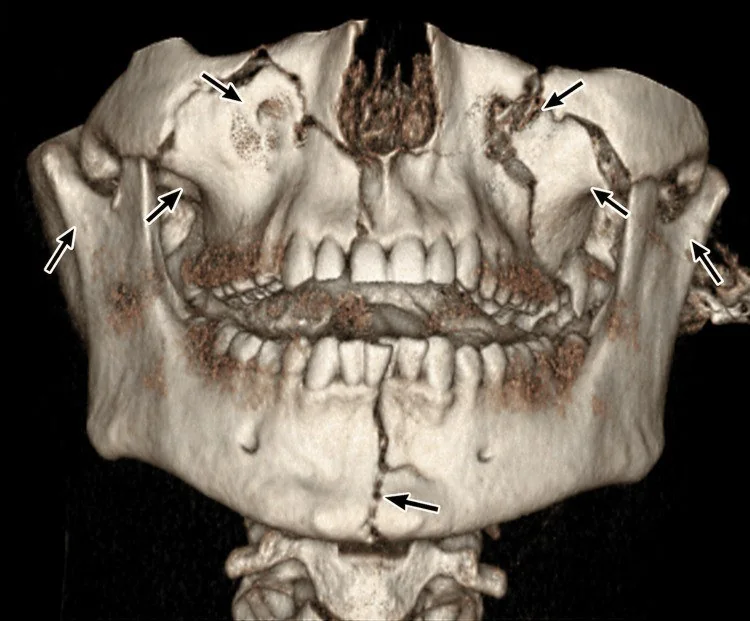
- Çok seviyeli kırık dağılımı — üst yüz (frontal/nazo-orbito-etmoid), orta yüz (maksilla-zigoma-orbita) ve alt yüz (mandibula) ünitelerinin birlikte tutulması.
- Le Fort bileşeni — maksiller pterigoid plak kırıklarına eşlik eden orta yüz düzeyinde yatay, piramidal veya kraniyofasiyal ayrılma hattı.
- Naso-orbito-etmoid kırığı — orta yüzün en sık parçalanan bölgesidir; medial kantus tendonunun tutulumu ve etmoid hava hücreleri hasarı sınıflamayı belirler.
- Zigomatikomaksiller bölge kırıkları, yüzün dikey taşıyıcı sütunlarından biri olan bu buttressin bütünlüğünü bozar ve zigoma ile maksilla ilişkisini etkiler.
- Palatal ve alveoler ayrışma — sert damakta orta hat/paramedian yarık, maksiller alveolde basamak ve diş taşıyan segmentin hareketliliği.
- Mandibular çoklu kırık — simfiz, korpus, açı veya kondil ünitelerinden birden fazlasında kırık ve oklüzal taşıyıcı arkın kesilmesi.
- Deplasman ve parçalanma — fragman rotasyonu, yüz projeksiyonunda kayıp ve karşılıklı taşıyıcı kolonlarda hizalanma bozukluğu.
- Eşlik eden kritik yaralanma — orbital hematom/glob yaralanması, kafa içi kanama, kafa tabanı uzanımı veya servikal omurga hasarı.
Ölçütler ve sınıflamalar
- Üst-orta-alt yüz bölümlerine göre tarif
- Panfasiyal kırıkta üst, orta ve alt yüzün eşzamanlı yaralanması pratik tanımdır; tanım üzerinde evrensel uzlaşı yoktur, her kemik ünitesi ayrıca tarif edilir.
- AO CMF sınıflamasının düzeyleri
- AO CMF sınıflaması hiyerarşik düzeylerden oluşur: düzey 1–2 kırığın anatomik yerleşimini, düzey 3 ise bölgesel kırık morfolojisini (parçalanma, deplasman) tarif eder. AO CMF sistemi hiyerarşik düzeylere dayanır; düzey 1 kırığın dört ana anatomik alandan (mandibula, orta yüz, kafa tabanı, kranial kubbe) hangisinde olduğunu belirler.
Normalde
Normal yüz iskeletinde yüz buttressleri ve damak yapısı bütünlüğünü korur; kırık olmayan durumlarda kortikal hatlar kesintisiz, mandibular alt kenar ve kondiler başlar simetrik konturludur. Aynı anatomik düzeylerde iki tarafın orbital taban ve medial duvarlarını, maksiller buttressleri, pterigoid plakları ve mandibula oklüzal arkını kıyaslayın; çoklu kortikal kesintilerin sürekliliği tek tek izlenir.
Ayırıcı tanı
- İzole Le Fort kırığı
- orta yüz pterigoid plakları ve tipik maksiller ayrılma hattı tutulur; frontal, orbital, zigomatik ve mandibular çoklu üniteler yoktur.
- İzole zigomatikomaksiller kompleks kırığı
- zigoma ve komşu buttressler etkilenir; üst yüz veya mandibular arkın eşlik eden çoklu kırıkları bulunmaz.
- İzole mandibula kırığı
- alt yüz oklüzal arkı bozulur, ancak maksilla, zigoma ve nazo-orbito-etmoid bileşenler korunur.
Tuzaklar
- Pterigoid plak kopukluğu arka maksillaya uzanan Le Fort kırık hatlarının bir bileşenidir; bu kırıklar üç temel desende sınıflandırılır ve kombinasyonları birlikte değerlendirilmelidir.
- 3D yüzey görüntüsü ince yer değiştirmemiş kırıkları saklayabilir; aksiyel, koronal ve sagittal kemik kesitlerini kaynak görüntü olarak tarayın.
- Mandibula kırığında dişli segmentin rotasyonu ve kondiler eklem ilişkisi 3D'de yanıltıcı olabilir; karşı eklemi ve oklüzal arkı kesitlerde kontrol edin.
- Yüksek enerjili panfasiyal paternde görüntü alanı dışındaki kafa içi ve servikal omurga yaralanmaları yüz BT'sinden dışlanmış olmaz.
Kendini dene
Yüksek enerjili travmada frontal sinüs, NOE, zigomatikomaksiller ve maksiller alveoler komplekslerle mandibular simfiz kırıkları birlikte izleniyor. Patern nasıl adlandırılır?
Cevabı göster
Panfasiyal kırık. Üst yüzü tutan frontal sinüs, orta yüz kırıkları ve alt yüzdeki mandibular simfiz kırığının birlikte bulunması panfasiyal paternle uyumludur. Le Fort sınıflaması orta yüz hattını tanımlar; izole ark veya mandibula açısı kırığı bu çok seviyeli dağılımı açıklamaz.
Pterigoid plak kırığı görülüyor; maksilla dışında başka yüz kemiklerinde kırık yok. En doğru yaklaşım hangisidir?
Cevabı göster
Maksiller kırık hattını haritala. Pterigoid plak kırığı orta yüz kırığı değerlendirmesini gerektirir, fakat tek başına panfasiyal yaralanma anlamına gelmez. Önce maksiller kırık hattı ve eşlik eden anatomik üniteler tarif edilir; kondiler dislokasyon ve orbital apse bu bulgunun sınıflaması değildir.
İlgili konular
Kaynaklar
Bu sayfadaki 42 cümle ve 2 quiz sorusu aşağıdaki kaynaklardan alıntılarla tek tek karşılaştırıldı; 7 cümle bu karşılaştırmada düzeltildi (2026-10-08).
- A Shift in Conceptual Thinking of Panfacial Fracture Sequencing: The Major Fragment Theorypmc.ncbi.nlm.nih.gov
- Facial fractures: The "bottom-up" approach.pubmed.ncbi.nlm.nih.gov
- Radiological assessment of facial fractures: a comparative study between surgeon and radiologist.pubmed.ncbi.nlm.nih.gov
- A study of sports-related orbital fractures in Singapore.pubmed.ncbi.nlm.nih.gov
- Use of Intraoperative Computed Tomography in Craniomaxillofacial Trauma Surgery.pubmed.ncbi.nlm.nih.gov
- Treatment of Panfacial Fractures and Three-Dimensional Outcome Analysis: The Occlusion First Approach.pubmed.ncbi.nlm.nih.gov
- Facial fractures of the upper craniofacial skeleton predict mortality and occult intracranial injury after blunt trauma: an analysis.pubmed.ncbi.nlm.nih.gov
- Characteristics of Panfacial Fractures in the Elderly: Etiology, Fracture Patterns, Concomitant Injuries, and Postoperative Complication Risk.pubmed.ncbi.nlm.nih.gov
- Correlation between facial bone fractures and associated long bone injuries in polytrauma patients: A retrospective imaging-based study.pubmed.ncbi.nlm.nih.gov
- Epidemiological and Clinical Characteristics of Facial Bone Fractures across Age Groups: A Single-Center Retrospective Analysis of 4,975 Patients at a Regional Trauma Center in Gangwon Province, South Korea.pubmed.ncbi.nlm.nih.gov
- Epidemiology of Craniomaxillofacial Trauma in Chile: A Systematic Review and 24-Year Nationwide Interrupted Time-Series Analysis.pubmed.ncbi.nlm.nih.gov
- Evaluation of an AI-based segmentation model for mandibular fracture segmentation on CBCT using volumetric and 2D slice-based validation approaches.pubmed.ncbi.nlm.nih.gov
- Digitally Guided Frontal Sinus Fracture Fixation: A Point-of-Care "In-House" Biomodel Protocol with Cyanoacrylate-Assisted Fragment Stabilization.pubmed.ncbi.nlm.nih.gov
- An integrated digital-to-surgical framework for patient-specific chest wall resection and reconstruction using 3D-printed titanium implants: proof-of-concept study.pubmed.ncbi.nlm.nih.gov
- The Impact of a Horse Kick: A Systematic Review of Horse-Related Maxillofacial Trauma.pubmed.ncbi.nlm.nih.gov
- Submental Intubation in Panfacial Trauma: A Pictorial Demonstration With Anesthetic Considerations.pubmed.ncbi.nlm.nih.gov
- Modern management of maxillofacial trauma in the emergency department.pubmed.ncbi.nlm.nih.gov
- CBCT-based volumetric assessment of the maxillary sinus in temporomandibular disorder: Integration of morphometric analysis and classical machine learning classification.pubmed.ncbi.nlm.nih.gov
- Management Protocol for Ballistic and Other High-Energy Avulsive Facial Injuries-An Update for the 21st Century.pubmed.ncbi.nlm.nih.gov
- Patient-Reported Outcomes Following Loss of Permanent Incisors due to Traumatic Dental Injuries: A Retrospective Cross-Sectional Pilot Cohort Study.pubmed.ncbi.nlm.nih.gov
- Does the use of a pterygoid osteotome affect pterygomaxillary fracture patterns in Le Fort I osteotomy?pubmed.ncbi.nlm.nih.gov
- Directed pterygomaxillary disjunction versus direct downfracture in Le Fort I osteotomy: application of a fracture quality framework using bilateral ten-point cone-beam computed tomography in a retrospective cohort of 205 patients.pubmed.ncbi.nlm.nih.gov
- Management of the pterygoid plate in orthognathic surgery: a narrative review.pubmed.ncbi.nlm.nih.gov
- Current Concepts in Frontal Sinus Fracture Management.pubmed.ncbi.nlm.nih.gov
- Naso-Orbito-Ethmoid Fractures: Refining the Role of Wires and Plates.pubmed.ncbi.nlm.nih.gov
- Non-Scar Fixation Technique for Zygomaticomaxillary Complex Tripod Fracture Using Upper Lid Transconjunctival Incision.pubmed.ncbi.nlm.nih.gov
- CT-based morphometric analysis of the zygomatic region: infraorbital foramen localization, bone thickness, and sutural relationships.pubmed.ncbi.nlm.nih.gov
- Reduction of zygomaticomaxillary complex fractures with elevator and modified wire and screw: A case report.pubmed.ncbi.nlm.nih.gov
- Case Report: Soft-tissue-preserving fixation for displaced segmental maxillary fractures involving partially detached bone segments.pubmed.ncbi.nlm.nih.gov
- Accuracy of Combined Osteotomy Guides and Patient-Specific Implants in Le Fort I Segmental Osteotomy Requiring Alveolar Bone Reduction.pubmed.ncbi.nlm.nih.gov
- Alveolar Ridge Split Technique With Simultaneous Implant Placement: A Clinical Case Series With One-Year Follow-Up.pubmed.ncbi.nlm.nih.gov
- Management of Bilateral Condylar Fracture With ORIF Using the Puppet Technique in the Adolescence: A Case Report.pubmed.ncbi.nlm.nih.gov
- Integrated management of mandibular fractures and traumatic dental injuries: a literature review and clinical algorithm proposal.pubmed.ncbi.nlm.nih.gov
- Feasibility assessment of fixation patterns in multiple mandibular fractures: A clinical study.pubmed.ncbi.nlm.nih.gov
- Conservative Treatment of Pediatric Fractures-Narrative Review of Acceptable Deformity and Remodeling Potential.pubmed.ncbi.nlm.nih.gov
- Isolated fracture of the anterior wall of the acetabulum: A rare fracture, even rarer in the skeletally immature patient. Report of two cases and literature review.pubmed.ncbi.nlm.nih.gov
- Clinical and Radiological Characteristics of Pediatric Skull Fractures and Their Association with Neurosurgical Intervention: A Retrospective Cohort Study.pubmed.ncbi.nlm.nih.gov
- Penetrating stab injury extending from the temporal region to the orbital apex and ethmoidal cells - A unique case report and review of the literature.pubmed.ncbi.nlm.nih.gov
- Severe Craniofacial Trauma With Bilateral Epidural Hematomas and Complex Skull Base and Midface Fractures Managed With Early Multidisciplinary Damage Control Surgery and Immediate Osteosynthesis: A Case Report.pubmed.ncbi.nlm.nih.gov
- CBCT-Based Analysis of Medial and Lateral Pterygoid Plates: Cross-Sectional Study of Saudi Subpopulation.pubmed.ncbi.nlm.nih.gov
- Imaging Evaluation for Jaw Deformities: Diagnostic Workup and Pre-Treatment Imaging Checklist for Orthognathic Surgery.pubmed.ncbi.nlm.nih.gov
- Patient-Specific Subperiosteal Implants for Oral and Maxillofacial Rehabilitation: A Scoping Review Across Indications, from Established Full-Arch Use to Emerging Single-Tooth and Oncologic Applications.pubmed.ncbi.nlm.nih.gov
- Maxillary Sinus Mucocele following Zygomaticomaxillary Complex Fracture Repair.pubmed.ncbi.nlm.nih.gov
- Evaluation of treatment outcomes of zygomaticomaxillary complex (ZMC) fractures using Foley catheter ballooning technique.pubmed.ncbi.nlm.nih.gov
- Maxillary Sinus Morphometry in Isolated Zygomatic Arch Fractures: A Within-Patient CT Analysis of Side-to-Side Differences.pubmed.ncbi.nlm.nih.gov
- Does the biplane three-dimensional miniplate design provide stable fixation for mandibular angle fractures? A clinical study and proposal for novel radiographic criteria.pubmed.ncbi.nlm.nih.gov
- Outcomes of Open, Percutaneous, and Closed Treatment of Isolated Mandibular Condylar Fractures.pubmed.ncbi.nlm.nih.gov
- Clinical and anatomical characteristics of mandibular angle fractures: a 10-year retrospective monocentric cohort study.pubmed.ncbi.nlm.nih.gov
- Staged reconstruction of panfacial trauma involving a comminuted mandibular fracture: a case report.pubmed.ncbi.nlm.nih.gov
- Silent Sinus Syndrome in a Paediatric Patient: An Incidental Diagnosis Following Facial Trauma.pubmed.ncbi.nlm.nih.gov
- Mandibular Fracture in A 12-Hour-Old Neonate: Successful Conservative Management With Excellent Long-Term Functional and Craniofacial Growth Outcomes.pubmed.ncbi.nlm.nih.gov
- Assessment of the skull base, pterygomaxillary junction, and its association with the orbit in skeletal malocclusion and cleft lip/palate implications for Le fort I osteotomy.pubmed.ncbi.nlm.nih.gov
- Morphological Variations of the Pterygomaxillary Suture According to Skeletal Patterns.pubmed.ncbi.nlm.nih.gov
- CT-Based Three-Dimensional Volumetric Analysis of Posterior and Lateral Malleolar Fragments in SER-Type Trimalleolar Ankle Fractures: Correlation and Reproducibility Study.pubmed.ncbi.nlm.nih.gov
- A multiscale X-ray CT study of degradation and safety behaviour of different Li-ion battery positive electrode morphologies.pubmed.ncbi.nlm.nih.gov
- Intracranial venous thrombosis imaging by anatomical location: an educational review with mimics and diagnostic pitfalls.pubmed.ncbi.nlm.nih.gov
- Management of recurrent posterior dislocation of a stock temporomandibular joint prosthesis using class II elastic traction: A case report and literature review.pubmed.ncbi.nlm.nih.gov
- Imaging-Guided Algorithmic Management of Mandibular Condylar Fractures: A 13-Year Institutional Analysis of 495 Joints.pubmed.ncbi.nlm.nih.gov
- Concurrent emergency head and cervical spine CT utilization: temporal trends, diagnostic yield, and clinical implications.pubmed.ncbi.nlm.nih.gov
- Diagnostic yield and number needed to screen for cervical and concomitant spinal injuries in geriatric head trauma.pubmed.ncbi.nlm.nih.gov
- Prognostic Value of Initial CT Imaging for Surgical Planning and Outcomes in Panfacial Fractures: A Systematic Review and Meta-Analysis.pubmed.ncbi.nlm.nih.gov
- Patterns of Surgically Managed Maxillofacial Injuries in a Tertiary Care Hospital in North India.pubmed.ncbi.nlm.nih.gov
- Facial fractures: classification and highlights for a useful report.pubmed.ncbi.nlm.nih.gov
- The Comprehensive AOCMF Classification System: Midface Fractures - Level 3 Tutorial.pubmed.ncbi.nlm.nih.gov
- Pearls of orbital trauma management.pubmed.ncbi.nlm.nih.gov
- Can different osteotomies have an influence on surgically assisted rapid maxillary expansion? A systematic review.pubmed.ncbi.nlm.nih.gov
- Reconstructive Surgery for Head and Neck Cancer Patients.pubmed.ncbi.nlm.nih.gov
- The Comprehensive AO CMF Classification System for Mandibular Fractures: A Multicenter Validation Study.pubmed.ncbi.nlm.nih.gov
- The Comprehensive AOCMF Classification System: Classification and Documentation within AOCOIAC Software.pubmed.ncbi.nlm.nih.gov
- The First AO Classification System for Fractures of the Craniomaxillofacial Skeleton: Rationale, Methodological Background, Developmental Process, and Objectives.pubmed.ncbi.nlm.nih.gov
- Facial Fractures Associated With Craniomaxillofacial Trauma in Adults: A Literature Review.pubmed.ncbi.nlm.nih.gov
- Interpersonal Violence-Related Facial Fractures: 12-Year Trends and Surgical Outcomes in a Southern European Level-I Trauma Centre.pubmed.ncbi.nlm.nih.gov
- Unfavourable outcomes in maxillofacial injuries: How to avoid and manage.pubmed.ncbi.nlm.nih.gov
- Management of Panfacial Trauma: Sequencing and Pitfalls.pubmed.ncbi.nlm.nih.gov
- Medial maxillary (nasomaxillary buttress) fracture: Two case reports.pubmed.ncbi.nlm.nih.gov
- Nasal Bone Fracture Reduction Under Local Anaesthesia: A Holistic Approach to Nasal Blocks and a Comparison with General Anaesthesia.pubmed.ncbi.nlm.nih.gov
- Application of a self-developed femoral artery compression hemostasis device in proximal femoral nail anti-rotation surgery for intertrochanteric fractures: a case report.pubmed.ncbi.nlm.nih.gov
- Clinical Utility of Infrared Thermography in Pediatric Patients: A Systematic Review of Surgical and Nonsurgical Applications.pubmed.ncbi.nlm.nih.gov
- International Multicenter Validation of an Expanded AI Diagnostic System for 18 Pathologies in Thoracic and Musculoskeletal Radiography.pubmed.ncbi.nlm.nih.gov
- Minimal Access Retromandibular Approach to Fractures of Vertical Segment of the Mandible: A Versatile Technique.pubmed.ncbi.nlm.nih.gov
- Optimizing Endo-DCR Outcomes in Traumatic Nasolacrimal Duct Obstruction.pubmed.ncbi.nlm.nih.gov
- Evaluating the usage of human placental tissue-derived xenograft in a surgically induced murine fracture model.pubmed.ncbi.nlm.nih.gov
- From bone replacement to regeneration. A biomaterials started journey.pubmed.ncbi.nlm.nih.gov
- Role of Adipose-Derived Mesenchymal Stem Cells in Bone Regeneration.pubmed.ncbi.nlm.nih.gov
- Effectiveness of Single Miniplate Fixation for Mandibular Symphysis and Parasymphysis Fractures: A Clinical Study.pubmed.ncbi.nlm.nih.gov
- Innovative landing zones for one-piece, rigidly fixated patient-specific subperiosteal implants in dental rehabilitation of severe maxillary and midfacial defects.pubmed.ncbi.nlm.nih.gov
- Sphenoid sinus and sphenoid bone fractures in patients with craniomaxillofacial trauma.pubmed.ncbi.nlm.nih.gov
- Innovative photobiomodulation-enhanced T-PRF in posterior mandibular fractures: a randomized pilot study.pubmed.ncbi.nlm.nih.gov
- Lyophilized apoptotic vesicles improve hemostasis and bone regeneration in traumatic patients with impacted third molar extraction.pubmed.ncbi.nlm.nih.gov
- The Ocular Signature of TBI: A Narrative Review of Structural Changes and Potential Candidate Biomarkers.pubmed.ncbi.nlm.nih.gov
- Quantification in bone SPECT/CT.pubmed.ncbi.nlm.nih.gov
Eğitim amaçlıdır; hasta başında tanı ve tedavi kararının yerine geçmez. İçerik yapay zekâ destekli bir süreçle güncel literatüre göre cümle cümle kaynaklarla karşılaştırıldı, ancak uzman radyolog incelemesinden geçmedi. Klinik kararlarda güncel kılavuzları, kurum protokollerini ve radyoloji raporunu esas alın.