Özet
Mesanenin skuamöz hücreli karsinomu, kronik irritasyon ve enfeksiyonla ilişkili olabilen, çoğu kez infiltratif büyüme gösteren bir histolojik alt tiptir. BT ve MR, heterojen kitlenin, duvar kalınlaşmasının, kalsifikasyonun ve perivezikal uzanımın gösterilmesinde kullanılır; ancak kesin tanı için sistoskopi ve patoloji standarttır. Papiller ürotelyal tümörden farklı olarak yalnız lümene uzanan ince saplı kitle görünümü beklenmez; ancak görüntüleme bulguları özgül değildir. BT ve MR'da yerel invazyonun değerlendirilmesi yalnızca orta düzeyde doğruluğa sahiptir; bu nedenle kesin evreleme ve tedavi planlaması için patoloji gereklidir.
Faz ve pencere
- Kontrastsız
- Kontrastsız BT’de mesane taşları saptanabilir.
- Nefrografik tanısal
- Sapsız duvar kitlesi ya da fokal/diffüz duvar kalınlaşmasının kontrastlanan solid bileşeni; perivezikal yağ, komşu organ ve lenf nodlarıyla ilişkisi değerlendirilir.
Önerilen pencereler: Batın (G 400 / M 50), Yumuşak doku (G 400 / M 40), Kemik (G 1800 / M 400).
BT bulguları
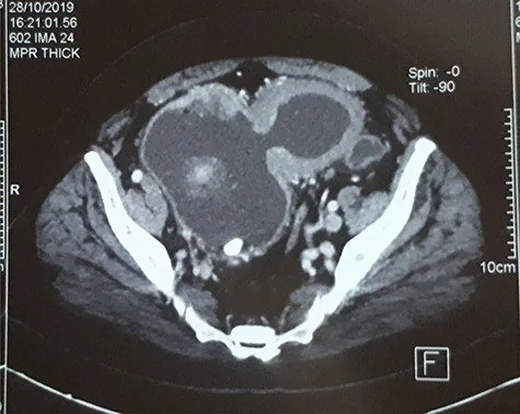
- Mesane duvarına geniş tabanla oturan sapsız, lobüle veya ülseratif yumuşak doku kitlesi.
- Fokal ya da diffüz duvar kalınlaşması; lezyonun bir duvar segmentinden kaynaklandığı izlenimi.
- Kontrastlanan periferik solid doku içinde düşük dansiteli nekrotik veya kistik alanlar.
- Mesane duvarı kalsifikasyonu şistozomiyazis ve üriner sistem amiloidozu gibi farklı durumlarda da görülebilir; bu nedenle tek başına histolojik tipi belirlemez.
- Perivezikal yağda düzensiz uzanım ve komşu pelvik organ planlarında silinme.
- Pelvik lenf nodları, üreterovezikal bileşkede tıkanma veya eşlik eden mesane taşı/kronik duvar değişiklikleri.
Ölçütler ve sınıflamalar
- Histopatolojik tanı ve evre
- Skuamöz hücreli karsinomun histolojik tanısı ve patolojik evresi patolojik incelemeyle belirlenir; bildirilen pT3bN0 evresi tek bir olguya aittir. BT, mesane kanserinin yerel evrelemesinde yalnızca orta düzeyde doğruluğa sahiptir.
Normalde
BT ve MR'da normal duvar yapısı yerine heterojen kitlenin, duvar kalınlaşmasının ve kontür bozukluklarının varlığı ön plandadır; kesin değerlendirme için sistoskopi standarttır. BT ve MR, heterojen kitleyi ve duvar kalınlaşmasını değerlendirmede kullanılır ancak kas invazyonunun derinliğini belirlemede sınırlıdır; kesin evreleme için sistoskopi ve patoloji gereklidir.
Normal BT ile kıyasla
Aynı bölgenin, kaynak veri setinde patoloji içermediği belirtilen bir BT incelemesini kesit kesit kaydırın; organ sınırlarını açarak anatomiyi hasta görüntüsüyle karşılaştırın. Küçük rastlantısal bulgular tümüyle dışlanmamıştır.
Kaynak: TotalSegmentator v2.01 veri seti (Wasserthal ve ark., Radiology: Artificial Intelligence 2023), CC BY 4.0, vaka s1256; organ sınırları veri setinin otomatik segmentasyonundan, birleştirilerek sadeleştirildi. Görüntüler 2,5 mm kesit aralığına yeniden örneklendi.
Ayırıcı tanı
- İnvaziv ürotelyal karsinom
- benzer kontrastlanan kitle yapabilir; papiller veya multifokal mukozal bileşen eşlik edebilir.
- Kronik enfeksiyon ve sistit, skuamöz hücreli karsinomla birlikte sık görülür veya diffüz duvar kalınlaşması ile taklit edebilir; bu nedenle kesin ayırıcı tanı için biyopsi gereklidir.
- Mesane taşı ve kronik sistit
- kalsifikasyon taş olarak lümende yer alır; çevresindeki duvar reaktif kalınlaşabilir.
- Kronik enfeksiyon, şistozomiazis veya amyloidoz gibi benign durumlar diffüz duvar kalınlaşması oluşturabilir ve ayırıcı tanı için biyopsi gereklidir.
- Komşu pelvik organdan mesaneye doğrudan uzanan tümörde anatomik devamlılık, sekonder mesane tutulumunun ayırıcı tanısında yardımcı olabilir.
Tuzaklar
- Kalsifikasyon veya nekroz skuamöz histolojiyi kanıtlamaz; raporda görünür morfolojiyi tarif edip histolojik tanıyı biyopsiye bırakın.
- Kronik enfeksiyon, taş veya kateterle ilişkili duvar kalınlaşması tümörü maskeleyebilir; fokal sapsız kitle ve dış kontur devamlılığını ayrıca arayın.
- Kronik irritasyona bağlı büyük mesane taşları ve duvar kalınlaşması tümörü taklit edebilir; taş çıkarıldıktan sonra iyileşmeyen yara veya devam eden kalınlaşma malignite açısından değerlendirilmelidir.
- Perivezikal yağ çizgilenmesi ekstravezikal yayılım şüphesi doğurabilir; ancak BT’nin mesane kanserinde yerel evrelemesi orta düzeyde doğruluğa sahiptir.
Kendini dene
Kronik mesane irritasyonu öyküsü olan hastada geniş tabanlı duvar kitlesi, yüzey kalsifikasyonu ve perivezikal uzanım görülüyor. Hangi histoloji olasılığı akılda tutulmalıdır?
Cevabı göster
Skuamöz hücreli karsinom. Kronik irritasyon zeminindeki sapsız infiltratif kitle skuamöz hücreli karsinomla uyumlu olabilir; ancak BT histolojiyi doğrulamaz. Papiller ürotelyal neoplazmlar ayrı bir sınıflandırma grubudur; urakal adenokarsinom ise urakal kalıntılardan, mesane kubbesi yakınında kaynaklanır.
Mesane yan duvarındaki tümör benzeri kalsifik odak kontrastsız seride lümende bağımsız ve çok yoğun görünüyor. Öncelikli taklitçi hangisidir?
Cevabı göster
Mesane taşı. Lümende bağımsız çok yoğun odak taş lehinedir; duvar tümörü ise duvarla devamlı yumuşak doku bileşeni gösterir. Diğer seçenekler kalsifik odağın lümen içi taş biçimini açıklamaz.
İlgili konular
- Mesane ürotelyal karsinomu
- İntraperitoneal mesane rüptürü
- Ekstraperitoneal mesane rüptürü
- BT sistografi ve mesane dolum tekniği
Kaynaklar
Bu sayfadaki 39 cümle ve 2 quiz sorusu aşağıdaki kaynaklardan alıntılarla otomatik olarak karşılaştırıldı; 16 cümle bu karşılaştırmada düzeltildi (2026-10-09).
- Peptidergic Systems and Cancer: Focus on Tachykinin and Calcitonin/Calcitonin Gene-Related Peptide Familiespmc.ncbi.nlm.nih.gov
- An uncommon manifestation of paraneoplastic cerebellar degeneration in a patient with high grade urothelial, carcinoma with squamous differentiation: A case report and literature reviewpmc.ncbi.nlm.nih.gov
- Surgical management of metastatic squamous cell carcinoma of the bladder: a case report and review of the literaturepmc.ncbi.nlm.nih.gov
- Gastric Outlet Obstruction as a presentation of Metastatic Squamous Cell Carcinoma of the Bladder: A case report and review of the literaturepmc.ncbi.nlm.nih.gov
- Delayed diagnosis of bladder squamous cell carcinoma secondary to massive bladder stonepmc.ncbi.nlm.nih.gov
- [Radiological findings in patients with imported schistosomiasis].pubmed.ncbi.nlm.nih.gov
- Squamous cell carcinoma of the bladder in a female associated with multiple bladder stones.pubmed.ncbi.nlm.nih.gov
- Cardiac and Skeletal Muscle Metastases From Squamous Cell Carcinoma of the Bladder: Positron Emission Tomography-Computed Tomography Findings.pubmed.ncbi.nlm.nih.gov
- Prognostic value of cyclooxygenase-2 expression in squamous cell carcinoma of the bladder.pubmed.ncbi.nlm.nih.gov
- Intravesical Condyloma Acuminata Progressing to Squamous Cell Carcinoma of the Bladder: An Unusual Presentation.pubmed.ncbi.nlm.nih.gov
- [Squamous cell carcinoma of the bladder in a patient with HIV and paraplegia].pubmed.ncbi.nlm.nih.gov
- [A case of squamous cell carcinoma of the bladder in a patient with interstitial cystitis].pubmed.ncbi.nlm.nih.gov
- Spontaneous bladder diverticulum rupture due to a squamous cell carcinoma of the bladder: a case report.pubmed.ncbi.nlm.nih.gov
- Expression of cell cycle-related molecular markers in patients treated with radical cystectomy for squamous cell carcinoma of the bladder.pubmed.ncbi.nlm.nih.gov
- Gastric Outlet Obstruction as a presentation of Metastatic Squamous Cell Carcinoma of the Bladder: A case report and review of the literature.pubmed.ncbi.nlm.nih.gov
- A silver lining … in the ureter: Keratinizing squamous metaplasia with a metallic twist.pubmed.ncbi.nlm.nih.gov
- Early presentation of pembrolizumab-associated pneumonitis.pubmed.ncbi.nlm.nih.gov
- High-grade Urothelial Carcinoma with Malignant Melanocytic Differentiation.pubmed.ncbi.nlm.nih.gov
- Invasive urothelial carcinoma with squamous differentiation and associated high-risk human papilloma virus infection: Clinical, cytologic, and histologic features of a rare entity.pubmed.ncbi.nlm.nih.gov
- p40-positive metastatic urothelial carcinoma mimicking primary pulmonary squamous cell carcinoma on limited lung biopsy.pubmed.ncbi.nlm.nih.gov
- Beyond Boundaries: Metastasis of Cervical Squamous Cell Carcinoma to the Kidney.pubmed.ncbi.nlm.nih.gov
- Ureteric squamous cell carcinoma in a duplex collecting system presenting with chronic obstructive uropathy: a rare case report.pubmed.ncbi.nlm.nih.gov
- Imaging evaluation of amyloidosis of the urinary tract and retroperitoneum.pubmed.ncbi.nlm.nih.gov
- Carcinoma of the Vulva.pubmed.ncbi.nlm.nih.gov
- Urinary bladder cancer: role of MR imaging.pubmed.ncbi.nlm.nih.gov
- Urinary bladder masses: techniques, imaging spectrum, and staging.pubmed.ncbi.nlm.nih.gov
- SLC39A6 as a pan-cancer promising biomarker and actionable therapeutic target for CH5132799 sensitivity.pubmed.ncbi.nlm.nih.gov
- Metastases to the Male Breast: A Systematic Review.pubmed.ncbi.nlm.nih.gov
- Retrospective single-center cytohistologic correlation study of fine-needle aspiration cytology for excised superficial enlarged lymph node lesions in different disease entities.pubmed.ncbi.nlm.nih.gov
- Klippel-Trénaunay Syndrome With Pelvic/Rectal and Urinary Bladder Involvement: A Rare Case Report.pubmed.ncbi.nlm.nih.gov
- The "perfect storm" in bladder oncology: a case of diverticular carcinoma with plasmacytoid features and its clinical ramifications.pubmed.ncbi.nlm.nih.gov
- Case Report: early regression and bladder-intact survival after limited-course immunotherapy-based systemic therapy in two patients with clinically staged bulky muscle-invasive bladder cancer.pubmed.ncbi.nlm.nih.gov
- Epidermoid Cyst of the Ureter Mimicking Recurrent Urothelial Carcinoma: A Case Report and Brief Literature Review.pubmed.ncbi.nlm.nih.gov
- Malignant Priapism as the Sole Initial Manifestation of Metastatic Carcinoma with Suspected Pulmonary Origin: A Case Report and Review of the Literature.pubmed.ncbi.nlm.nih.gov
- Pembrolizumab-Associated Immune-Related Cystitis Mimicking Urothelial Malignancy as Part of a Multi-organ Immune-Related Adverse Event (irAE) Phenotype in a Patient With Metastatic Squamous Cell Lung Cancer: A Case Report and Literature Review.pubmed.ncbi.nlm.nih.gov
- Primary Versus Secondary Non-Urothelial Tumors Involving the Bladder: A 10-Year Analysis of Clinicopathologic Profiles and Adverse Feature Burden.pubmed.ncbi.nlm.nih.gov
- Molecular Classifications and Candidate Biomarkers for Personalizing BCG Therapy in Non-Muscle-Invasive Bladder Cancer.pubmed.ncbi.nlm.nih.gov
- Histological Subtypes of Bladder Cancer: Epidemiology, Molecular Biology, and Clinical Implications.pubmed.ncbi.nlm.nih.gov
- BK Polyomavirus-Associated Urothelial Carcinoma Presenting as Obstructive Uropathy in a Long-Term Lung Transplant Recipient.pubmed.ncbi.nlm.nih.gov
- Preferred surgical strategies for bladder diverticular carcinoma.pubmed.ncbi.nlm.nih.gov
- Managing bladder tumor with long-segment anterior urethral stricture: Perineal urethrostomy as a critical surgical solution.pubmed.ncbi.nlm.nih.gov
- MRI of Tumors and Tumor Mimics in the Female Pelvis: Anatomic Pelvic Space-based Approach.pubmed.ncbi.nlm.nih.gov
- Urinary Bladder Adenocarcinoma Metastatic to the Abdominal Wall: Report of a Case with Cytohistologic Correlation.pubmed.ncbi.nlm.nih.gov
- Penile involvement associated with renal pelvic squamous cell carcinoma: a case report and mechanistic considerations.pubmed.ncbi.nlm.nih.gov
- ESUR female pelvis group approach to cystic female pelvic lesions.pubmed.ncbi.nlm.nih.gov
- Neoplasia in the dromedary camel: a review (<i>Camelus dromedarius</i>).pubmed.ncbi.nlm.nih.gov
- Survival Prediction in Patients With Bladder Cancer Undergoing Radical Cystectomy Using a Machine Learning Algorithm: Retrospective Single-Center Study.pubmed.ncbi.nlm.nih.gov
- Variant histology in urothelial carcinoma: associated factors and survival impact after radical cystectomy.pubmed.ncbi.nlm.nih.gov
- Bladder's Blind Spot: A Rare Case of Non-bilharzial Diverticular Squamous Cell Carcinoma Treated With Partial Cystectomy.pubmed.ncbi.nlm.nih.gov
- HPV-associated moderately differentiated squamous cell carcinoma of the cervix with pathologically confirmed bladder invasion and radiologically presumed adrenal metastasis in a patient with prior lung adenocarcinoma resection: a rare case report and clinical discussion.pubmed.ncbi.nlm.nih.gov
- Urothelial carcinoma of the bladder with prostatic stromal invasion and early postoperative bone metastases: a case report.pubmed.ncbi.nlm.nih.gov
- Primary keratinizing squamous cell carcinoma of the renal pelvis with pancreatic tail invasion and five-year disease-free survival: A case report.pubmed.ncbi.nlm.nih.gov
- Case Report: Urachal calculus with an atypical intravesical CT appearance and literature review.pubmed.ncbi.nlm.nih.gov
- Bilateral multifocal nephrogenic adenomas arising in the renal pelves: a case report and review of the literature.pubmed.ncbi.nlm.nih.gov
- Small cell carcinoma in a bladder diverticulum: a rare case report and literature review.pubmed.ncbi.nlm.nih.gov
- Case report: Radiographic and cystoscopic manifestations of chronic urogenital Schistosomiasis in an asymptomatic Zimbabwean man with HIV.pubmed.ncbi.nlm.nih.gov
- Differentiating between benign and malignant bone lesions: The value of using SPECT/CT.pubmed.ncbi.nlm.nih.gov
- Computed tomography-based nomogram for estimating progression-free survival probability in bladder cancer patients undergoing partial cystectomy.pubmed.ncbi.nlm.nih.gov
- Mastering rectal cancer MRI: From foundational concepts to optimal staging.pubmed.ncbi.nlm.nih.gov
- MRI anatomy of the rectum: key concepts important for rectal cancer staging and treatment planning.pubmed.ncbi.nlm.nih.gov
- Clinical and Pathological Characteristics of Bladder Cancer in Patients Aged 18-45 Undergoing Transurethral Resection of Bladder Tumor.pubmed.ncbi.nlm.nih.gov
- Primary Neoplasms of the Seminal Vesicles: A Narrative Review of Carcinoma and the Rarer Non-Epithelial and Biphasic Tumours.pubmed.ncbi.nlm.nih.gov
- Navigating pelvic anatomy for exenteration: a clinical guide for radiologists.pubmed.ncbi.nlm.nih.gov
- Improvement in the Image Quality of Bile and Pancreatic Ducts with Dual- Layer Spectral CT.pubmed.ncbi.nlm.nih.gov
- Radiologic evaluation of the kidney transplant donor and recipient.pubmed.ncbi.nlm.nih.gov
- Osteogenic-Like Microenvironment of Renal Interstitium Induced by Osteomodulin Contributes to Randall's Plaque Formation.pubmed.ncbi.nlm.nih.gov
- The comparative diagnostic and therapeutic application value of FAPI PET/CT and <sup>18</sup>F-FDG PET/CT in oncology.pubmed.ncbi.nlm.nih.gov
- Swyer syndrome complicated by rapidly progressive invasive ovarian dysgerminoma with bladder and rectal direct invasion: a rare case report.pubmed.ncbi.nlm.nih.gov
- A giant serous papillary cystadenofibroma mimicking a bladder tumor: A diagnostic pitfall.pubmed.ncbi.nlm.nih.gov
- Spontaneus Suburothelial Hemorrhage Associated With Forniceal Rupture and Retroperitoneal Hemorrhage.pubmed.ncbi.nlm.nih.gov
- Unique presentation of urachal cyst disease: incidental finding to complicated infection.pubmed.ncbi.nlm.nih.gov
- Haematuria: an imaging guide.pubmed.ncbi.nlm.nih.gov
- Serum multi-element profiling and a Metallobalance index for noninvasive differentiation of canine prostatic adenocarcinoma: a pilot case-control study.pubmed.ncbi.nlm.nih.gov
- Mature cystic teratoma at a cesarean-scar uterine isthmus: a case report and literature review.pubmed.ncbi.nlm.nih.gov
- Case report: Duplicate renal ureteral malformation with renal tumor, ureteral tumor, renal rupture, calculi and infection.pubmed.ncbi.nlm.nih.gov
- Unveiling a Rare Pathology: Case Report of Carcinosarcoma of the Gallbladder.pubmed.ncbi.nlm.nih.gov
- Overexpression of MIEN1 in Oral Squamous Cell Carcinoma: Correlation with Tumor Invasion and Lymph Node Metastasis.pubmed.ncbi.nlm.nih.gov
- The Role of 18F-Fluorodeoxyglucose (18F-FDG) Positron Emission Tomography/Computed Tomography (PET/CT) Values in the Detection of Bladder Carcinoma.pubmed.ncbi.nlm.nih.gov
- Bladder wall abscess revealing squamous cell carcinoma in an adult with neurogenic bladder: A rare case report.pubmed.ncbi.nlm.nih.gov
- Ex vivo near-infrared targeted imaging of human bladder carcinoma by ICG-anti-CD47.pubmed.ncbi.nlm.nih.gov
- Pregnancy after sexuality preserving cystectomy with urinary diversion for bladder cancer: case report and review of the literature.pubmed.ncbi.nlm.nih.gov
- Treatment outcomes and next-generation sequencing of a rare malignancy - urachal carcinoma: case report and literature review.pubmed.ncbi.nlm.nih.gov
- Comparison of [<sup>18</sup>F]FDG and [<sup>18</sup>F]PSMA-1007 PET/CT in the Evaluation of Muscle-Invasive Bladder Cancer: A Pilot Feasibility Study.pubmed.ncbi.nlm.nih.gov
- Rectal Adenocarcinoma With Enteroblastic Differentiation and Hepatic Metastases: A Rare and Aggressive Variant of Colorectal Carcinoma.pubmed.ncbi.nlm.nih.gov
- Evaluation of magnetic resonance imaging for bladder cancer detection following transurethral resection of bladder tumour (TURBT).pubmed.ncbi.nlm.nih.gov
- Unveiling an Inverted Papilloma of the Bladder: A Case Series and Literature Review.pubmed.ncbi.nlm.nih.gov
- Pitfalls and Limitations of the Vesical Imaging-Reporting and Data System (VI-RADS): Challenges in the Multiparametric Magnetic Resonance Imaging (mpMRI) Assessment of Bladder Cancer.pubmed.ncbi.nlm.nih.gov
- Recent advances in three-dimensional ultrasound virtual cystoscopy in modeling and local staging for urothelial carcinoma with histopathological correlation: a cohort prospective study.pubmed.ncbi.nlm.nih.gov
- Missed Diagnosis of Clear Cell Renal Cell Carcinoma on Noncontrast Computed Tomography: The Potential Role of Artificial Intelligence in Reducing Radiological Diagnostic Error.pubmed.ncbi.nlm.nih.gov
- Cosmic Signs in Radiology: A Pictorial Review.pubmed.ncbi.nlm.nih.gov
- CT findings and clinical characteristics in distinguishing renal urothelial carcinoma mimicking renal cell carcinoma from clear cell renal cell carcinoma.pubmed.ncbi.nlm.nih.gov
- Case report and literature review: key clinical management points and prognostic analysis of paraganglioma of the urinary bladder.pubmed.ncbi.nlm.nih.gov
- Diagnostic and Prognostic Non-Invasive Markers in Bladder Cancer.pubmed.ncbi.nlm.nih.gov
- Imaging Spectrum of Granulomatous Diseases of the Abdomen and Pelvis.pubmed.ncbi.nlm.nih.gov
- Overlooked and Challenging Encounters-Inflammatory Pseudotumors in the Abdomen and Pelvis: A Pictorial Essay.pubmed.ncbi.nlm.nih.gov
Eğitim amaçlıdır; hasta başında tanı ve tedavi kararının yerine geçmez, tıbbi tavsiye değildir. Metinler yapay zekâ desteğiyle yazıldı ve otomatik bir adımda kaynak alıntılarıyla karşılaştırıldı; bu bir tıbbi doğrulama değildir ve içerik uzman radyolog incelemesinden geçmedi. Klinik kararlarda güncel kılavuzları, kurum protokollerini ve radyoloji raporunu esas alın.