
Özet
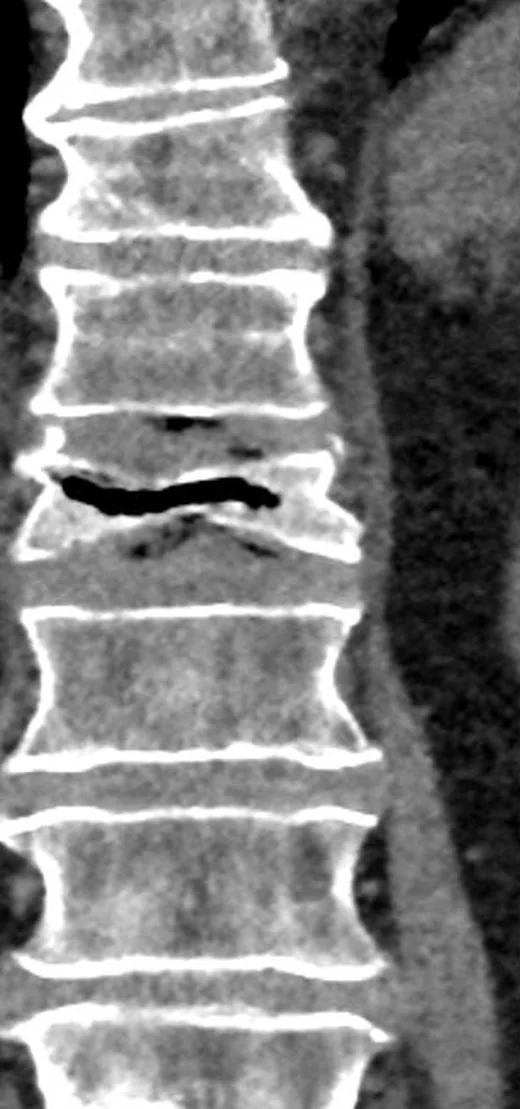
Vertebra kompresyon kırığı travma, osteoporoz veya tümöral kemik zayıflaması sonrasında korpusun ön, orta ya da tüm yüksekliğinde çökme olarak görülür. BT, kortikal kırık hattını, son plak çökmesini, arka duvar retropulsiyonunu ve posterior eleman hasarını göstererek kırığın morfolojisini ve kanal daralmasını tanımlar. Kemik algoritmalı sagittal ve aksiyel görüntüler temel incelemedir; malignite veya epidural yumuşak doku kuşkusunda MRG kemik iliği ve nöral yapıları daha iyi değerlendirir. Arka duvar parçası, instabil kırık paterni veya epidural kitle gözden kaçarsa spinal kanal ve omurilik basısı fark edilmeyebilir.
Faz ve pencere
- Kontrastsız tanısal
- Sagittal kemik penceresinde korpus ön/orta/arka kontur yüksekliği, son plak çökmesi, kortikal kırık çizgisi ve retropulse kemik parçası; aksiyelde pedikül, lamina ve posterior eleman devamlılığı incelenir. Kırığı göstermek için kontrast gerekmez.
- Kemik algoritması tanısal
- İnce aksiyel, koronal ve sagittal rekonstrüksiyonlar kırık hattının son plak ve posterior duvarla ilişkisini, retropulsiyonun kanal içindeki yerini ve eşlik eden posterior eleman kırıklarını netleştirir.
Önerilen pencereler G genişlik, M merkez; değerler Hounsfield birimi (HU)
- KemikG 1800 / M +400
- Yumuşak dokuG 400 / M +40
BT bulguları
- Korpus yükseklik kaybı — kama biçimli ön çökme, orta bölüm çökmesi veya korpusun yaygın yassılaşması.
- Son plak basamaklanması — üst ya da alt son plakta kortikal kesinti ve trabeküler kompresyon.
- Kırık çizgisi — korteksten spongioz kemik içine ilerleyen lineer açıklık; kemik pencere ve sagittal düzlemde takip edilir.
- Posterior duvar retropulsiyonu — kemik fragmanının korpus arka sınırından kanala doğru yer değiştirmesi ve kanal çapını daraltması.
- Posterior eleman kırığı — pedikül, lamina veya spinöz/transvers çıkıntı kırığı; eşlik eden gerilme bandı hasarı instabiliteyi düşündürebilir.
- Korpus kortikal destrüksiyonu — benign osteoporotik ve malign kompresyon kırıklarının görüntüleme bulguları örtüşebilse de, karakteristik görüntüleme özellikleri ayrımda yardımcı olabilir.
- Pedikül/posterior eleman litik tutulumu — vertebra korpusu dışındaki odaksal kemik yıkımı patolojik kırık lehinedir ancak tek başına özgül değildir.
- Epidural veya paravertebral yumuşak doku — kitle benzeri komponent maligniteyi düşündürür; travma sonrası kanama da yumuşak doku dansitesi yapabilir.
- İntravertebral vakum yarığı — çökmüş korpus içinde yatay veya çizgisel radyolüsent yarık görülebilir; osteoporotik vertebra kırığında kırık kaynamamasıyla ilişkili olabilir, ancak tek başına etiyolojiyi belirlemez.
Ölçütler ve sınıflamalar
- AO Spine torakolomber yaralanma sınıflaması
- AO Spine torakolomber sınıflamasında A3 inkomplet, A4 komplet burst kırıklarını ifade eder. Bu sınıflama travmatik torakolomber yaralanma morfolojisini tanımlar.
Normalde
Normal korpusta ön, orta ve arka yükseklik birbirine uyumlu, üst-alt son plak konturları düzgün ve kortikal halka kesintisizdir; arka duvar spinal kanala doğru bombeleşmez. Kırık şüphesinde komşu seviyeler ile karşılaştırarak kama deformitesini, yeni kortikal basamağı ve retropulse fragmanı gösterin; posterior elemanların sürekliliği de normal seviyedeki simetrik pedikül ve laminalarla kıyaslanır.
Normal BT ile kıyasla
Aynı bölgenin, kaynak veri setinde patoloji içermediği belirtilen bir BT incelemesini kesit kesit kaydırın; organ sınırlarını açarak anatomiyi hasta görüntüsüyle karşılaştırın. Küçük rastlantısal bulgular tümüyle dışlanmamıştır.
Kaynak: TotalSegmentator v2.01 veri seti (Wasserthal ve ark., Radiology: Artificial Intelligence 2023), CC BY 4.0, vaka s1338; organ sınırları veri setinin otomatik segmentasyonundan, birleştirilerek sadeleştirildi. Görüntüler 2,5 mm kesit aralığına yeniden örneklendi.
Ayırıcı tanı
- Akut benign osteoporotik kırık
- keskin sınırlı kırık çizgileri, retropulse köşe fragmanı ve korunmuş korteks görülebilir; kemik iliği ödemi için MRG daha duyarlıdır.
- Malign patolojik kırık
- kortikal/spongioz kemik destrüksiyonu, ekspansil arka kontur, pedikül tutulumu veya kitle benzeri epidural/paravertebral doku şüpheyi artırır.
- Schmorl nodülü
- akut Schmorl nodülü, porotik kırık ve spondilodiskiti taklit edebilir.
- Eski kama deformitesi
- akut kırık ile kronik deformiteyi ayırmada MRG temel görüntüleme yöntemidir.
- Spondilodiskit
- karşılıklı son plak erozyonu, disk aralığında değişiklik ve paravertebral inflamasyon kırık hattından farklı bir örüntüdür.
Tuzaklar
- Tek bir çökmüş vertebra yeni ve akut olmayabilir; eski BT veya grafi ile kıyaslayıp kortikal kenarların kronik yeniden şekillenmesini kontrol edin.
- Akut osteoporotik kırıkta pedikül ödemi ya da paravertebral kanama maligniteyi taklit edebilir; kitle benzeri doku ile düzgün ince kanama/ödemi ayırın ve gerektiğinde MRG kullanın.
- Kemik penceresinde kanal içi yumuşak doku sınırlı seçilir; belirgin retropulsiyon veya nörolojik bulgu varsa yumuşak doku penceresi ve MRG ile epidural alanı değerlendirin.
- Korpus yüksekliği korunmuş olsa da posterior eleman veya gerilme bandı yaralanması daha geniş instabilite paterninin parçası olabilir; posterior arkı aynı incelemede tarayın.
Kendini dene
T11'de tek son plak kırılmış, korpus arka duvarı sağlam ve yalnız ön yükseklik azalmış. AO Spine morfolojisi hangisidir?
Cevabı göster
A1 kama kompresyonu. A1 tek son plak kırığıdır ve arka duvarı tutmaz. A2 her iki son plağı içerir ancak arka duvarı tutmaz; A3 arka duvar ve tek son plağı, A4 arka duvar ile iki son plağı içerir.
Korpus çökmesine arka duvarın düzensiz yıkımı, pedikül litik odağı ve kitle biçimli epidural doku eşlik ediyor. En olası mekanizma nedir?
Cevabı göster
Malign patolojik kırık. Kortikal ve medüller destrüksiyonla birlikte pedikül odağı ve kitle benzeri epidural komponent malign patolojik kırığı destekler. Osteoporotik kırıkta tipik olarak kitle benzeri tümör uzanımı olmaz; Schmorl nodülü fokal son plak herniasyonudur; kronik deformite eski incelemede stabil kalır.
İlgili konular
Kaynaklar
Bu sayfadaki 43 cümle ve 2 quiz sorusu aşağıdaki kaynaklardan alıntılarla otomatik olarak karşılaştırıldı; 5 cümle bu karşılaştırmada düzeltildi (2026-10-09).
- What Factors Contribute to the Poor Prognosis of Conservative Treatment for Osteoporotic Vertebral Compression Fracture (OVCF): A Systematic Reviewpmc.ncbi.nlm.nih.gov
- Prevalence and risk factors for residual back pain after percutaneous vertebral augmentation in osteoporotic vertebral compression fracture patients: a systematic review and meta-analysispmc.ncbi.nlm.nih.gov
- Vertebrogenic Low Back Pain and Basivertebral Nerve Ablation: A Review of Mechanisms, Imaging-Driven Selection, and Clinical Outcomespmc.ncbi.nlm.nih.gov
- Risk factors for new vertebral compression fracture following percutaneous vertebral augmentation: a systematic review and meta-analysis based on multivariate logistic regression analysispmc.ncbi.nlm.nih.gov
- Risk factors of residual back pain after vertebral augmentation in osteoporotic vertebral compression fracture patients: a systematic review and meta-analysispmc.ncbi.nlm.nih.gov
- Diagnosis and Management of Vertebral Compression Fracture.pubmed.ncbi.nlm.nih.gov
- Vertebral Compression Fractures.pubmed.ncbi.nlm.nih.gov
- Red flags to screen for vertebral fracture in people presenting with low back pain.pubmed.ncbi.nlm.nih.gov
- [Kyphoplasty and vertebroplasty for spinal trauma].pubmed.ncbi.nlm.nih.gov
- Vertebral compression fracture after stereotactic body radiotherapy for spinal metastases.pubmed.ncbi.nlm.nih.gov
- Anatomic and functional imaging in the diagnosis of spine metastases and response assessment after spine radiosurgery.pubmed.ncbi.nlm.nih.gov
- Update of vertebral cementoplasty in porotic patients.pubmed.ncbi.nlm.nih.gov
- Fat embolism syndrome following percutaneous vertebroplasty: a case report.pubmed.ncbi.nlm.nih.gov
- [Progress on treatment of osteoporotic vertebral compression fracture].pubmed.ncbi.nlm.nih.gov
- New vertebral fractures after osteoporotic vertebral compression fracture between balloon kyphoplasty and nonsurgical treatment PRISMA.pubmed.ncbi.nlm.nih.gov
- Radiological Diagnosis and Advances in Imaging of Vertebral Compression Fractures.pubmed.ncbi.nlm.nih.gov
- Vertebral Compression Fracture Related to Pancreatic Cancer With Osteoblastic Metastasis: A Case Report and Literature Review.pubmed.ncbi.nlm.nih.gov
- Life-threatening intracardiac cement embolisms after percutaneous kyphoplasty: a case report and literature review.pubmed.ncbi.nlm.nih.gov
- Clinical and radiological subsequent fractures after vertebral augmentation for treating osteoporotic vertebral compression fractures: a meta-analysis.pubmed.ncbi.nlm.nih.gov
- Non-osteoporotic L4 vertebral compression fracture after low-voltage electrical injury without secondary trauma: A rare case report.pubmed.ncbi.nlm.nih.gov
- Predictors of adjacent level fractures following kyphoplasty for vertebral compression fractures of all etiologies: A retrospective cohort study.pubmed.ncbi.nlm.nih.gov
- Diagnostic decision-making, vertebral augmentation, and osteoporosis therapy in vertebral compression fractures: a narrative review.pubmed.ncbi.nlm.nih.gov
- Single-position robot-assisted lateral lumbar corpectomy with minimally invasive posterior spinal fusion for traumatic burst fracture showing MRI-demonstrated indirect decompression: illustrative case.pubmed.ncbi.nlm.nih.gov
- Breast Cancer Metastases Presenting as Musculoskeletal Complaints.pubmed.ncbi.nlm.nih.gov
- Intrabody Cage Augmentation in Kümmell Disease and Osteoporotic Burst Fractures: Technical Insights and Narrative Review of Current Evidence.pubmed.ncbi.nlm.nih.gov
- Acute Cauda Equina Syndrome Following Transpedicular Biopsy of a Lumbar Vertebral Lesion: A Case Report of Spinal Non-Hodgkin's Lymphoma.pubmed.ncbi.nlm.nih.gov
- Pathological Vertebral Fractures Misdiagnosed as Osteoporotic Vertebral Fractures: A Case Series of Four Patients and Diagnostic Strategies.pubmed.ncbi.nlm.nih.gov
- Surgical Management of Metastatic Extraskeletal Extradural Ewing Sarcoma of the Thoracic Spine in a Patient with Wiskott-Aldrich Syndrome and Hypertrophic Cardiomyopathy: A Case Report.pubmed.ncbi.nlm.nih.gov
- Emergency radiology of severe acute injury in extreme alpine summer sports: a pictorial essay.pubmed.ncbi.nlm.nih.gov
- Traumatic Durotomy with Entrapment of Nerve Roots in a Lumbar Burst Fracture Diagnosed Intraoperatively: A Case Report.pubmed.ncbi.nlm.nih.gov
- Anatomical and biological reconstruction of traumatic complete burst fractures of the thoracolumbar vertebrae using pedicle fixation combined with stent-armed kyphoplasty and intracorporeal bone grafting: technique rationale, 7-year experience and clinical, imaging, and histological outcomes.pubmed.ncbi.nlm.nih.gov
- Radiomics in spinal research: a narrative review.pubmed.ncbi.nlm.nih.gov
- Case Report: Thoracic spinal metastasis without definite intrahepatic recurrence after conversion therapy and hepatectomy for hepatocellular carcinoma.pubmed.ncbi.nlm.nih.gov
- Metastatic Retroperitoneal Rhabdomyosarcoma in a Child: A Case Report Highlighting the Role of Imaging in Diagnosis, Staging, and Follow-Up.pubmed.ncbi.nlm.nih.gov
- Classifying thoracolumbar fractures: role of quantitative imaging.pubmed.ncbi.nlm.nih.gov
- Intraoperative three-dimensional imaging-guided vertebral body stenting for cleft-associated very severe osteoporotic vertebral compression fractures: a surgical technique case series.pubmed.ncbi.nlm.nih.gov
- Comparison of Bilateral and Unilateral Applications of Percutaneous Vertebroplasty and Kyphoplasty Procedures.pubmed.ncbi.nlm.nih.gov
- Anatomy of the intraosseous arterial microvasculature of the adult lumbar vertebral body and its role in fracture healing: a literature review and historical perspective.pubmed.ncbi.nlm.nih.gov
- Percutaneous vertebroplasty and percutaneous kyphoplasty for osteoporotic vertebral compression fractures: medium- and long-term evaluation of clinical outcomes and affecting factors.pubmed.ncbi.nlm.nih.gov
- Multiphysics finite element analysis of vertebral stability in simulated osteolytic lumbar defects treated with <sup>125</sup>I brachytherapy and vertebroplasty.pubmed.ncbi.nlm.nih.gov
- Diagnostic Value of Opportunistic CT-Based Bone Density Assessment in Patients with and Without Sacral Insufficiency Fractures.pubmed.ncbi.nlm.nih.gov
- A Plea for a Paradigm Shift from X-Ray to Ultrasound in Adults: An Update for Emergency Physicians, General Practitioners, Orthopedists and Sports Medicine Physicians.pubmed.ncbi.nlm.nih.gov
- Magnetic resonance bone imaging: applications to vertebral lesions.pubmed.ncbi.nlm.nih.gov
- Evaluation of corticosteroid treatment in patients with post-traumatic ascending myelopathy and spinal cord injury: three case reports and review of the literature.pubmed.ncbi.nlm.nih.gov
- Revision surgical treatments and classification system for cage retropulsion in degenerative lumbar disease.pubmed.ncbi.nlm.nih.gov
- Impact of lamina preservation height during posterior decompression on lumbar biomechanical stress distribution: a finite element study.pubmed.ncbi.nlm.nih.gov
- Direct pars repair techniques for lumbar spondylolysis: a comparative literature review.pubmed.ncbi.nlm.nih.gov
- Thoracic Spine Fracture-Dislocation After Minor Trauma in a Neurologically Intact Patient With Congenital Absence of Posterior Spinal Elements: A Case Report.pubmed.ncbi.nlm.nih.gov
- Bilateral L3-L4 pedicular insufficiency fractures in a patient with breast cancer and treated spinal metastasis: A diagnostic pitfall.pubmed.ncbi.nlm.nih.gov
- Pseudomyogenic hemangioendothelioma of the thoracolumbar spine: A case-based review of a rare cause of vertebral collapse and neurological deficit.pubmed.ncbi.nlm.nih.gov
- Augmented-reality-assisted minimally invasive quad-rod spinopelvic fixation for spinopelvic dissociation caused by pathological fracture due to extramedullary plasmacytoma: an evaluation of technique and its benefits.pubmed.ncbi.nlm.nih.gov
- Spinal granulocytic sarcoma with both extradural and intradural involvement: a case report.pubmed.ncbi.nlm.nih.gov
- Paravertebral soft tissue swelling on magnetic resonance images helps in differentiation between osteoporotic and malignant vertebral fractures.pubmed.ncbi.nlm.nih.gov
- Unveiling Primary Bone Tumors of the Spine: A Review of Essential Imaging Clues.pubmed.ncbi.nlm.nih.gov
- Evolutionary Specializations of the Human Vertebral Body and Intervertebral Disc in Relation to Bipedalism.pubmed.ncbi.nlm.nih.gov
- Biomechanical evaluation of a novel cervical interfacet self-locking cage versus ACDF: a goat cadaveric study combined with human CT-based finite element analysis.pubmed.ncbi.nlm.nih.gov
- Association Between Adjacent Disc Vacuum Phenomenon and Adjacent Vertebral Fracture After Balloon Kyphoplasty for Osteoporotic Vertebral Fractures: A Retrospective Multicenter Study.pubmed.ncbi.nlm.nih.gov
- SMARCB1 (INI1)-deficient malignant melanocytic neoplasm with histologically confirmed vertebral metastases in a young adult: a case report.pubmed.ncbi.nlm.nih.gov
- Epidemiology, AO morphology, and diagnostic delay of discontinuous thoracolumbar fractures: A 10-year single-center cohort study.pubmed.ncbi.nlm.nih.gov
- Clinicodemographic features of traumatic thoracolumbar spine fractures presenting to a tertiary care center in Nepal.pubmed.ncbi.nlm.nih.gov
- Inducing thoracolumbar burst fractures in human cadaveric specimens using a combined axial-flexion loading: a fracture simulation.pubmed.ncbi.nlm.nih.gov
- Agreement and discordance between the modified thoracolumbar injury classification and severity score and the thoracolumbar AOSpine injury score in guiding surgical decision-making for thoracolumbar fractures: a comparative study.pubmed.ncbi.nlm.nih.gov
- Mechanical augmentation for vertebral compression fractures: A scoping review.pubmed.ncbi.nlm.nih.gov
- Crosslink augmentation in posterior fixation of unstable thoracic and thoracolumbar fractures: A comparative cohort study of mechanical failure and sagittal alignment.pubmed.ncbi.nlm.nih.gov
- Asymptomatic Multiple Bilateral Segmental Pulmonary Embolisms Caused by Cement After Multilevel Vertebroplasty: A Case Report and Literature Review.pubmed.ncbi.nlm.nih.gov
- A Primer on Anatomy, Biophysics, Pathology, Imaging and Treatment of the Intervertebral Disc and the Anterior Spinal Column: The Discogenic, Intervertebral, Spinal Column (DISC) ASPN Workgroup.pubmed.ncbi.nlm.nih.gov
- Diagnostic Approach and Differences between Spinal Infections and Tumors.pubmed.ncbi.nlm.nih.gov
- Diagnosis and treatment of Paget's disease of bone: position paper from the Italian Society of Osteoporosis, Mineral Metabolism and Skeletal Diseases (SIOMMMS).pubmed.ncbi.nlm.nih.gov
- Secondary changes in sagittal alignment after instrumented surgery with and without corpectomy for pyogenic spondylodiscitis.pubmed.ncbi.nlm.nih.gov
- Spondylodiscitis and Its Mimickers: A Pictorial Review.pubmed.ncbi.nlm.nih.gov
- Imaging of Spondylodiscitis: A Comprehensive Updated Review-Multimodality Imaging Findings, Differential Diagnosis, and Specific Microorganisms Detection.pubmed.ncbi.nlm.nih.gov
- Beyond the T-Score: A Narrative Clinical Review of Adult Endocrine Osteoporosis Care.pubmed.ncbi.nlm.nih.gov
- Acute-phase rehabilitation for osteoporotic vertebral fractures: current evidence from scoping review.pubmed.ncbi.nlm.nih.gov
- Diagnostic value of computed tomography plus magnetic resonance imaging in assessing the benign and malignant nature of vertebral compression fractures.pubmed.ncbi.nlm.nih.gov
- The value of magnetic resonance imaging and computed tomography in the study of spinal disorders.pubmed.ncbi.nlm.nih.gov
- Review of the Imaging Features of Benign Osteoporotic and Malignant Vertebral Compression Fractures.pubmed.ncbi.nlm.nih.gov
- Complications of vertebral augmentation in metastatic spinal fractures: a systematic review of multiple study designs.pubmed.ncbi.nlm.nih.gov
- Aggressive lumbar vertebral hemangioma presenting with foot drop mimicking spinal tuberculosis: A case report.pubmed.ncbi.nlm.nih.gov
- Occipital plate-assisted posterior reduction for tumor-related severe atlantoaxial dislocation: a single-case surgical technique.pubmed.ncbi.nlm.nih.gov
- Compression fracture of the T12 vertebra combined with diaphragmatic hernia after low-energy trauma: a case report and literature review.pubmed.ncbi.nlm.nih.gov
- Radiologically Devastating Yet Neurologically Intact: A Rare Case of Ambulatory C6-C7 Translational Injury with Bilateral Facet Dislocation and Vertebral Artery Thrombosis.pubmed.ncbi.nlm.nih.gov
- Case Report: Diagnostic and therapeutic challenges of secondary spinal tuberculosis following percutaneous vertebroplasty: a case of staged surgery with bone cement retention report.pubmed.ncbi.nlm.nih.gov
- Biomaterials for vertebral body repair: interior augmentation and total replacement-a literature review of bone fusion outcomes in clinical studies.pubmed.ncbi.nlm.nih.gov
- THBS1<sup>+</sup> Macrophages Exacerbate Modic Changes via SDC4-Dependent Activation of NLRP3 Inflammasome.pubmed.ncbi.nlm.nih.gov
- Vertebrogenic Low Back Pain and Basivertebral Nerve Ablation: A Review of Mechanisms, Imaging-Driven Selection, and Clinical Outcomes.pubmed.ncbi.nlm.nih.gov
- Exercise for myeloma patients with bone disease: a scoping review.pubmed.ncbi.nlm.nih.gov
- Advances in Supportive Care for Multiple Myeloma-Related Bone Disease-A Review.pubmed.ncbi.nlm.nih.gov
- The Integrated Nerve, Discoligamentous Complex, and Vertebra Scoring System for Thoracolumbar Junction (TLJ) Injury.pubmed.ncbi.nlm.nih.gov
- Spinal lesions: a comprehensive radiologic overview.pubmed.ncbi.nlm.nih.gov
- Advances in Metastatic Disease Spinal Oncology: Novel Technology Without Forgetting the Fundamentals of Surgical Treatment.pubmed.ncbi.nlm.nih.gov
- Multiple Treatment Analysis of Aneurysmal Bone Cysts in Mobile Spine.pubmed.ncbi.nlm.nih.gov
- 3D-printed tantalum artificial vertebral body or titanium mesh in anterior column reconstruction post-spondylectomy for thoracic vertebral tumors: a retrospective comparative cohort study and finite element analysis.pubmed.ncbi.nlm.nih.gov
- Extravertebral low back pain: a scoping review.pubmed.ncbi.nlm.nih.gov
- Bone metastases from hepatocellular carcinoma: Guidance on the management of spinal and long bone lesions.pubmed.ncbi.nlm.nih.gov
- Fracture Patterns of an Osteolytic Hole Involved Lumbar Vertebra, Assessed for a Case Study by Computational Models.pubmed.ncbi.nlm.nih.gov
- Application of the pivot forward combined leveraging technique in the treatment of thoracolumbar fractures: a finite element analysis and clinical study.pubmed.ncbi.nlm.nih.gov
- Minimal kyphotic progression following pediatric vertebral fractures: implications for reduced radiographic surveillance.pubmed.ncbi.nlm.nih.gov
- Magnetic resonance imaging of the spine.pubmed.ncbi.nlm.nih.gov
- Identifying osteoporotic vertebral endplate and cortex fractures.pubmed.ncbi.nlm.nih.gov
- An exploratory multimodal imaging and clinicopathological strategy for suspected Kümmell's disease in the absence of MRI.pubmed.ncbi.nlm.nih.gov
- Pathogenic mechanisms of adult degenerative scoliosis.pubmed.ncbi.nlm.nih.gov
- Risk-stratified management of ankylosing spondylitis-related spinal fractures-a meta-synthesis of contemporary surgical and nonsurgical strategies: a narrative review.pubmed.ncbi.nlm.nih.gov
- The evolution of cervical spine trauma classification: a paradigm shift from morphological description to clinical decision-making.pubmed.ncbi.nlm.nih.gov
- Mechanical Instability After Civilian Thoracolumbar Gunshot Injuries: A Systematic Review to Support Classification Development.pubmed.ncbi.nlm.nih.gov
- Acute Schmorl's Node during Strenuous Monofin Swimming: A Case Report and Review of the Literature.pubmed.ncbi.nlm.nih.gov
- Long-term safety and effectiveness of the "OptEase" vena cava filter.pubmed.ncbi.nlm.nih.gov
- The impact of vertebral fractures on pulmonary function tests in patients with interstitial lung disease: a cross-sectional study.pubmed.ncbi.nlm.nih.gov
- Management of aneurysmal bone cysts of the spine and sacrum: A narrative review.pubmed.ncbi.nlm.nih.gov
- Minimally invasive surgical techniques for the treatment of thoracolumbar burst fractures.pubmed.ncbi.nlm.nih.gov
- One-Stage Posterior Open Fixation with SpineJack Expansion Kyphoplasty for Unstable A4 Complete Thoracolumbar Burst Fracture with Neurological Deficit: A Proof-of-Concept Case Series.pubmed.ncbi.nlm.nih.gov
- Diabetes, Osteosarcopenia, and Immobilization: A Novel Nomogram for Predicting Kümmell's Disease After Osteoporotic Vertebral Fractures.pubmed.ncbi.nlm.nih.gov
Eğitim amaçlıdır; hasta başında tanı ve tedavi kararının yerine geçmez, tıbbi tavsiye değildir. Metinler yapay zekâ desteğiyle yazıldı ve otomatik bir adımda kaynak alıntılarıyla karşılaştırıldı; bu bir tıbbi doğrulama değildir ve içerik uzman radyolog incelemesinden geçmedi. Klinik kararlarda güncel kılavuzları, kurum protokollerini ve radyoloji raporunu esas alın.