Özet
Künt veya penetran ekstremite travması arter duvarında yırtılma, diseksiyon, tromboz, psödoanevrizma ya da arteriyovenöz fistül oluşturabilir. Ekstremite BTA yaralanmanın seviyesini, lezyon tipini, distal akımı ve kemik-yumuşak doku eşlikçilerini gösterir. Akım kesisi veya devam eden kanamanın atlanması ekstremite perfüzyonunu ve doku canlılığını tehdit edebilir.
Okuma sırası
- Yaralanma seviyesindeki ana arter. BTA'nın koronal MIP görüntüsünde travma hattına girin; yaralı ekstremitenin ana arterini proksimalden distale izleyip ani kalibre veya opaklaşma değişimini bulun.
- Arter lümeni ve damar dışı odak. Şüpheli noktayı aksiyel kesitlerde açın; lümen içinde flep mi, damar dışında kontrast mı, yoksa arterle boyun üzerinden bağlı bir kese mi olduğunu ayırın.
- Distal arter ağacı. Lezyonun distalindeki radial-ulnar ya da tibial-peroneal dalların opaklaşmasını izleyin; kesilme sonrası kollateral yeniden dolumun başladığı seviyeyi not edin.
- Yumuşak doku, komşu ven ve kemik. Yara yolu ve kas hematomunu, komşu venin arteriyel fazdaki dolumunu ve eşlik eden kırığı göstererek kanama, fistül ve iskelet hasarı birlikteliğini tamamlayın.
Faz ve pencere
- BTA tanısal
- Arteriyel kontrastla dolan ekstremite damarları boyunca ani kesilme, lümen daralması, intimal flep, trombüs, damar dışı kontrast, sakküler kese ve yaralanma yerinde erken venöz opaklaşma araştırılır; distal arterlerin dolumu kesintisiz izlenir.
- Gecikmiş tanısal
- Zamanla büyüyen şüpheli ekstravazyon aktif kanamayı düşündürür; psödoanevrizma ise arterle bağlantılı sınırlı bir kontrast kesesi olarak izlenir ve çevresinde aktif kanama olmayabilir. Proksimal oklüzyon veya yavaş akımlı yaralanmalarda kollateral dolaşımın sağladığı distal yeniden dolam, limb kurtarma açısından kritik olabilir.
Önerilen pencereler: Anjiyo (G 600 / M 150), Yumuşak doku (G 400 / M 40), Kemik (G 1800 / M 400).
BT bulguları
- Damar kesisi veya oklüzyon — arter kontrast dolumu bir noktada aniden sonlanır; distal damarlar dolmuyorsa tromboz veya tam kesilme düşünülür.
- İntimal flep — lümen içinde ince duvar parçası, eksantrik daralma veya kısmi dolum kusuru oluşturur.
- Aktif ekstravazasyon — BTA'da damar dışı aktif kontrast ekstravazasyonu arteriyel yaralanma bulgusu olarak izlenebilir.
- Travmatik psödoanevrizma — arter lümeniyle bağlantılı, sınırlı kontrast kesesi ve komşu yumuşak doku hematomu görülür.
- Arteriyovenöz fistül — yaralanma çevresindeki venin arteriyel fazda erken opaklaşması, bazen eşlik eden arter kesesiyle birlikte izlenir.
- Distal yeniden dolum — ana arter trombozu veya kesisi sonrasında kollateral yollarla distal arter dalları kontrastlanabilir; bu distal dolam, proksimaldeki tam kan akışı kesintisini maskeleyebilir ve doku perfüzyonunu sürdürebilir.
- Perivasküler hematom veya yara kanalı — kanama ve penetran travmanın seyri damar yaralanma bölgesine yaklaşabilir.
- İskelet-kas eşlikçisi — kırık, kas içi kanama, kompartıman çevresinde şişme veya yabancı cisim damar lezyonunun düzeyiyle eşleşebilir.
Normalde
Normal ekstremite BTA'da damarların normal anatomisi ve sık görülen varyantları dikkate alınır. Ekstremite BTA'da damar açıklığı ve düzensizliği değerlendirilir; anatomik ayrıntılar ve olası varyantlar dikkate alınır.
Normal BT ile kıyasla
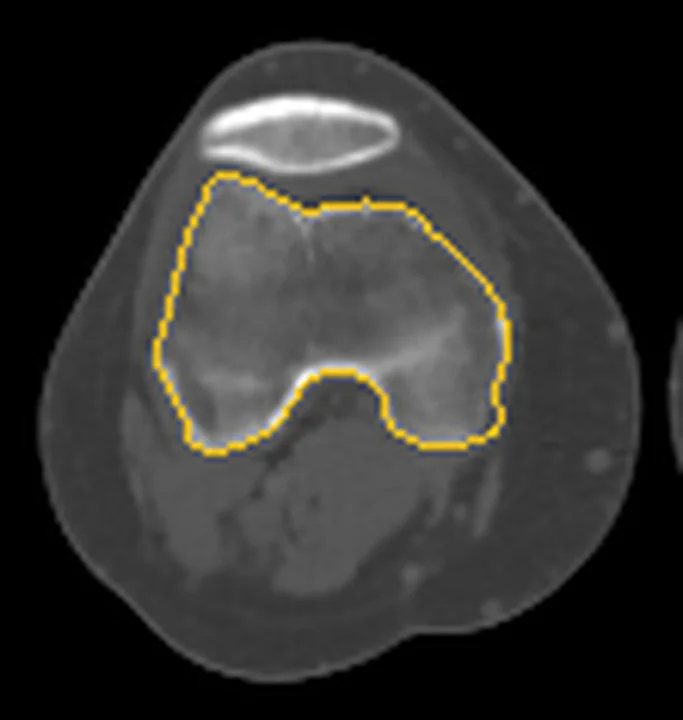
Aynı bölgenin, kaynak veri setinde patoloji içermediği belirtilen bir BT incelemesini kesit kesit kaydırın; organ sınırlarını açarak anatomiyi hasta görüntüsüyle karşılaştırın. Küçük rastlantısal bulgular tümüyle dışlanmamıştır.
Kaynak: TotalSegmentator v2.01 veri seti (Wasserthal ve ark., Radiology: Artificial Intelligence 2023), CC BY 4.0, vaka s0685; organ sınırları veri setinin otomatik segmentasyonundan, birleştirilerek sadeleştirildi. Görüntüler 2,5 mm kesit aralığına yeniden örneklendi.
Ayırıcı tanı
- Vazospazm, ekstremite iskemisine yol açabilen damar patolojileri arasındadır.
- Psödo-oklüzyon veya zayıf bolus
- ekstremite BTA'sında bolus zamanlaması, damar anormalliğini taklit edebilen ya da maskeleyebilen teknik bir tuzak olarak dikkate alınmalıdır.
- Arteriyel varyant
- beklenmeyen damar seyri başka kesitlerde anatomik devamlılıkla izlenir ve çevresinde travma odağı yoktur.
- Travmatik psödoanevrizma
- sınırlı kontrast kesesiyle seyreder; aktif kanama gibi hematom içinde ilerleyici yayılım oluşturmaz.
- Venöz yaralanmalar (tromboz, diseksiyon) akut dönemde arteriyel faza göre geç evre BT anjiyografide daha belirgin olabilir.
Tuzaklar
- Ekstremite BTA'da teknik tuzaklar veya artefaktlar damar anormalliğini taklit edebilir ya da maskeleyebilir; görüntüler bu olasılık gözetilerek değerlendirilmelidir.
- Ağır kırık veya metal parçanın yanındaki çizgi artefaktı damarı örtebilir; farklı düzlem ve pencerede, artefakttan uzak segmentleri izleyin.
- Distal yeniden dolum — ana arter trombozu veya kesisi sonrasında kollateral yollarla distal arter dalları kontrastlanabilir; bu distal dolam, proksimaldeki tam kan akışı kesintisini maskeleyebilir ve doku perfüzyonunu sürdürebilir.
- Arteriyel fazda erken venöz opaklaşma AV fistül düşündürebilir ancak hiperemi veya diğer nedenlerle de görülebilir; kesin tanı için klinik ve radyolojik değerlendirme gereklidir.
Kendini dene
Bacağın BTA'sında popliteal arter ani kesiliyor, distal tibial dallar daha aşağıda yeniden opaklaşıyor. En olası açıklama nedir?
Cevabı göster
Arter kesisi ve kollateral dolum. Fokal ani arter kesintisi ve distal yeniden dolum, proksimal yaralanma sonrasında kollateral akımı düşündürür; distal opaklaşma lezyonu dışlamaz. Spazm genellikle düzgün daralma yapar, diğer seçenekler bu arteriyel örüntüyü açıklamaz.
Kol travması BTA'sında yaralanma yakınındaki ven arteriyel fazda erken kontrastlanıyor. Hangi bulgu öncelikle aranır?
Cevabı göster
Arteriyovenöz fistül. Yaralanma odağına yakın venin erken opaklaşması arteriyovenöz bağlantıyı destekler. Oklüzyon arter dolumunun kesilmesidir; kalsifikasyon kronik duvar bulgusudur; kemik iliği ödemi damar şantını göstermez.
İlgili konular
Kaynaklar
Bu sayfadaki 38 cümle ve 2 quiz sorusu aşağıdaki kaynaklardan alıntılarla tek tek karşılaştırıldı; 12 cümle bu karşılaştırmada düzeltildi (2026-10-08).
- Repair lower extremity vascular injury using a parallel connection for reconstruction of vessel graft with autogenous veinpmc.ncbi.nlm.nih.gov
- Utility of ABI and API Versus CTA to Identify Surgically Significant Arterial Injury After Lower Extremity Trauma in a LMICpmc.ncbi.nlm.nih.gov
- The Outcomes of Delayed Revascularization in Lower Extremity Vascular Injury: A Retrospective Cohort Studypmc.ncbi.nlm.nih.gov
- Comment to: The Outcomes of Delayed Revascularization in Lower Extremity Vascular Injury: A Retrospective Cohort Studypmc.ncbi.nlm.nih.gov
- Computed tomography angiography is associated with low added utility for detecting clinically relevant vascular injuries among patients with extremity traumapmc.ncbi.nlm.nih.gov
- Recent advances and the future of abdominopelvic and lower extremity vascular injury management.pubmed.ncbi.nlm.nih.gov
- MDCT angiography of emergent, non-traumatic, upper extremity vascular lesions.pubmed.ncbi.nlm.nih.gov
- Patency of arterial repairs from wartime extremity vascular injuries.pubmed.ncbi.nlm.nih.gov
- Paediatric extremity vascular injuries - experience from a large urban trauma centre in India.pubmed.ncbi.nlm.nih.gov
- The predictive value of multidetector CTA on outcomes in patients with below-the-knee vascular injury.pubmed.ncbi.nlm.nih.gov
- Prospective evaluation of multidetector computed tomography for extremity vascular trauma.pubmed.ncbi.nlm.nih.gov
- The Role of CT Angiography in Evaluating Lower Extremity Trauma: 157 Patient Case Series at a Military Treatment Facility.pubmed.ncbi.nlm.nih.gov
- The Impact of Geniculate Artery Collateral Circulation on Lower Limb Salvage Rates in Injured Patients.pubmed.ncbi.nlm.nih.gov
- Hard signs gone soft: A critical evaluation of presenting signs of extremity vascular injury.pubmed.ncbi.nlm.nih.gov
- Popliteal artery occlusion secondary to exostosis of the femur.pubmed.ncbi.nlm.nih.gov
- Contributions of the surgeon Nikolai Korotkov (1874-1920) to the management of extremity vascular injury.pubmed.ncbi.nlm.nih.gov
- Computed tomography angiography is associated with low added utility for detecting clinically relevant vascular injuries among patients with extremity trauma.pubmed.ncbi.nlm.nih.gov
- Characteristics and Validation of Pediatric Extremity Vascular Trauma in Dedicated Pediatric and Adult Trauma Centers: A Scoping Review Protocol.pubmed.ncbi.nlm.nih.gov
- Incidence and clinical impact of lower extremity vascular injuries in the setting of whole body computed tomography for trauma.pubmed.ncbi.nlm.nih.gov
- Proximal and distal endovascular embolization of a penetrating V3 vertebral artery transection with adjunctive surgical ligation: A case report.pubmed.ncbi.nlm.nih.gov
- Repair lower extremity vascular injury using a parallel connection for reconstruction of vessel graft with autogenous vein.pubmed.ncbi.nlm.nih.gov
- Penetrating Ballistic Trauma to the Popliteal Fossa Without Neurovascular Injury Despite High-Risk Trajectory: An Unusual Case Report.pubmed.ncbi.nlm.nih.gov
- Intraindividual comparison of imaging modalities in anterolateral thigh perforator mapping.pubmed.ncbi.nlm.nih.gov
- Surgical Reduction Techniques and Outcomes for Cervical Spondyloptosis: A Technical Report and Case Series.pubmed.ncbi.nlm.nih.gov
- Traumatic brachial artery reconstruction using an in-wound no-touch superficial vein graft with 20-month imaging follow-up: a case report.pubmed.ncbi.nlm.nih.gov
- Successful limb salvage using a fresh maternal great saphenous vein allograft for combined femoral artery and vein transection after gunshot injury in a child.pubmed.ncbi.nlm.nih.gov
- Lateral Plantar Angioplasty and Reverse Sural Flap Reconstruction for Complex Heel Limb Salvage.pubmed.ncbi.nlm.nih.gov
- When salvage becomes suffering: re-evaluating the limits of limb preservation in modern orthoplastic surgery.pubmed.ncbi.nlm.nih.gov
- Complete abdominal aortic occlusion following seat-belt trauma: a proposal for early recognition.pubmed.ncbi.nlm.nih.gov
- Vascular and lymphatic complications after renal transplant.pubmed.ncbi.nlm.nih.gov
- CT angiography of acute aortic syndrome in patients with chronic kidney disease.pubmed.ncbi.nlm.nih.gov
- Traumatic intracranial pseudoaneurysms of cortical middle cerebral artery and posterior cerebral artery branches presenting as subdural hematomas in elderly patients: A two-case report.pubmed.ncbi.nlm.nih.gov
- Adjunctive middle meningeal artery embolization with low-viscosity liquid embolic agents for acute epidural hematoma: technical considerations and a case series.pubmed.ncbi.nlm.nih.gov
- Successful Endovascular Treatment of Traumatic Renal Artery Thrombosis and Dissection Associated with Liver Injury: A Case Report.pubmed.ncbi.nlm.nih.gov
- Non-occlusive mesenteric ischemia secondary to diabetic ketoacidosis in a patient receiving olanzapine: A case report.pubmed.ncbi.nlm.nih.gov
- Post-therapy imaging of adult brain tumours: patterns, pitfalls, and practical framework.pubmed.ncbi.nlm.nih.gov
- Common femoral artery transection during total hip arthroplasty for a neglected septic hip dislocation: a case report.pubmed.ncbi.nlm.nih.gov
- Iatrogenic aortic and iliac artery transections during robotic nephrectomies requiring emergent open vascular repair.pubmed.ncbi.nlm.nih.gov
- ESR Essentials: trauma team and the role of Interventional Radiology-practice recommendations by the Cardiovascular and Interventional Radiological Society of Europe.pubmed.ncbi.nlm.nih.gov
- Contralateral vertebral artery dissection after an unprecedented 14-year interval with a persistent intimal flap: A case report.pubmed.ncbi.nlm.nih.gov
- Severe celiac trunk stenosis following blunt trauma in a patient with diabetic ketoacidosis: a diagnostic dilemma of traumatic injury versus median arcuate ligament syndrome.pubmed.ncbi.nlm.nih.gov
- Endovascular repair of traumatic innominate artery injury: case report.pubmed.ncbi.nlm.nih.gov
- Transcatheter arterial embolization for traumatic adrenal hemorrhage with contrast extravasation: case series and literature review.pubmed.ncbi.nlm.nih.gov
- Predictors of the need for angioembolization in blunt pelvic trauma.pubmed.ncbi.nlm.nih.gov
- Recurrent spontaneous cervical hemorrhage in a patient with neurofibromatosis type 1 requiring repeated endovascular embolization: illustrative case.pubmed.ncbi.nlm.nih.gov
- Combined Post-traumatic Pseudoaneurysms of the Superior Gluteal and Aberrant Obturator Arteries: A Case Report.pubmed.ncbi.nlm.nih.gov
- Post-Traumatic Bronchial Artery Pseudoaneurysm: A Case Report.pubmed.ncbi.nlm.nih.gov
- Infected splenic artery pseudoaneurysm within a complex splenic cystic lesion: CT angiography pitfalls and surgical correlation.pubmed.ncbi.nlm.nih.gov
- Pitfall in necrotizing pancreatitis: Organized hematoma with arteriovenous fistula mimicking a splenic artery pseudoaneurysm.pubmed.ncbi.nlm.nih.gov
- Case Report: Delayed coil migration after endovascular embolization of an inferior mesenteric arteriovenous malformation.pubmed.ncbi.nlm.nih.gov
- Balloon-assisted endovascular embolization of a subcutaneous penile arteriovenous fistula using a quadruple coaxial system: A case report.pubmed.ncbi.nlm.nih.gov
- Stent Retriever-Assisted Embolic Protection During Recanalization of Chronic Internal Carotid Artery Occlusion with Contralateral Carotid Stenosis: A Case Report.pubmed.ncbi.nlm.nih.gov
- Computed Tomography Angiography Recognition of a Hemorrhagic Moyamoya Pattern May Alter Acute Blood Pressure Management.pubmed.ncbi.nlm.nih.gov
- Traumatic common iliac artery occlusion mimicking acute sciatica: a case report.pubmed.ncbi.nlm.nih.gov
- Cryptococcosis in a seemingly immunocompetent patient presenting with knee and lower limb soft tissue infection complicated by meningitis: a case report.pubmed.ncbi.nlm.nih.gov
- Acute Innominate Vein Dissection During Pacemaker Revision Procedure: A Case Report and Conservative Management.pubmed.ncbi.nlm.nih.gov
- Open treatment of superior mesenteric artery pseudoaneurysm due to infective endocarditis.pubmed.ncbi.nlm.nih.gov
- 5-Factor Modified Frailty Index predicts 30-day complications after amputation for open lower-extremity fracture: an American College of Surgeons Trauma Quality Improvement Program database study.pubmed.ncbi.nlm.nih.gov
- Clinical and Socioeconomic Predictors of Outcomes in Patients with Lower Extremity Vascular Trauma Requiring Operative Management.pubmed.ncbi.nlm.nih.gov
- Fibula fracture is associated with high rate of vascular injury among low velocity ballistic tibia fractures.pubmed.ncbi.nlm.nih.gov
- Unilateral High Brachial Artery Bifurcation Encountered During Cadaveric Dissection: An Anatomical Case Report.pubmed.ncbi.nlm.nih.gov
- Multiterritory Acute Ischemic Stroke with Bilateral Middle Cerebellar Peduncle T2/FLAIR Hyperintensities in the Setting of a Fatal Systemic Arterial Thrombotic Process: A Case Report.pubmed.ncbi.nlm.nih.gov
- Acute aortic dissection presenting as crossed neurological symptoms: a case report.pubmed.ncbi.nlm.nih.gov
- Multiterritory Bihemispheric Ischemic Stroke in the Setting of Unilateral Internal Carotid Artery Disease.pubmed.ncbi.nlm.nih.gov
- Non-invasive Vascular Laboratory Evaluation of the Upper Extremity.pubmed.ncbi.nlm.nih.gov
- COVID-19-Associated Reversible Cerebral Vasoconstriction Syndrome: A Rare Case of Secondary Thunderclap Headache.pubmed.ncbi.nlm.nih.gov
- From Stroke Suspicion to Genetic Confirmation: Familial Hemiplegic Migraine Type 2 as a Rare Stroke Mimic With Persistent Hemiplegia.pubmed.ncbi.nlm.nih.gov
- Patient-specific timing acquisition for coronary CT angiography: A retrospective patient validation study.pubmed.ncbi.nlm.nih.gov
- Optimizing coronary CT angiography in patients with delayed contrast arrival using a free-breathing, high-threshold bolus-tracking protocol.pubmed.ncbi.nlm.nih.gov
- Sequential Helical-Axial-Helical Triple-Rule-Out CT Angiography: Technical Feasibility and Territory-Specific Image Quality in the Emergency Department.pubmed.ncbi.nlm.nih.gov
- Unusual and High Origin of Terminal Branches of the Brachial Artery: A Cadaveric Study With Embryological and Clinical Correlations.pubmed.ncbi.nlm.nih.gov
- Percutaneous Occlusion of Anomalous Circumflex From Pulmonary Artery Treating Coronary Steal and Left Ventricular Dysfunction.pubmed.ncbi.nlm.nih.gov
- Disrupted anastomotic pseudoaneurysm in arteriovenous grafts: an etiology-driven case series with a proposed preliminary management framework.pubmed.ncbi.nlm.nih.gov
- Neurovascular injuries associated with proximal humerus fractures: a review of the current literature.pubmed.ncbi.nlm.nih.gov
- CT-Centered Multimodality Imaging of Arterial Wall Fragility in Acute Aortic Syndromes: A Narrative Review of Imaging Markers and Clinical Implications.pubmed.ncbi.nlm.nih.gov
- Anatomical patterns and clinical outcomes of central venous catheter malpositions: A systematic review of published case reports and case series.pubmed.ncbi.nlm.nih.gov
- Efficiency and Optimization of Iodinated Contrast Agents in Cerebral Aneurysm CT Angiography: A Systematic Review.pubmed.ncbi.nlm.nih.gov
- Incidental recognition of partial anomalous pulmonary venous return involving the left inferior pulmonary vein during central venous catheterization: A case report.pubmed.ncbi.nlm.nih.gov
- Poor Distal Left Atrial Appendage Opacification on Early-Phase Cardiac CTA and Association With Arterial Thromboembolism.pubmed.ncbi.nlm.nih.gov
- Role of metal artifact reduction software in computed tomography angiography of lower limb metallic prosthesis: A retrospective study.pubmed.ncbi.nlm.nih.gov
- Acute Traumatic Aortic Injury: What the Radiologist Needs to Know.pubmed.ncbi.nlm.nih.gov
- Understanding Photon-Counting CT: Physics, Detector Technology, and Image Reconstructions.pubmed.ncbi.nlm.nih.gov
- To Explore or Not? Conservatively Managed Brachial Artery Injury with Good Collateral Flow After Elbow Reduction: A Case Report.pubmed.ncbi.nlm.nih.gov
- Radiological Diagnosis of Axillary Artery and Brachial Plexus Involvement in a Proximal Humerus Fracture-Dislocation: A Case Report.pubmed.ncbi.nlm.nih.gov
- Imaging for Pediatric Head and Neck Emergencies: Critical Insights.pubmed.ncbi.nlm.nih.gov
- CT and MR imaging of the upper extremity vasculature: pearls, pitfalls, and challenges.pubmed.ncbi.nlm.nih.gov
- Indian College of Radiology and Imaging Guidelines on Interventions in Hepatocellular Carcinoma.pubmed.ncbi.nlm.nih.gov
- Three-Station Non-Contrast MR Angiography of the Lower Extremities Using Standard and Centric Fresh Blood Imaging.pubmed.ncbi.nlm.nih.gov
- Multimodal imaging of acquired aortic diseases: clinical efficacy, comparative analysis, and future perspectives.pubmed.ncbi.nlm.nih.gov
- Chronic Total Occlusion After Kawasaki Disease.pubmed.ncbi.nlm.nih.gov
- Neurosonology in acute stroke revealing bilateral internal carotid artery occlusion maintained by persistent embryologic collaterals: A case report.pubmed.ncbi.nlm.nih.gov
- Double vertebral artery-connected persisting proatlantal artery coexisting with a persisting carotid duct in an adult case: first evidence.pubmed.ncbi.nlm.nih.gov
- Bilateral Persistent Sciatic Artery With Unilateral Thrombosis: A Rare Case of Acute Limb Ischemia Successfully Managed With Endovascular Intervention.pubmed.ncbi.nlm.nih.gov
- Intentional subintimal loop technique for orientation recovery in superficial femoral artery chronic total occlusion with pedal-origin controlled antegrade and retrograde subintimal tracking.pubmed.ncbi.nlm.nih.gov
- Endovascular management of iliac vessel injury complicating lumbar disc surgery: a case report and review of literature.pubmed.ncbi.nlm.nih.gov
- Staged endovascular and surgical management of vertebral arteriovenous fistula with ruptured aneurysm and pseudoaneurysm in neurofibromatosis type 1 complicated by fatal reperfusion injury: illustrative case.pubmed.ncbi.nlm.nih.gov
- A Case Report of a Fulminant Necrotizing Fasciitis of the Upper Extremity in an Immunocompromised Patient.pubmed.ncbi.nlm.nih.gov
- Case Report: Intravascular lithotripsy combined with a new-generation 3-in-1 carotid stent for calcified carotid artery stenosis.pubmed.ncbi.nlm.nih.gov
- A Novel Lateral Tibiofibular Index for Simulated Posterior Fibular Translation: A Three-Dimensional CT Study.pubmed.ncbi.nlm.nih.gov
- Intentional Self-Inflicted Transcranial Screwdriver Injury: A Case Report.pubmed.ncbi.nlm.nih.gov
- Case Report: HHS-spectrum distal palmar arterial thrombosis in a volleyball athlete with provocative-position thoracic outlet narrowing.pubmed.ncbi.nlm.nih.gov
- Multimodality Imaging of Thoracic Outlet Syndrome: Etiological and Anatomical Correlates.pubmed.ncbi.nlm.nih.gov
- How we do it: artery of Adamkiewicz evaluation by CTA in children.pubmed.ncbi.nlm.nih.gov
- Artificial Intelligence for Computer-Aided Detection in Endovascular Interventions: Clinical Applications, Validation, and Translational Perspectives.pubmed.ncbi.nlm.nih.gov
- Optimal approach to performing and reporting computed tomography angiography for suspected acute pulmonary embolism: a clinical consensus statement of the ESC Working Group on Pulmonary Circulation & Right Ventricular Function, the Fleischner Society, the Association for Acute CardioVascular Care (ACVC) and the European Association of Cardiovascular Imaging (EACVI) of the ESC, endorsed by European Respiratory Society (ERS), Asian Society of Thoracic Radiology (ASTR), European Society of Thoracic Imaging (ESTI), and Society of Thoracic Radiology (STR).pubmed.ncbi.nlm.nih.gov
- Longitudinal Kinetics of Cerebrospinal Fluid and Serum S100B in Patients with Delayed Cerebral Ischemia After Aneurysmal Subarachnoid Hemorrhage.pubmed.ncbi.nlm.nih.gov
- Serial serum calcium dynamics predict delayed hydrocephalus after spontaneous subarachnoid hemorrhage: development and validation of a clinical nomogram in an observational cohort.pubmed.ncbi.nlm.nih.gov
- Middle cerebral artery dissection: pathophysiology, diagnosis, and therapeutic options.pubmed.ncbi.nlm.nih.gov
- Calciphylaxis Mimicry in End-Stage Renal Disease: Acute Limb Ischemia From Calcific Peripheral Arterial Disease.pubmed.ncbi.nlm.nih.gov
- Inflammatory Aortopathies in Rheumatic Diseases: A State-of-the-Art Review.pubmed.ncbi.nlm.nih.gov
- ESR Essentials: imaging in nasal obstruction and epistaxis-practice recommendations by the European Society of Head and Neck Radiology.pubmed.ncbi.nlm.nih.gov
- Case Report: Life-saving external hemipelvectomy after missed external iliac artery occlusion in severe pelvic trauma.pubmed.ncbi.nlm.nih.gov
- CT Angiography of the Upper Extremities: Review of Acute Arterial Entities.pubmed.ncbi.nlm.nih.gov
- A Narrative Review of Biomarkers and Imaging in the Diagnosis of Acute Aortic Syndrome.pubmed.ncbi.nlm.nih.gov
- Update in combined musculoskeletal and vascular injuries of the extremities.pubmed.ncbi.nlm.nih.gov
Eğitim amaçlıdır; hasta başında tanı ve tedavi kararının yerine geçmez. İçerik yapay zekâ destekli bir süreçle güncel literatüre göre cümle cümle kaynaklarla karşılaştırıldı, ancak uzman radyolog incelemesinden geçmedi. Klinik kararlarda güncel kılavuzları, kurum protokollerini ve radyoloji raporunu esas alın.