Özet
Travma BT'sinde kemik fragmanı, damar kıvrımı, kalsifikasyon ve metal artefaktı kanama odağı ya da damar kesisi izlenimi verebilir. İnce kesit, çok düzlemli rekonstrüksiyon ve varsa farklı kontrast fazları, şüpheli odağın damarla bağlantısını ve zaman içindeki davranışını sınar. Taklitçinin gerçek yaralanma sanılması gereksiz ileri işlem doğurabilir; tersine, artefakt arkasında kalan gerçek kanama da atlanabilir.
Faz ve pencere
- Kontrastsız
- Fazlar arası kontrastlanma değişimi değerlendirilerek aktif kaçağın varlığı sorgulanır; değişim yoksa yapıya ait temel yoğunluk (kalsifikasyon, kemik veya hematom) düşünülmelidir. Bu faz kontrast kaçağını tanımaz, fakat sonraki fazdaki odağın önceden mevcut yoğunluk olup olmadığını ayırmaya yarar.
- BTA tanısal
- Şüpheli odağın arter lümeniyle bağlantısı çok düzlemli rekonstrüksiyonlarla incelenir; lümen dışı kontrastlanmanın sonraki faza göre büyümesi veya şekil değiştirmesi aktif kaçağı destekler.
- Portal tanısal
- Arteriyel fazdaki sınırlı odağın büyüyüp büyümediği veya ilk kez venöz fazda ortaya çıkıp çıkmadığı kontrol edilir; fazlar arası değişmeyen kemik, metal ve kalsifikasyon kontrast havuzlanması değildir.
Önerilen pencereler: Anjiyo (G 600 / M 150), Kemik (G 1800 / M 400), Yumuşak doku (G 400 / M 40), Batın (G 400 / M 50).
BT bulguları
- Kırık fragmanı — BT tabanlı üç boyutlu rekonstrüksiyonda fragmanlar ayrıştırılarak kırık hattı izlenebilir.
- Damar kıvrımı — şüpheli kontrast odağı ardışık aksiyel kesit veya MPR'da arter lümenine kesintisiz bağlanır.
- Vasküler kalsifikasyonlar, damar duvarını izleyen ve kontrastlı görüntülerde de sabit kalan yüksek yoğunluklu yapılar olup, gerçek kaçağa taklitçi olabilir; anjiyografik varyantlar ve mimiklere dikkat edilmelidir.
- Teknik artefaktlar, özellikle metal kaynaklı ışın sertleşmesi, damar lümenini örtebilir ve yalancı patoloji izlenimine yol açabilir; bu durum protokole ve yeniden yapılandırma stratejisine dikkat edilerek azaltılmalıdır.
- Akım ya da zamanlama artefaktı — yetersiz veya eşit olmayan opaklaşma lümende yalancı dolum kusuru izlenimi verebilir; komşu damarlardaki kontrastlanma da etkilenir.
- Lümen dışı kontrastlanmanın arteriyel ve venöz fazlar arasında büyümesi veya şekil değiştirmesi, aktif kaçağın varlığını gösterir; bu bulgu retroperitoneal hematom gibi komşu yapılarla birlikte değerlendirilir.
- Gerçek psödoanevrizma — kaynak arterle bağlantılı, gecikmiş görüntüde sınırlı kalan kontrast kesesi şeklindedir.
Normalde
Travma değerlendirmesinde normal damar anatomisinin korunması, komşu organ yaralanmaları ve hematomların ayırt edilmesinde referans alınır; anjiyografik varyantlar ve mimiklerin bilinmesi yanlış pozitifleri önler. Kanama kaynağının karakterizasyonu için arteriyel ve venöz fazların karşılaştırmalı analizi yapılır; bu yaklaşım yüksek basınçlı arteriyel kaçağın düşük basınçlı venöz-osseoz kanamalardan ayırt edilmesini sağlar.
Normal BT ile kıyasla
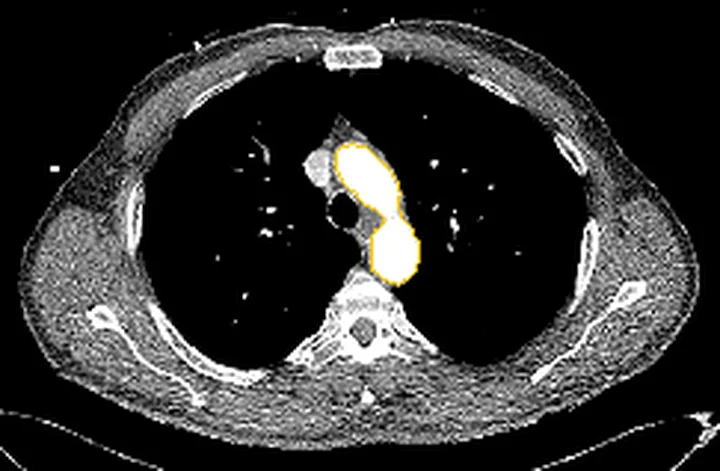
Aynı bölgenin, kaynak veri setinde patoloji içermediği belirtilen bir BT incelemesini kesit kesit kaydırın; organ sınırlarını açarak anatomiyi hasta görüntüsüyle karşılaştırın. Küçük rastlantısal bulgular tümüyle dışlanmamıştır.
Kaynak: TotalSegmentator v2.01 veri seti (Wasserthal ve ark., Radiology: Artificial Intelligence 2023), CC BY 4.0, vaka s0115; organ sınırları veri setinin otomatik segmentasyonundan, birleştirilerek sadeleştirildi. Görüntüler 2,5 mm kesit aralığına yeniden örneklendi.
Ayırıcı tanı
- Çok fazlı görüntüleme, arteriyel ve venöz fazlardaki kontrast dağılımını karşılaştırarak aktif arteriyel ekstravazasyonu ve diğer kanama desenlerini ayırt etmeye yarar.
- Travmatik psödoanevrizma
- arterle boyun bağlantısı olan sınırlı kese, sonraki fazda serbestçe yayılmaz.
- Arter diseksiyonu
- lümen içinde duvar boyunca uzanan ince flep, çift kanal veya eksantrik daralma seçilir.
- Vasküler kalsifikasyon
- kontrastsız fazda mevcut yoğunluk damar duvarı çizgisini izler; yeni bir yumuşak doku kontrast odağı gibi davranmaz.
- Hematom
- kontrast öncesi yumuşak doku yoğunluk artışı vardır; damar opaklaşmasıyla aynı atenüasyonda bir lümen dışı havuz oluşturmaz.
Tuzaklar
- Tek aksiyel kesitte damar dalı yuvarlak kontrast odağı gibi görünür; ardışık kesit ve koronal MPR'da damarın yönünü izleyin.
- Metal çizgi artefaktı damar lümeninde kesinti veya yalancı ekstravazasyon yaratabilir; pencereyi değiştirip artefaktın kaynağına göre diğer düzlemi inceleyin.
- Kontrastsız karşılığı olmayan yüksek yoğunluk otomatik olarak aktif kanama değildir; kontrast fazı, damar bağlantısı ve sonraki fazdaki boyut birlikte değerlendirilmelidir.
- Hasta hareketi ve bolus zamanlaması farklı fazları aynı anatomik noktaya denk getirmeyebilir; karşılaştırmayı komşu kemik işaretlerine göre hizalayın.
Kendini dene
Kırık komşuluğundaki parlak nokta kontrastsız fazda da aynı konumda ve kemik penceresinde korteksle devamlı. En olası açıklama nedir?
Cevabı göster
Kemik fragmanı. Kontrast öncesinde mevcut olan ve kemik korteksiyle süreklilik gösteren yoğunluk kırık fragmanıdır. Ekstravazasyon ve psödoanevrizma kontrastla dolar; fistülde erken venöz dolum beklenir.
Nekrotizan pankreatit sonrası dalak hilusu lezyonu venöz fazda da doluyor ve anjiyografide belirgin arteriyel iletişim gösterilemiyor. Bu olgunun nihai tanısı nedir?
Cevabı göster
Arteriyovenöz fistülle ilişkili organize hematom. Cerrahi incelemede lezyonun gerçek psödoanevrizma değil, arteriyovenöz fistülle ilişkili organize hematom olduğu gösterilmiştir.
Bu konunun yer aldığı turlar
İlgili konular
- Aktif kontrast ekstravazasyonu
- Travmatik psödoanevrizma
- Abdominal aorta ve visseral damar yaralanması
- Ekstremite damar yaralanması
Kaynaklar
Bu sayfadaki 37 cümle ve 2 quiz sorusu aşağıdaki kaynaklardan alıntılarla tek tek karşılaştırıldı; 10 cümle bu karşılaştırmada düzeltildi (2026-10-08).
- Torsion of a pedunculated accessory hepatic lobe: Cross-sectional imaging and histopathological correlationpmc.ncbi.nlm.nih.gov
- Fulminant Multisystem IgA Vasculitis With Diffuse Alveolar Hemorrhage, Severe Gastrointestinal Hemorrhage, Paralytic Ileus, and Renal Involvement in an Adolescent: A Case Reportpmc.ncbi.nlm.nih.gov
- Stroke or Seizure? Diagnostic Role of Neuroimaging in Acute Neurologic Mimicspmc.ncbi.nlm.nih.gov
- Clinical Utility of Circulating Biomarkers for Diagnosis and Prognosis of Acute Stroke in the Emergency Department: A Narrative Review from Current Evidence to Clinical Implementationpmc.ncbi.nlm.nih.gov
- Massive rectus sheath hematoma following anticoagulation requiring operative hemorrhage control: a case reportpmc.ncbi.nlm.nih.gov
- Multidetector CT in Vascular Injuries Resulting from Pelvic Fractures: A Primer for Diagnostic Radiologists.pubmed.ncbi.nlm.nih.gov
- Pearls and pitfalls of hepatobiliary and splenic trauma: what every trauma radiologist needs to know.pubmed.ncbi.nlm.nih.gov
- The vascularization pattern of acellular nerve allografts after nerve repair in Sprague-Dawley rats.pubmed.ncbi.nlm.nih.gov
- Training model for control of an internal carotid artery injury during transsphenoidal surgery.pubmed.ncbi.nlm.nih.gov
- Comparison of the efficacy of the anterolateral thigh flap for perforator localization in the repair of head and neck soft tissue defects patients: A protocol study for a randomized controlled trial.pubmed.ncbi.nlm.nih.gov
- Progressive Vascular Functional and Structural Damage in a Bronchopulmonary Dysplasia Model in Preterm Rabbits Exposed to Hyperoxia.pubmed.ncbi.nlm.nih.gov
- Peripheral vascular atherosclerosis in a novel PCSK9 gain-of-function mutant Ossabaw miniature pig model.pubmed.ncbi.nlm.nih.gov
- [APPLICATION OF DIGITAL TECHNOLOGY IN ANTEROLATERAL THIGH FLAP FOR REPAIRING WOUNDS OF HAND AND FOOT].pubmed.ncbi.nlm.nih.gov
- Spontaneous Lumbar Artery Injury Resulting in Retroperitoneal Hematoma Mimicking Abdominal Aortic Aneurysm Rupture.pubmed.ncbi.nlm.nih.gov
- Review of multidetector computed tomography angiography as a screening modality in the assessment of blunt vascular neck injuries.pubmed.ncbi.nlm.nih.gov
- Three-Dimensional Computed Tomography of the Detoured Facial Artery: Variations and Implications for Nasojugal Groove Correction.pubmed.ncbi.nlm.nih.gov
- Minimally Invasive Sacroiliac Joint Fusion: A Lateral Approach Using Triangular Titanium Implants and Navigation.pubmed.ncbi.nlm.nih.gov
- Transcranial ultrasound tomography for neonatal brain imaging: A feasibility study.pubmed.ncbi.nlm.nih.gov
- [Application of digital 3D imaging technique in flap design before maxillofacial soft tissue reconstruction].pubmed.ncbi.nlm.nih.gov
- High-affinity alphavbeta3 integrin targeted optical probe as a new imaging biomarker for early atherosclerosis: initial studies in Watanabe rabbits.pubmed.ncbi.nlm.nih.gov
- Fused right S-shaped kidney incidentally detected on multidetector CT during staging of periampullary adenocarcinoma: A case report.pubmed.ncbi.nlm.nih.gov
- Aortic Injury and Hemopericardium: Key Findings and Evaluation.pubmed.ncbi.nlm.nih.gov
- Acute Traumatic Aortic Injury: What the Radiologist Needs to Know.pubmed.ncbi.nlm.nih.gov
- Surgeon interpretation of intravascular ultrasound is insufficient for aortic injury detection during uncontrolled hemorrhage.pubmed.ncbi.nlm.nih.gov
- Stem cell-derived extracellular vesicles -mediated bone regeneration: mechanisms, targeted delivery, and clinical perspectives in promoting angiogenesis.pubmed.ncbi.nlm.nih.gov
- A Primer on Anatomy, Biophysics, Pathology, Imaging and Treatment of the Intervertebral Disc and the Anterior Spinal Column: The Discogenic, Intervertebral, Spinal Column (DISC) ASPN Workgroup.pubmed.ncbi.nlm.nih.gov
- Progranulinopathy: A diverse realm of disorders linked to progranulin imbalances.pubmed.ncbi.nlm.nih.gov
- Evaluation of Posterior Segment Structural and Vascular Changes After Gonioscopy-Assisted Transluminal Trabeculotomy.pubmed.ncbi.nlm.nih.gov
- Multimodal Detection of Subclinical Cardiovascular Disease in Chronic Kidney Disease.pubmed.ncbi.nlm.nih.gov
- Subcutaneous Adipose Tissue Attenuation Change on Chest CT Is Associated with Overall Survival After Allogeneic Hematopoietic Stem Cell Transplantation.pubmed.ncbi.nlm.nih.gov
- Combined Post-traumatic Pseudoaneurysms of the Superior Gluteal and Aberrant Obturator Arteries: A Case Report.pubmed.ncbi.nlm.nih.gov
- Infected splenic artery pseudoaneurysm within a complex splenic cystic lesion: CT angiography pitfalls and surgical correlation.pubmed.ncbi.nlm.nih.gov
- Atypical presentation of an impending thoracoabdominal aortic aneurysm rupture: The hyperattenuating crescent sign as a life-saving imaging feature.pubmed.ncbi.nlm.nih.gov
- Transcatheter arterial embolization for traumatic adrenal hemorrhage with contrast extravasation: case series and literature review.pubmed.ncbi.nlm.nih.gov
- Abdominal apoplexy complicating ulcerative colitis: a case report of venous mesenteric hemorrhage.pubmed.ncbi.nlm.nih.gov
- Case Report: Progressive acquired ileal mesenteric venous malformation after right hemicolectomy: serial imaging evolution leading to delayed gastrointestinal bleeding.pubmed.ncbi.nlm.nih.gov
- All-Suture Anchor Fixation for Coronoid Process Fractures via a Transolecranon Fracture Approach.pubmed.ncbi.nlm.nih.gov
- Tibial Bone Transcortical Erosion Caused by a Posterior Tibial Artery Pseudoaneurysm: A Rare Case Report.pubmed.ncbi.nlm.nih.gov
- Surgical Techniques for Managing Complex Distal Radius Fractures: A Technical Report.pubmed.ncbi.nlm.nih.gov
- HUG-VAS: A Hierarchical NURBS-Based Generative Model for Aortic Geometry Synthesis and Controllable Editing.pubmed.ncbi.nlm.nih.gov
- Vasculature segmentation in 3D hierarchical phase-contrast tomography images of human kidneys.pubmed.ncbi.nlm.nih.gov
- Robot-Assisted Distal Gastrectomy with Preservation of a Congenital Portosystemic Shunt for Gastric Neuroendocrine Tumor: A Case Report.pubmed.ncbi.nlm.nih.gov
- Serum Alpha-Klotho and Coronary Atherosclerosis: Associations with Coronary CT Angiography Findings and Atherogenic Indices.pubmed.ncbi.nlm.nih.gov
- Coronary artery calcium score-emerging role for opportunistic screening on thoracic CT and novel applications.pubmed.ncbi.nlm.nih.gov
- NaF-PET Imaging for Detection of Early Arterial Microcalcification and Monitoring of Targeted Therapy: A Narrative Review.pubmed.ncbi.nlm.nih.gov
- Dual-Energy CT in Cardiothoracic Imaging: Current Developments.pubmed.ncbi.nlm.nih.gov
- The Role of Computed Tomography in Imaging Non-neurologic Disorders of the Head in Equine Patients.pubmed.ncbi.nlm.nih.gov
- Surgical Navigation Technology Based on Augmented Reality and Integrated 3D Intraoperative Imaging: A Spine Cadaveric Feasibility and Accuracy Study.pubmed.ncbi.nlm.nih.gov
- Multimodal imaging in neuro-ophthalmology.pubmed.ncbi.nlm.nih.gov
- Venous-significant intracranial hemorrhage in neonatal HIE treated with therapeutic hypothermia: imaging phenotypes, diagnostic pitfalls, and prognostic implications.pubmed.ncbi.nlm.nih.gov
- Recurrent spontaneous cervical hemorrhage in a patient with neurofibromatosis type 1 requiring repeated endovascular embolization: illustrative case.pubmed.ncbi.nlm.nih.gov
- Ruptured Peritoneal Dissemination of Hepatocellular Carcinoma Successfully Treated with Transcatheter Arterial Embolization: A Case Report and Literature Review.pubmed.ncbi.nlm.nih.gov
- Adjunctive middle meningeal artery embolization with low-viscosity liquid embolic agents for acute epidural hematoma: technical considerations and a case series.pubmed.ncbi.nlm.nih.gov
- Delayed hepatic artery pseudoaneurysm with arterioportal fistula after penetrating liver trauma successfully treated with coil embolization: a case report and focused literature review.pubmed.ncbi.nlm.nih.gov
- Traumatic intracranial pseudoaneurysms of cortical middle cerebral artery and posterior cerebral artery branches presenting as subdural hematomas in elderly patients: A two-case report.pubmed.ncbi.nlm.nih.gov
- Post-Traumatic Middle Cerebral Artery Pseudoaneurysm Following Depressed Skull Fracture: Case Report and PRISMA-Guided Literature Review.pubmed.ncbi.nlm.nih.gov
- Enabling Transfemoral TAVI Through a Hostile Abdominal Aortic Anatomy and a Migrated Mesenteric Stent Fragment: Review of the Literature and a Case Presentation.pubmed.ncbi.nlm.nih.gov
- Arterial Supply to the Atrioventricular Node: Anatomical Variability and Clinical Implications.pubmed.ncbi.nlm.nih.gov
- Coronary Computed Tomography Angiography for the Diagnosis and Revascularization Guidance of Coronary Bifurcation Lesions: A Contemporary Review.pubmed.ncbi.nlm.nih.gov
- The role of contrast-enhanced transcranial color-coded real-time sonography combined with the common carotid artery compression test in preoperative evaluation of anterior communicating artery patency in patients with insufficient temporal bone windows.pubmed.ncbi.nlm.nih.gov
- A systematic review on imaging and diagnostic modalities for the detection, evaluation, and surgical planning of upper and lower extremity lymphedema.pubmed.ncbi.nlm.nih.gov
- Quantitative EEG in post-stroke delirium: Spectral and Functional Connectivity Analyses in a Case-Control Study.pubmed.ncbi.nlm.nih.gov
- Pitfall in necrotizing pancreatitis: Organized hematoma with arteriovenous fistula mimicking a splenic artery pseudoaneurysm.pubmed.ncbi.nlm.nih.gov
- Early CTA Diagnosis of Hemodynamically Occult External Iliac Artery Injury After Direct Anterior Total Hip Arthroplasty Treated with Covered Stent-Graft Repair: A Case Report.pubmed.ncbi.nlm.nih.gov
- Traumatic pseudoaneurysm of a distal middle cerebral artery branch with findings suggestive of an interdural location: illustrative case.pubmed.ncbi.nlm.nih.gov
- External Carotid Artery Pseudoaneurysm: A Rare Cause of Ischemic Stroke via Internal Carotid Artery Compression-A Case Report.pubmed.ncbi.nlm.nih.gov
- Acute aortic dissection presenting as crossed neurological symptoms: a case report.pubmed.ncbi.nlm.nih.gov
- Transfemoral TAVR in Chronic Type A Aortic Dissection and Severe Aortic Stenosis.pubmed.ncbi.nlm.nih.gov
- Isolated Infrarenal Aortic Dissection Presenting With Predominant Neurological Symptoms Without Limb Ischemia: A Case Report.pubmed.ncbi.nlm.nih.gov
- Discordance between CECT and angiographic findings in severe acute pancreatitis-related hemorrhage: implications for interventional management.pubmed.ncbi.nlm.nih.gov
- Endovascular Coil Embolization of a Ruptured Gastroduodenal Artery Aneurysm: A Case Report.pubmed.ncbi.nlm.nih.gov
- Imaging in the postpartum period.pubmed.ncbi.nlm.nih.gov
- Society for Cardiovascular Magnetic Resonance 2024 Cases of SCMR case series.pubmed.ncbi.nlm.nih.gov
- Radiologic Imaging of Traumatic Bowel and Mesenteric Injuries: A Comprehensive Up-to-Date Review.pubmed.ncbi.nlm.nih.gov
- The predictive value of CTSI scoring system in non-operative management of patients with splenic blunt trauma: The experience of a level 1 trauma center.pubmed.ncbi.nlm.nih.gov
- Research progress on the application of dual energy CT in gastric diseases.pubmed.ncbi.nlm.nih.gov
- Computed Tomography Imaging of Thoracic Aortic Surgery: Distinguishing Life-Saving Repairs from Life-Threatening Complications.pubmed.ncbi.nlm.nih.gov
- Intracranial venous thrombosis imaging by anatomical location: an educational review with mimics and diagnostic pitfalls.pubmed.ncbi.nlm.nih.gov
- Diagnostic Performance and Imaging Features of Dual-Phase Contrast-Enhanced CT in Peripheral Lung Cancer: A Prospective Study With Pathological Correlation.pubmed.ncbi.nlm.nih.gov
- Diagnostic evaluation of suspected aneurysmal subarachnoid hemorrhage after negative CT: risk-stratified use of lumbar puncture and CT angiography.pubmed.ncbi.nlm.nih.gov
- Where Does the Signal Go? Technical Challenges of CT Perfusion in Lacunar and Infratentorial Stroke.pubmed.ncbi.nlm.nih.gov
- A Practical Weakly Supervised Framework for Dose-Up Translation of Low-Enhanced CT Under Clinical Acquisition Variability.pubmed.ncbi.nlm.nih.gov
- Artificial Intelligence for Computer-Aided Detection in Endovascular Interventions: Clinical Applications, Validation, and Translational Perspectives.pubmed.ncbi.nlm.nih.gov
- Complete subserosal embedding of the appendix-cecal complex presenting as a non-visualized appendix during pediatric laparoscopic appendectomy: a case report.pubmed.ncbi.nlm.nih.gov
- How I do it: inside-out bony window design in the retrosigmoid suboccipital approach.pubmed.ncbi.nlm.nih.gov
- Electromagnetic Surgical Navigation for Accurate Pediatric Tumor Localization: A Preclinical Animal Cadaver Study.pubmed.ncbi.nlm.nih.gov
- Advanced Visualization of Peroneal Artery Perforators Prior to Autologous Transplantation in Head and Neck Surgery by Dual-Energy CTA and Semiautomatic Vessel Unfolding.pubmed.ncbi.nlm.nih.gov
- Integration of detection and tracking networks for automated rib multiplanar reconstruction: a feasibility study for fracture diagnosis.pubmed.ncbi.nlm.nih.gov
- Preoperative CT-based 3D analysis of middle colic vein anatomy for complete mesocolic excision in right-sided colon cancer: a retrospective cohort study from a prospective clinical trial.pubmed.ncbi.nlm.nih.gov
- Experimental investigation of metal artifact reduction using one-step spectral CT reconstruction.pubmed.ncbi.nlm.nih.gov
- Commissioning a single photon counting CT simulator for radiotherapy planning: Methods, challenges, and initial results.pubmed.ncbi.nlm.nih.gov
- Photon-counting detector computed tomography for temporal bone: does higher resolution matter?pubmed.ncbi.nlm.nih.gov
- Letter to the Editor: Traditional medical image interpretation and deep learning-based image analysis in predicting risk in patients with spontaneous intracerebral hemorrhage.pubmed.ncbi.nlm.nih.gov
- The Human Hyoid Body-Greater Cornu Junction: Development, Histological Diversity, and Imaging Correlates.pubmed.ncbi.nlm.nih.gov
- Quantitative three-dimensional fracture mapping reveals subtype-specific morphology of acetabular roof column and wall fractures.pubmed.ncbi.nlm.nih.gov
- Beyond Palmer: a topographic classification of non-Palmer triangular fibrocartilage complex injuries.pubmed.ncbi.nlm.nih.gov
- Staged endovascular and surgical management of vertebral arteriovenous fistula with ruptured aneurysm and pseudoaneurysm in neurofibromatosis type 1 complicated by fatal reperfusion injury: illustrative case.pubmed.ncbi.nlm.nih.gov
- Aortic pseudoaneurysm caused by Tempofilter II inferior vena cava filter strut perforation: a case report.pubmed.ncbi.nlm.nih.gov
- Unusual and High Origin of Terminal Branches of the Brachial Artery: A Cadaveric Study With Embryological and Clinical Correlations.pubmed.ncbi.nlm.nih.gov
- Spontaneous Intracranial Vertebral Artery Dissection: A Rare Cause of Ischemic Stroke.pubmed.ncbi.nlm.nih.gov
- Endovascular Repair of Thoracic Aortic Atresia in Adults: A Narrative Review of a Rare Entity and Emerging Technique.pubmed.ncbi.nlm.nih.gov
- Spontaneous Massive Intrathoracic Hematoma in a Patient with Marfan Syndrome.pubmed.ncbi.nlm.nih.gov
- Duodenal perforation after retroperitoneal laparoscopic radical nephrectomy for ruptured malignant renal PEComa with spontaneous retroperitoneal hemorrhage: a case report.pubmed.ncbi.nlm.nih.gov
- Evaluation of venous anatomy after treatment with an intraluminal tissue debulking system in a porcine model.pubmed.ncbi.nlm.nih.gov
- Neuroimmune Regulation in Posttraumatic Bone Repair: From Inflammatory Transition to Neurovascular Coupling and Functional Recovery.pubmed.ncbi.nlm.nih.gov
- Plaque-Adapted Virtual Monoenergetic Image Selection for Carotid Plaque Visualization Using Photon-Counting CT.pubmed.ncbi.nlm.nih.gov
- Understanding Photon-Counting CT: Physics, Detector Technology, and Image Reconstructions.pubmed.ncbi.nlm.nih.gov
- Clinical Utility of Circulating Biomarkers for Diagnosis and Prognosis of Acute Stroke in the Emergency Department: A Narrative Review from Current Evidence to Clinical Implementation.pubmed.ncbi.nlm.nih.gov
- C3 spinal cord infarction associated with cervical ossification of the posterior longitudinal ligament presenting as a stroke mimic: illustrative case.pubmed.ncbi.nlm.nih.gov
- Pulmonary Alveolar Proteinosis-Like Presentation of Murine Typhus in a Previously Healthy Adult.pubmed.ncbi.nlm.nih.gov
- Endovascular Interventional Radiology of the Urogenital Tract.pubmed.ncbi.nlm.nih.gov
- High-resolution ultrasound in the evaluation of musculoskeletal infections.pubmed.ncbi.nlm.nih.gov
- Discussion on the comparison of Raman spectroscopy and cardiovascular disease-related imaging techniques and the future applications of Raman technology: a systematic review.pubmed.ncbi.nlm.nih.gov
- Consensus guidelines for the use and interpretation of angiogenesis assays.pubmed.ncbi.nlm.nih.gov
- Long-term safety and effectiveness of the "OptEase" vena cava filter.pubmed.ncbi.nlm.nih.gov
Eğitim amaçlıdır; hasta başında tanı ve tedavi kararının yerine geçmez. İçerik yapay zekâ destekli bir süreçle güncel literatüre göre cümle cümle kaynaklarla karşılaştırıldı, ancak uzman radyolog incelemesinden geçmedi. Klinik kararlarda güncel kılavuzları, kurum protokollerini ve radyoloji raporunu esas alın.